
Slow Teacher · Think Clearly
Break down confusion with critical thinking
Slow Teacher · Think Clearly
Break down confusion with critical thinking
Showcase
Description
Share any confusion—about work, study, life, relationships, emotions, decisions, or anything else. Using the framework from Tian Hongyun's “General Course in Critical Thinking: Methods for Thinking Correctly,” the Skill breaks it down into “question—premise—conclusion—unstated premise,” then tests it with two questions: “Is the premise true?” and “Can the premise support the conclusion?” It identifies unstated premises and common fallacies, distinguishes factual judgments from value judgments, and ultimately helps you see the essence of the situation and define a practical next step. The tone is equal, gentle, and conversational, with hand-drawn marker-style illustrations added automatically for key steps.
Best for
For anyone who wants to clarify emotions, judgments, and decision-making, and view work, study, life, or relationship concerns more clearly.
How to use this Skill
Provide your input
Enter a specific dilemma, explaining what happened, who was involved, the outcome, and what matters most to you.
Run the Skill
The Skill organizes your concern through a critical-thinking lens, examines the evidence and assumptions, distinguishes facts from value judgments, and points out possible reasoning errors.
Review your result
Receive a gentle, clear analysis with a more objective perspective, actionable next steps, and simple diagrams to clarify the key points.
Related Skills
View all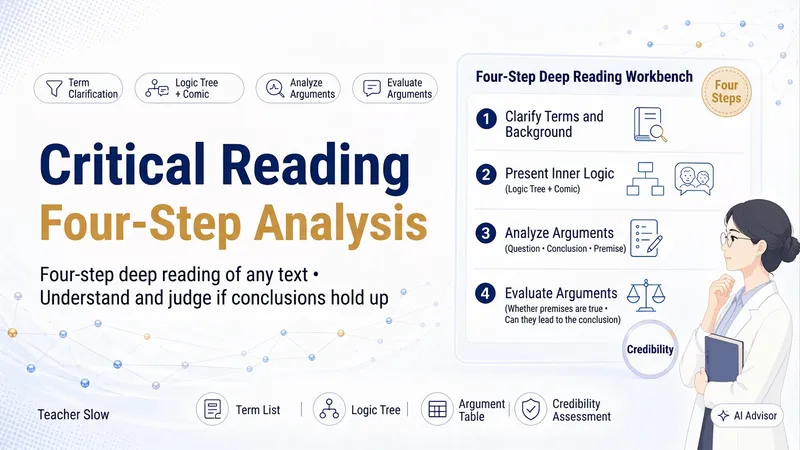 Research
Four-Step Critical Reading
When reading a book, paper, or report, the hardest part is often not understanding the words, but explaining what the author is really saying—and why they believe it. Based on Tian Hongyun’s *Critical Thinking in Plain English: From Beginner to Master*, this skill uses a four-step critical reading method to break down a passage: ① Clear up terminology and background obstacles; ② Use a text logic tree and a hand-drawn cartoon to map its underlying logic; ③ Create an analytical argument table identifying the issues, conclusion, premises, and unstated premises; ④ Create a commentary argument table to assess whether the premises are true and whether they support the conclusion. It then provides a credibility assessment of the conclusion and a list of knowledge that still needs to be added. It knows when not to overdo it: only texts that genuinely express a viewpoint go through all four steps, while purely explanatory or narrative texts go through the first two steps only. Suitable for papers, commentary, reports, policy texts, book passages, and any other material that calls for close reading, helping you move from “opening a book and counting it as reading” to genuine deep reading.
 Research
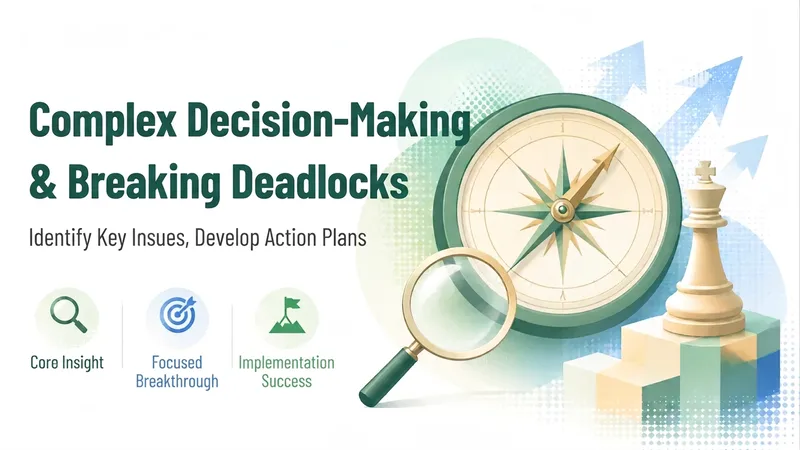
Selected Works of Mao
When facing business decisions, startup strategies, workplace competition, organizational management, project bottlenecks, major personal choices, or industry issues, this turns complex dilemmas into manageable, actionable problems. It uses principles from the Selected Works of Mao such as seeking truth from facts, interest analysis, principal contradictions, unity of opposites, protracted war, mass line, and practice to strip away emotions, slogans, and surface conflicts, pointing directly to the interest structures and critical contradictions that determine success or failure. Whether you provide a brief description or full background, you will receive a distinct and in-depth analysis: clarifying known facts and information blind spots, identifying allies, opponents, and forces that can be won over, determining whether to defend, build strength, or concentrate for a breakthrough under current conditions, and deducing feasible paths for different scenarios. The analysis does not dodge problems or replace judgment with ambiguous balance. The final output is a complete breakthrough analysis and action plan covering emergency damage control, near-term breakthroughs, and long-term mechanism building, complete with low-cost validation actions and feedback standards to help you quickly correct your judgment in real-world practice. Ideal for managers, entrepreneurs, and individual users who need strategic clarity, complex decision analysis, and executable solutions.
Steelman Major Decisions
Before making a major decision, don’t rush to a snap judgment. This skill helps you think the problem through before reaching a conclusion: clarify the real problem you need to solve, surface hidden assumptions you may not realize you’re making, steelman the strongest arguments on both sides, identify the critical point of disagreement—the condition that would flip the conclusion—and finally ask you the one question most likely to change the outcome. After you answer, it gives you a clear judgment and concrete action steps—not the empty claim that “both sides have a point.” Use it for career choices, technology selection, product direction, business decisions, investment judgments, team disagreements, and any moment when you find yourself saying, “Help me think this through.” How to use it: Enter the decision you’re wrestling with. For example: “Should I leave my big-tech job to start a company?” “Should we use option A or B for this solution?” or “Should we cut this product line?”
Information
- Version
- v4
- Last updated
- Runtime credits
- Usage-based
- Models
- Auto
- Use cases
- Research & analysisLearning & educationPersonal growth
- What you get
- ReportDiagram
- Visual styles
- Hand-drawn
