Project Decision Health Check
Project Decision Health Check
Showcase
Description
Evaluate key project risks, capability alignment, and resilience through three rounds of interactive assessment, providing evidence-based trial plans and stop-loss decisions.
Best for
Ideal for systematically checking risks and creating validation plans before investing in startups, businesses, investments, or career transitions.
How to use this Skill
Provide your input
Provide the project overview, budget, funding sources, stop-loss threshold, personal capabilities, known market data, constraints, and risk tolerance.
Run the Skill
Conduct a three-round evaluation to analyze project nature, key risks, and quantifiable loss tolerance, combining evidence and uncertainty before deciding whether to proceed.
Review your result
Receive a structured decision report including progression recommendations, key risks, low-cost validation plans, stop-loss exit conditions, and loss estimations.
Related Skills
View all
B2B Collaboration Feasibility
Input a client name, output a deal feasibility report ready for decision meetings. Process: Company profiling research → Value chain breakdown (including in-house/outsourcing assessment) → Scenario matching matrix → Hard constraint veto → Six-dimension weighted scoring (1-10) → Decision chain and 30/60/90-day action plan → Verification checklist. Produces both YouMind document and web report. Three key differences from ordinary client analysis: ① Will say 'no'. Things your solution cannot do are recorded in the 'Solution Profile', and boundary-crossing scenarios are directly vetoed, without masking through rhetoric. ② First determine whether the process is in-house or outsourced. No matter how painful the client's problem is, if that process has already been outsourced, the buyer is their supplier; the client entity has changed, and it must be assessed separately. ③ Check if value metrics can align. You talk about defect rate, the client talks about government assessment scores; proposals without a 'conversion rate' between the two languages will be rejected during financial review. Our capabilities are injected once via the 'Solution Profile' and reused long-term, applicable to any industry and any B2B solution (hardware/software/service/integration). Built-in value chain decomposition for seven types of industries: discrete manufacturing, retail chain, software/internet, B2B services & finance, energy & infrastructure, healthcare/education/government, and project-based integration, along with a mixed-ownership decision chain template. Every key piece of information is required to be labeled as fact/inference/unknown to avoid using inference as fact. Trigger words: client assessment, cooperation feasibility, client analysis, deal assessment, worth pursuing, can we take it, client screening.
 Research
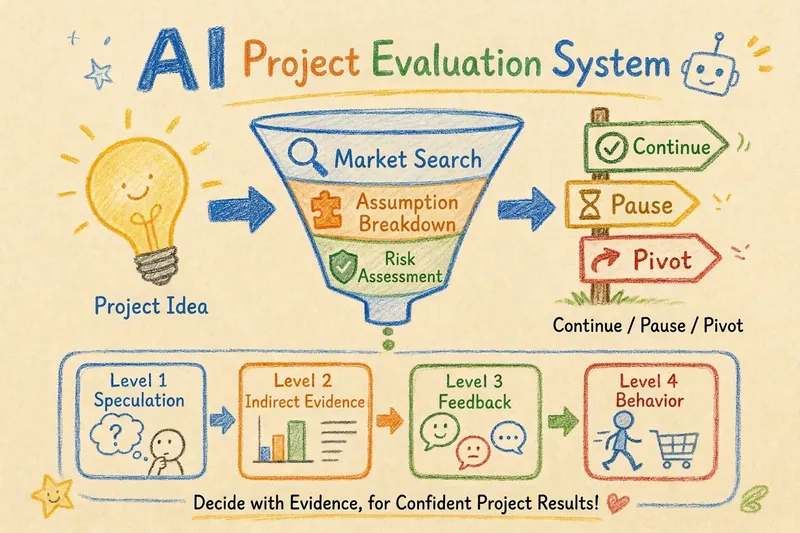
AI Project Eval & Validation
This skill is designed to provide comprehensive product or project validation analysis for entrepreneurs, product managers, and innovation teams. It helps users deeply analyze the market potential, risk points, and validation paths of new ideas, ensuring a clear understanding of core project assumptions before investing significant resources. Through multi-dimensional analysis, this skill can assess the project's current stage, identify key assumptions, and build an assumption dependency map to pinpoint the most vulnerable and dangerous parts of the project. It also analyzes the target user's role chain, the strength of current alternatives, and evaluates whether your solution has '10x improvement' potential. Additionally, it helps users identify potential 'killer questions,' conduct counterfactual failure analysis, and generate multiple positioning variants to explore more possibilities. In terms of commercialization, this skill assists users in selecting the appropriate business model, breaking down the deep reasons for user payment and purchase triggers, and proposing preliminary pricing logic. It also plans the Minimum Viable Saleable product (MVS) and devises a specific go-to-market (GTM) initial path and resource matching recommendations. Finally, it provides a tiered report containing detailed analysis, 7-day and 30-day validation plans, clear stage-gate decision suggestions, and next-step action guidelines, helping users quickly validate core assumptions at minimal cost.
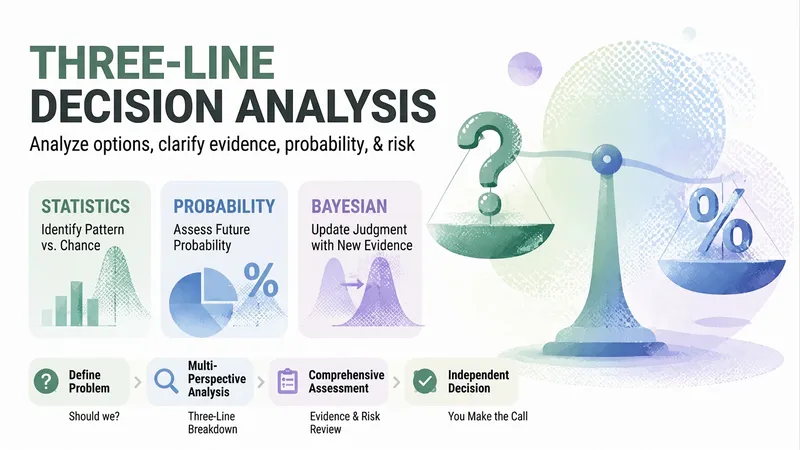
Should I Do It? Analysis
Turn the vague uncertainty of “Should I do X?” into a clearly bounded decision analysis that can be checked and updated over time. Whether you’re considering leaving your job to start a business, investing in a project, buying an asset, or making a career or life choice, you can provide text, tables, documents, or screenshots to organize your options, time horizon, major costs, how much risk you’re willing to accept, and how much confidence you need before acting. The analysis examines the question through statistics, probability theory, and Bayesian reasoning: checking whether samples are reliable and whether an observed pattern is more likely a real trend or a coincidence; breaking down possible future scenarios and comparing probabilities, expected returns, and tail risks; then combining prior beliefs with new evidence to determine which information is truly discriminating and how your judgment should be updated. User-provided facts, public information, and analytical assumptions are clearly separated. When reliable data is lacking, uncertainty is not concealed behind false precision. You’ll receive a replayable decision framework that includes new information worth verifying, actionable next steps, triggers for reassessment, and key evidence still needed. It won’t make the decision for you or present assumptions as facts. Instead, it helps you see the evidence, probabilities, costs, and risks clearly, leaving the decision in your hands.
Information
- Version
- v2
- Last updated
- Runtime credits
- Usage-based
- Models
- Auto
- Use cases
- Business & strategyCareer developmentInvestment & finance
- What you get
- ReportPlanData
