
Past 30 Days Trending Clues
Research recent changes, official updates, and discussions
Past 30 Days Trending Clues
Research recent changes, official updates, and discussions
Showcase
Description
Suitable for creators preparing to write, research, or select content topics. Provide the topic, audience, purpose, region/language, source limits, and deadline; defaults to 30 calendar days including the deadline in Beijing time. Specify other time zones or historical windows as needed. Process: Determine the window and queries, open accessible primary sources, and verify event occurrence dates, publication dates, update dates, and access dates. Merge syndicated coverage of the same event and different versions, distinguish official announcements, discussions, and inferences, and then provide evidence-backed topic angles and verification actions. When no recent credible information is available, leave the results empty rather than using old news to pad counts. Delivery: A Chinese topic briefing, an evidence table with URLs, locations, dates, and publication statuses, and explanations of candidate exclusions, failures, and source coverage. If file capability is available, save as Markdown, CSV, or JSON; otherwise, provide copyable content. You can trace back to the original text along with the entries, and then test functions or user feedback that may affect judgment; suggestions do not imply execution. Four local real query cases: AI models, coding assistants, code video tools, and knowledge management updates. With 2026-11-11 as the deadline and a window from 2026-10-13 to 11-11, actual official announcements and release notes were read to organize 8 update records with clear dates. GitHub was used to fetch official release JSON for exact publication times and Shanghai dates. Obsidian early access and public versions were treated separately, and out-of-window old releases or same-event versions were excluded. This is a self-devised research requirement, not a client project. These four cases limit official update materials and did not acquire social media comments or comparable interaction time series. They are not whole-web popularity rankings, public opinion surveys, or public consensus; multiple pages from the same organization do not count as independent consensus. Candidate software was not installed, upgraded, or performance-tested, and official performance descriptions do not equal personal measurements. Local image tool models cannot be determined based on new model announcements. Four 1920x1080 displays show original typography excerpts of the actual briefings, with complete records saved locally; individual avatars are ImageGen conceptual visuals, not news or popularity evidence. Requires a text model (GPT recommended) and real internet search or webpage reading capabilities. Social media authorization, subtitles, PDF/OCR, and file exports depend on environment capabilities. A vision model is not strictly required, and the skill does not include an upstream last30days engine, paid APIs, or accounts. When platform tools are missing, only provided materials are processed with a note that real-time queries were not performed; stories cannot be made up without sources. YouMind internet/file capabilities and fixed model bindings were verified without consuming points. 199 points is the installation price and does not include model/API or third-party service fees. Cookies, registration, payments, posting, or scheduled crawling are not automatically handled, and exhaustive coverage, traffic, paid conversion, revenue, or moderation are not promised. Likes, comments, views, installs, and orders are not mixed together, paid rates without a denominator are not calculated, and cumulative totals are not treated as 30-day increments. Materials may change, so recheck before formal use.
Recommended by
Dancang
Why we love this skill
Rigorously distinguishes event occurrence, page publication, and access dates while verifying original sources, version status, and interaction metric definitions. Perfect for recent trend research requiring traceable evidence, clear exclusion logs, and actionable angles.
Best for
Ideal for creators, editors, and researchers who need to research recent news, product updates, or public discussions to prepare content topics.
How to use this Skill
Provide your input
Provide the topic, target audience, purpose, region or language, source restrictions, deadline, and entry count. You can also specify a time zone or custom historical window.
Run the Skill
The system searches and verifies accessible primary sources within the specified window, distinguishes event, release, update, and access dates, merges duplicates, and notes unverified content.
Review your result
Receive a verifiable Chinese topic briefing, evidence records, source coverage and exclusion notes, evidence-based angles, and follow-up verification suggestions.
Related Skills
View all Research
Tool Selection Report
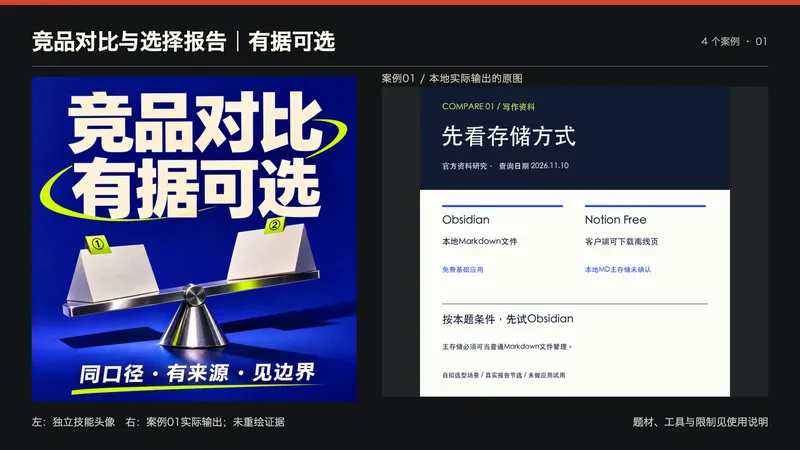
Ideal for anyone who needs to organize rationale before software subscriptions, tool migration, or workflow selection. Provides: The task to complete, candidate tools, operating system, budget, frequency, and required features; you can also provide restricted materials. Process: Determines comparison dimensions, checks accessible official documentation and pricing, records official statements, inferences, actual observations, and unknowns separately, and organizes comparisons by the same billing cycle, currency, and applicable conditions. When real-time access is unavailable, it relies solely on user-provided materials and notes the cutoff date. Output: Task- and condition-based recommendations, uniform comparison table, evidence ledger with links and dates, trial acceptance checklist, and unverified items. When file capabilities are available, it saves Markdown and CSV; otherwise, it provides complete, copyable text without pretending to generate downloadable files. Usage: Provide scenarios and hard constraints, and read the report before trying it out on your own small sample. Research reports do not replace software performance tests and do not declare quality winners based on install counts or official website claims. Dependencies: Text model, GPT recommended, with specific versions chosen by the platform. Web search/browsing tools are required for real-time research. The core does not need image APIs, registration, or paid subscriptions, and does not upload private materials without authorization. Platform model runtime fees are billed separately by the platform; this product does not include third-party services. The cover is an original ImageGen conceptual visual, not a software trial result. The four preview images are local excerpts of simulated selection research reports generated by the final skill, based on official data snapshots actually obtained on 2026-11-09, finalized on 2026-11-10. The software in the images is not installed or performance-tested, and accuracy, speed, or optimal pricing are not guaranteed. Pricing and features may change, so recheck before formal decisions. No YouMind runtime tests were added, and persistent model binding was not verified. Display notes: The first image is a side-by-side layout of the independent skill avatar and actual output of case study 01 for horizontal thumbnail display; it is not a new case study, nor did the image generation model redraw the evidence. The remaining three images correspond to case studies 02 through 04.
 Research
Competitor Selection Report
Ideal for creators, small teams, or procurement researchers who need to choose between two to five specific products. Provide candidate names, plans, use cases, team size, region, currency, budget, and mandatory requirements. Process: Establishes decision boundaries, checks current official pricing and documentation, records facts and sources to build a standardized matrix, filters mandatory requirements, and analyzes trade-offs. Unknown items remain marked as unknown, and conditions that could alter the recommendation are recorded. Cost calculations detail unit prices, seats, billing cycles, and unverified items. Output: A readable Markdown report, a competitor matrix, an evidence log with dates and links, conditions for selection or postponement, a baseline cost estimate when data is complete, and a trial and migration checklist. JSON can be included when writing files. Python is available to check checklist structures and calculations, but cannot replace fact-checking. Usage: Provide candidates and scenarios. Read the summary and hard requirements first, check facts against evidence IDs, and then perform validation actions. Re-verify pricing, region, and account details before signing contracts or changing plans.
 Research
User Pain Point Analysis
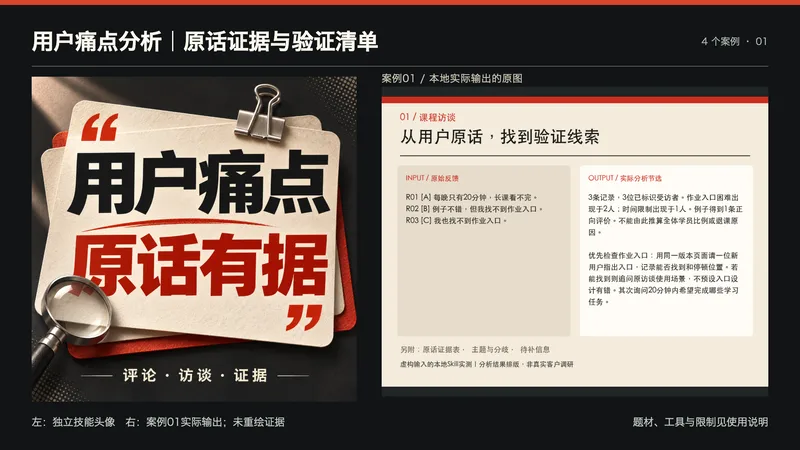
Target Audience: Creators and product operators who need to organize user comments, interviews, surveys, or customer service logs. What You Need to Provide: Authorized, anonymized raw feedback, product background, and the decision you want to make, along with available channels, dates, and anonymous user IDs. How It Works: Keeps original quotes and sources item by item, distinguishes record counts from user counts, consolidates duplicates from the same person, extracts scenarios and friction points, organizes themes and counterexamples, and then proposes minimal validation actions. Final Delivery: Scope and findings, original quote evidence table, theme and divergence table, validation priorities, and missing information. Defaults to fully copyable Markdown. Does not present individual feedback as applying to all users, nor does it infer paid conversion rates from comment counts. Usage: Paste feedback and state the problem to be solved; review the theme table and check original quotes, then follow the validation checklist to check the actual process or follow up. Suggestions are not yet implemented, and problem causes must be reproduced to be confirmed. Requires a text model only; GPT is recommended, with the model chosen by the platform. Does not require image models or external APIs. The four display images are fictional inputs and outputs analyzed by the local GPT main agent according to the actual final skill for layout presentation, not real customer research. No additional runtime tests were run on YouMind, so actual results still need to be verified. Not Suitable For: Impersonating real interviews, inferring total market share or purchase intent, unauthorized public disclosure of original quotes, or automatically contacting users. Does not promise commercial opportunities, growth, or conversion lifts. Display Notes: The first image is a side-by-side layout of the independent skill avatar and the actual output of Case 01 for horizontal thumbnail display; it is not a new case, nor did an image generation model redraw the evidence. The remaining three images correspond to Cases 02 through 04. The independent avatar is an original conceptual visual created by local ImageGen, not a research or polishing result; the specific image model ID was not returned by the tool.
Information
- Version
- v2
- Last updated
- Runtime credits
- Usage-based
- Models
- Auto
- Use cases
- Writing & contentResearch & analysis
- What you get
- ReportBriefData
