Slow Teacher Paper Reader
14-part deep dive and 1-page paper card
Slow Teacher Paper Reader
14-part deep dive and 1-page paper card
Showcase
Description
Transforms a research paper into an evidence-controlled, 14-part in-depth Chinese analysis document covering the five soul questions, argument structure, step-by-step breakdowns of the title, abstract, conclusion, figures, introduction, and methods, P-I-E-C, and three levels of understanding, concluding with a one-page paper internalization card.
Recommended by
Dancang
Why we love this skill
Uses an evidence chain throughout the entire text, verifying layer by layer from the original text, figures, and charts to mechanism boundaries, completing a 14-part deep interpretation and quality inspection, and distilling it into a memorable, transferable one-page literature internalization card.
Best for
Ideal for learners, researchers, and educators who need to systematically read research papers, map out evidence chains, and extract reusable research ideas.
How to use this Skill
Provide your input
Provide the PDF, document, DOI, or web link of a research paper, along with any specific focus, length, or scope requirements.
Run the Skill
The system thoroughly reads and organizes paper evidence, systematically analyzing research questions, methods, results, charts, and limitations while distinguishing original evidence, author interpretations, and further inferences.
Review your result
Receive a Chinese document containing a 14-part in-depth analysis and a one-page literature internalization card; unverified content and inaccessible charts will be clearly marked.
Related Skills
View all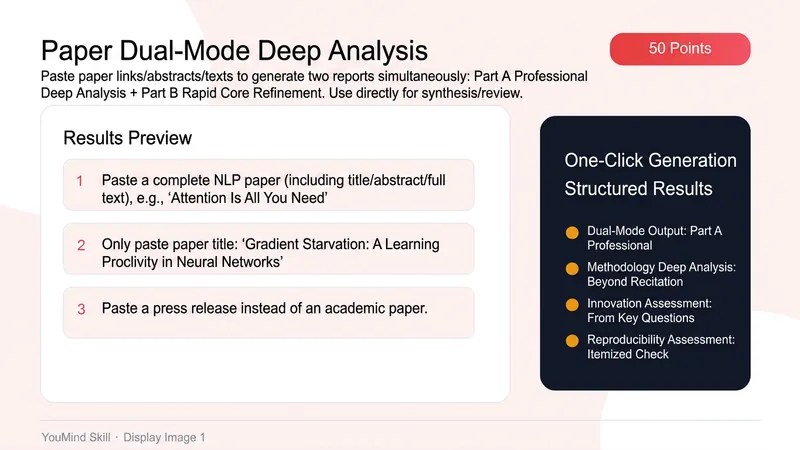
Dual-Mode Deep Read for Papers
A 30-page paper, and your advisor expects you to present it at tomorrow's group meeting. A literature review requires reading 50 papers, but deep understanding of each is impossible. Worse still — after spending two hours grinding through one paper, you only remember 'it seems important,' but the specific innovation, methodological flaws, and quotable insights are all gone. Paste the paper content and get two reports at once: Part A is a professional-level analysis for researchers in your field — from deep methodological analysis to quantitative evaluation of innovations to a critical perspective. Part B is a concise version for yourself, your advisor, or cross-disciplinary colleagues to grasp the core value in 3 minutes, including curated quotable quotes. ✨ Core Capabilities 1. Dual-mode output: Part A professional depth + Part B quick extraction, one paper, two reports 2. Deep methodological analysis: goes beyond restating methods to analyze design cleverness, core assumptions, and alternatives 3. Quantitative innovation evaluation: scores across problem, method, data, and conclusion dimensions — no vague praise 4. Reproducibility assessment: itemized checks for missing information (unreleased code/data/parameters) 5. Critical perspective: methodological flaws, overclaims, overlooked factors, each with original text evidence 6. Quotable quote extraction: retains original English sentences + Chinese paraphrases, ready for literature reviews 📱 Use Cases - Graduate group meeting paper presentations: Part A directly expands into slides, Part B as opening introduction - Literature reviews/thesis proposals: batch-read related papers to quickly build a field map - Cross-disciplinary collaboration: let collaborators understand core papers in your field in 3 minutes - Research blogs/social media: Part B with slight edits becomes a paper interpretation post Together with 'Paper Speed Reading Notes' and 'Academic Illustrations,' it forms a research trio — speed reading for overview, deep reading to master key points, and illustrations to showcase core findings.
 Research
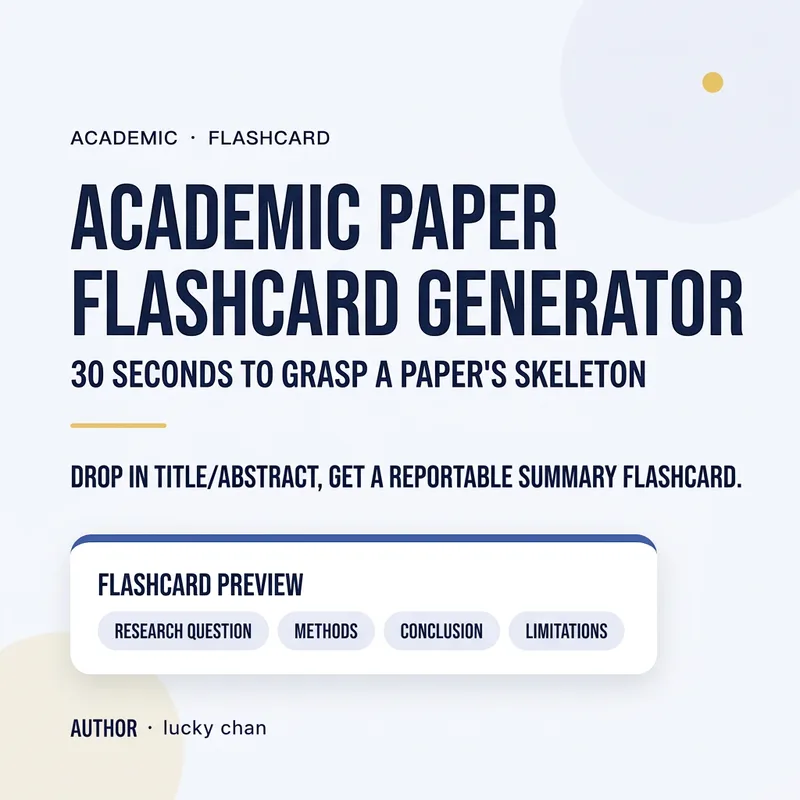
Academic Paper Skimming Card
Too many papers to read? Drop in a title or abstract to generate a ready-to-present skimming card in 30 seconds. The brief card captures key points at a glance, while the detailed card provides a six-dimensional breakdown (Problem / Method / Conclusion / Limitations / Innovation / Takeaways), making lab meetings and literature reviews stress-free. Supports three export options: **Editable HTML + One-Click PNG Export + Print / Save as PDF**: - Editable HTML: Edit text on the fly and preview your changes instantly in the browser. - Export Long PNG: Use the bottom toolbar to export the entire card as a long image for group chats and posts. - Print / Save as PDF: Automatically hides the toolbar to leave a clean card ready for archiving. ## Target Audience - Undergraduate and graduate students buried in literature and rushing before lab meetings - Researchers and product managers who need to quickly decide if a paper is worth a deep read - Professionals writing literature reviews, sharing popular science, or citing papers in weekly reports
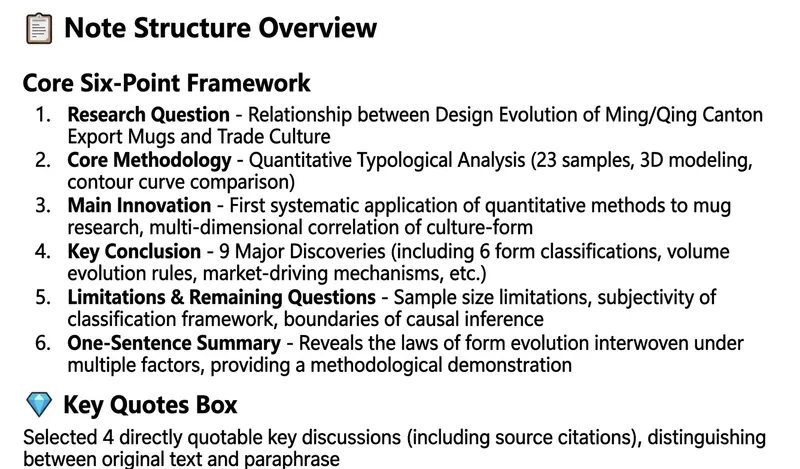
Paper Quick Note Generator
A 30-page paper due for tomorrow's group meeting; 40 papers to review for literature survey, each read from scratch, only to forget key points and lose that quotable line. Half of research time is spent on 'reading.' Paste an arXiv link or paper text and instantly receive a structured speed-reading note ready for use. ✨ Core Capabilities 1. Six-part speed-reading framework: Research Question / Core Method / Main Innovation / Key Conclusion / Limitations & Doubts / One-Sentence Summary 2. Automatically extracts 'quotable quotes' with location markers; copy directly for literature reviews. 3. Contribution breakdown: What's new compared to existing work, explained in plain language. 4. Critical perspective: Methodological flaws, overclaims, reproducibility risks pointed out point by point. 5. Optional outputs: Group meeting presentation outline / literature card / draft review paragraph / multi-paper comparison table. 6. Chinese-English terminology glossary, not machine-translated. 📱 Use Cases Graduate student thesis proposals and literature reviews, group meeting paper sharing, researchers tracking frontiers, tech professionals diving into technical papers; output can be posted on Zhihu or WeChat public accounts as academic content to attract readers. Make papers thinner—so you spend more time thinking than slogging through text.
Information
- Version
- v6
- Last updated
- Runtime credits
- Usage-based
- Models
- Auto
- Use cases
- Writing & contentResearch & analysisLearning & education
- What you get
- ReportDocument
