Slow Teacher's Root Reading
Slow Teacher's Root Reading
Showcase
Description
Slow Teacher's G-P-L-R Root Reading Method. This is not an ordinary paper summarization tool, but a professional "research thinking training coach." It uses the original G-P-L-R four-stage iceberg reading method (also called root reading method) to help you transform your understanding of top SCI papers from "comprehension" to "application": Stage G: Quickly lock in the core argument of the paper in the most plain language. Stage P: You play the role of the author, predicting the paper's argumentative script and figure layout. Stage L: AI precisely compares your prediction with the actual paper, points out key differences, and provides a full high-quality Chinese translation. Stage R: Explore layer by layer asking "why the author did this" to uncover the underlying first principles and argumentative wisdom. Unlike ordinary AI, it strictly forbids giving you direct answers; instead, it forces your brain to participate fully, like a one-on-one sparring session with a top journal reviewer. After reading a paper...
Related Skills
View all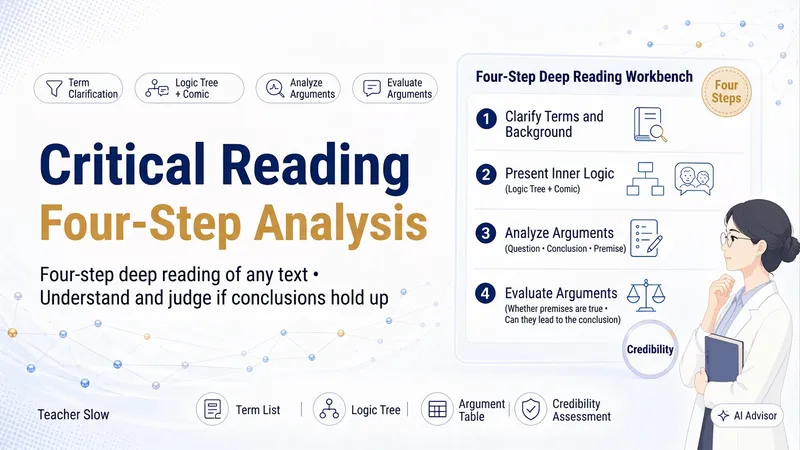 Research
Four-Step Critical Reading
When reading a book, paper, or report, the hardest part is often not understanding the words, but explaining what the author is really saying—and why they believe it. Based on Tian Hongyun’s *Critical Thinking in Plain English: From Beginner to Master*, this skill uses a four-step critical reading method to break down a passage: ① Clear up terminology and background obstacles; ② Use a text logic tree and a hand-drawn cartoon to map its underlying logic; ③ Create an analytical argument table identifying the issues, conclusion, premises, and unstated premises; ④ Create a commentary argument table to assess whether the premises are true and whether they support the conclusion. It then provides a credibility assessment of the conclusion and a list of knowledge that still needs to be added. It knows when not to overdo it: only texts that genuinely express a viewpoint go through all four steps, while purely explanatory or narrative texts go through the first two steps only. Suitable for papers, commentary, reports, policy texts, book passages, and any other material that calls for close reading, helping you move from “opening a book and counting it as reading” to genuine deep reading.
 Research
One-Page Research Paper
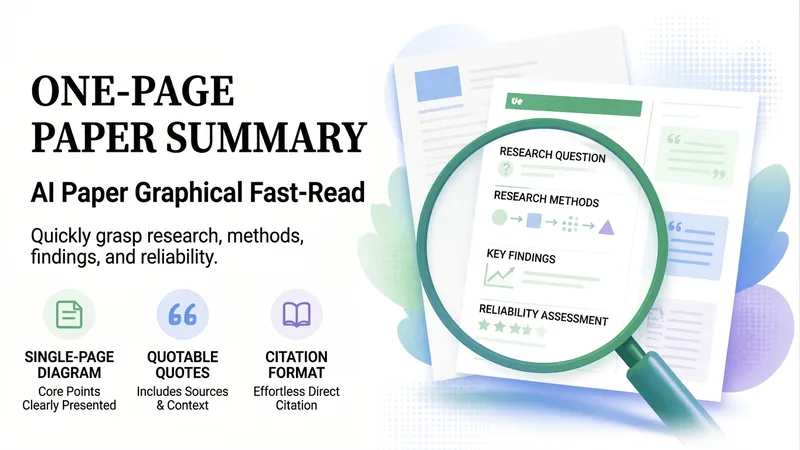
# One-Page Research Paper Upload a paper PDF or link to quickly understand what it studied, how it was done, what it found, and how reliable it is. All figures and citations are annotated with sources, and a one-page diagram is generated at the end. ## What You Get - **Quick Read**: One-sentence conclusion, research questions, methods, main findings, and author-stated limitations, each with a source - **Credibility Check**: First identifies the paper type (quantitative, qualitative, review, theoretical, technical), then checks with corresponding criteria: are samples sufficient, is correlation confused with causation, is comparison fair, can it be replicated - **Inconsistency Check**: Contradictory numbers between sections are pointed out, such as differences between the abstract and main text - **Quotable Sentences**: Verbatim excerpts with sources, indicating whether they fit the introduction, methods, or discussion - **Glossary and References**: Both GB/T 7714 and APA formats, missing fields are marked without fabrication - **Tailored Additions**: For writing literature reviews, finding methods, or preparing lab meeting reports (includes a 5-slide PPT outline and a 2-minute speech script) - **One-Page Diagram**: Research question → method → findings → limitations, all explained in a single chart ## Who It Is For Undergraduates, graduate students, researchers, and anyone who needs to quickly determine whether a paper is worth reading and citing. Supports both Chinese and English papers. ## Tips - Uploading a PDF works best; when providing a link, the PDF version is prioritized - State your purpose to make the content more targeted, such as "preparing a lab meeting presentation" or "writing a literature review" - All content comes strictly from the paper itself, and missing parts are stated honestly - Each run consumes about 100–200 credits (including 1 diagram generated)
Teaching Paper Architect
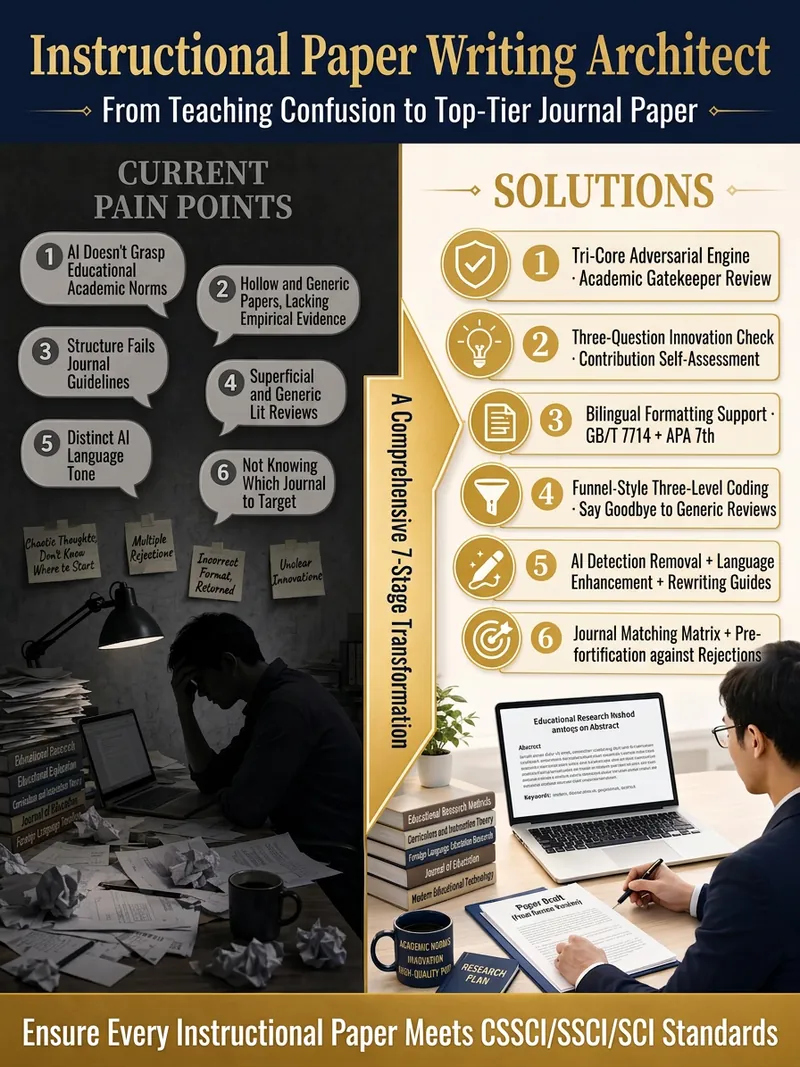
From teaching research accumulation to CSSCI/SSCI/SCI — making every teaching paper stand up to peer review. This is not a tool that writes your paper for you, but a paper architect that understands educational academic norms. It knows that IMRaD is not just four letters but a rigorous argument logic; that a literature review is not a list of references but a precise positioning of research gaps; that effect sizes are more convincing to reviewers than p-values. Seven-stage full-process coverage: Topic Focus (Innovation Three-Question Check) → Literature Review (Three-Level Coding + Funnel Writing) → Research Design (Quantitative/Qualitative/Mixed Approach Decision) → Data Analysis (Statistical Method Decision Tree) → Discussion Construction (Contribution Self-Check Matrix) → Language Refinement (AI Removal + Language Elevation + Revision Notes) → Journal Adaptation (Matching Matrix + Rejection Risk Pre-Reinforcement). Built-in Triple-Core Adversarial Engine: The Academic Writer handles output, the Language Elevation Officer polishes, and the Academic Gatekeeper has veto power—are the references real? Is the data reliable? Is the argument grounded in evidence? Does the contribution match the target journal level? Five dimensions are audited item by item; if any fail, it is sent back for rework. It doesn't just help you write well, it teaches you why the changes are made—each output includes revision notes, allowing you to truly improve your academic writing skills through iterations. Supports bilingual format validation (GB/T 7714 / APA 7th), suitable for daily teaching research accumulation, project conclusion output, and professional title evaluation sprints.
Information
- Version
- v2
- Last updated
- Runtime credits
- Usage-based
- Models
- Auto
