Social Science Survey Design Expert
Quick survey design for sociology, psychology, management
Social Science Survey Design Expert
Quick survey design for sociology, psychology, management
Showcase
Description
Guides users through survey design based on research topic, target population, and other information, delivering a complete questionnaire and supporting documentation. Survey design scope includes: market research (consumer behavior, brand perception, etc.), policy evaluation (public service satisfaction, policy awareness, etc.), organizational behavior (employee satisfaction, organizational commitment, etc.), and psychometrics (attitude scales, personality scales, etc.). Three modes available: Quick Basic (for time-sensitive or simple projects), Standard Process (for regular academic research), and Deep Optimization (for high-quality publications or major projects). Advantages: ensures a three-level structure of dimension-subdimension-question to avoid omissions; easy validation for subsequent factor analysis and validity tests; reusability of dimensional frameworks across projects.
Related Skills
View all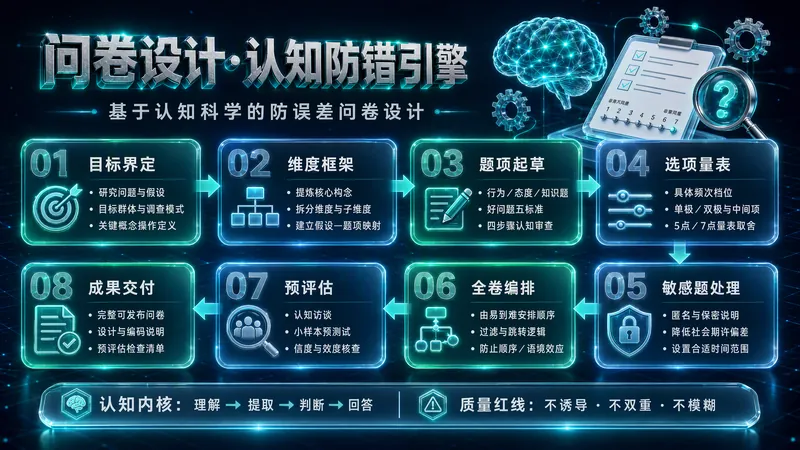
Survey Design Error Control
An academic questionnaire design engine distilled from three classic works: *The Questionnaire Design Handbook*, *The Design and Evaluation of Surveys*, and *Theory, Methods, and New Trends in Questionnaire Design*. Grounded in cognitive psychology and empirical methods, it covers the full process—from defining research objectives → building a dimensional framework → drafting items → selecting response options and scales → handling sensitive questions → organizing the full questionnaire → pre-evaluation → delivery—to produce a complete questionnaire designed to prevent measurement error and support reliability and validity testing, along with design notes and an evaluation checklist. Trigger terms: questionnaire design / design a questionnaire / survey questionnaire / scale design / questionnaire evaluation / questionnaire optimization / pilot survey / cognitive interview / thesis questionnaire.

STEM PhD Topic Diagnostician
Already have a PhD dissertation topic but unsure whether it is rigorous, innovative, and feasible? This Skill is designed to diagnose existing topics—not randomly generate topics from scratch or merely polish the wording. It breaks down the research subject, core variables, mechanisms, outcome measures, and research boundaries in your topic. Based on the Chinese and English literature, experimental foundation, samples, methods, equipment, timeline, and budget you provide, it assesses the topic’s rigor, novelty, and feasibility, while identifying risks such as “innovation” based only on changing materials, confounded variables, insufficient evidence for the proposed mechanism, an uncontrolled sample matrix, and chapters that cannot build progressively. The final output is a STEM PhD Topic Health Check Report, which clearly recommends whether to: retain the topic with minor adjustments; retain the research subject while strengthening its dimensions; retain the research problem and reconstruct the subject; or stop patching and redesign the topic. It is intended for STEM PhD students in food science, chemistry, materials science, biology, basic medical sciences, environmental science, agriculture, energy, and engineering. It is especially useful for those preparing a proposal defense, revising a topic at an advisor’s request, who have already defended their proposal but lack a clear central thread, or who have existing experiments but are unsure whether they can support an entire PhD dissertation.
 Research
Efficient Test Creation Lab
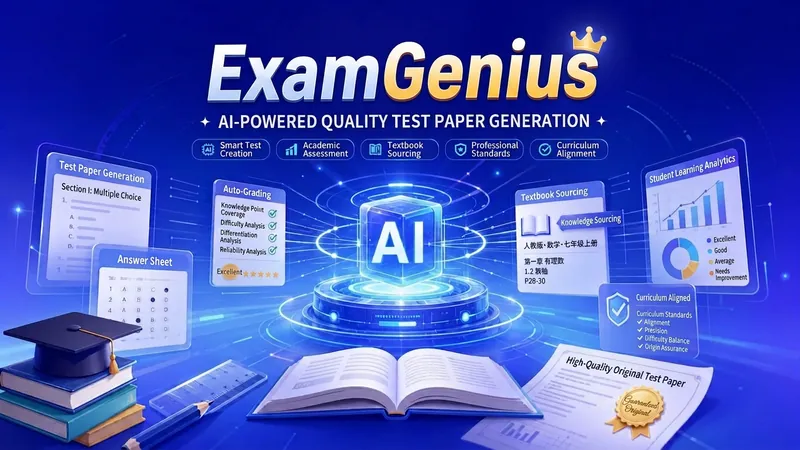
A professional system for creating high school entrance exam test papers. Using a six-step standardized process (analysis template → plan knowledge points → select and create questions → generate answers → check and revise → output specification table) and a four-layer quality assurance mechanism, it integrates the 【素养命题研究室】 skill to ensure each question has a realistic context, includes images, and meets curriculum standards. It automatically generates four standardized documents: test paper text, answer key, two-way specification table, and question type and source table, achieving a transformation from 'experience-based test design' to 'evidence-based test design.'
Information
- Version
- v5
- Last updated
- Runtime credits
- Usage-based
- Models
- Auto