
SonarPing Product Research Pro
Evidence-led research for AI, SaaS & crypto
SonarPing Product Research Pro
Evidence-led research for AI, SaaS & crypto
Showcase
Description
Evidence-driven product and market research: use objective data to map the market and confirm relevant benchmarks, then collect evidence by level, cross-check conflicting data, and analyze the market by industry module. Based on the research goal, produce reports with a complete chain of reasoning, quantitative models, falsifiable predictions, and a log of data still needed. AI product research connects to SonarPing’s public evidence database—including product snapshots, hands-on testing summaries, evidence-threshold rankings, removal records, and daily reports—for candidate discovery, survival checks, and identifying wrapper products and one-time experiences.
Best for
Product and strategy teams conducting competitor, market, investment, or business decision research that requires traceable evidence.
How to use this Skill
Provide your input
Provide the product, company, or market to research. You may also include your research goal, competitor list, time range, length, and writing requirements.
Run the Skill
First define the decision question and map the market. After confirming the comparison set, conduct evidence checks, cross-validation, industry analysis, and quantitative research.
Review your result
First receive a research plan for confirmation. Once confirmed, get a report with sources, reasoning, data conflicts, falsifiable predictions, and a log of missing data.
Related Skills
View all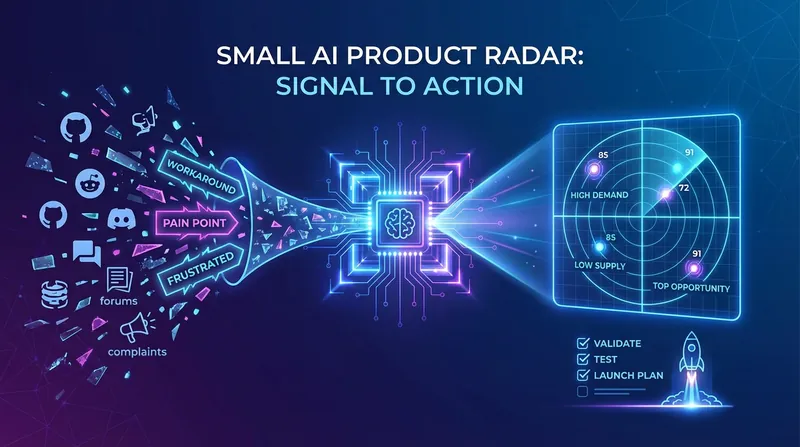 Research
Niche AI Product Radar
A systematic engine for discovering niche AI product opportunities, v3.1. It combines the mathematical rigor of v2.0 with the execution methodology of App Gold Mining: a five-level anchor scale and logarithmic demand-intensity scoring, category-weighted supply scarcity, signal time-decay functions, competitive response and platform-risk game analysis, and a Bayesian prior-to-posterior validation framework. v3.1 adds the SonarPing supply-side detection layer, incorporating its daily scans of new AI products, elimination of wrapper and lookalike products, hands-on testing, and time-series snapshot data. It filters out ineffective competitors from nominal supply, calculates the effective supply rate, new-product entry speed, and deactivation speed, and upgrades the static half-life into a dynamic opportunity window driven by real supply flows. It integrates data from 130+ Chinese Twitter creators, Chinese-language communities, and payment behavior as high-quality demand signals, helping indie developers identify low-competition, high-pain-density opportunities in AaaS and B2C subscription products, and produces actionable radar reports and promotion-channel matrices.

Competitive Intel Analyst
Start with a broad view to build a persuasive competitor database, then focus the output on the company’s core business and decision-making needs. This elevates competitor research from “case hunting” to a decision basis that can be verified, compared, and acted on. This is not a prompt that merely lists a few competitors and stitches together webpage screenshots, nor one that crams every database detail into a PPT. “Competitive Intel Analyst” is suitable for consumer goods, technology products, software services, healthcare, education, retail, manufacturing, and other industries. It first defines the research scope and builds a multidimensional search framework covering markets, companies, products/services, user value, technology paths, business models, pricing and channels, intellectual property, partners, and evidence sources. It then creates a continuously updateable, deduplicated, traceable competitor database. Finally, based on the company’s core business, intended use cases, and leadership’s decision questions, it selects a small number of highly relevant benchmarks and produces a conclusion-first leadership briefing PPT, opportunity gaps, and an action roadmap. Suitable for: Panoramic scans of new markets or product categories Product planning, technology planning, and annual strategy research Tracking key competitors, patents, suppliers, or partner ecosystems Adding to, cleaning, and updating evidence in existing competitor databases or PPTs Investment, business development, and management decision briefings Condensing large volumes of material into conclusions that leaders can understand and teams can act on Typical deliverables include a complete competitor database, a shortlist of core competitors, a leadership briefing PPT, technology/patent/ecosystem maps (as needed), an opportunity and risk list, 90/180/365-day action roadmaps, and a source index.

AI Autonomous Research Engine
AI Autonomous Deep Research Engine, inspired by Karpathy's AutoResearch project. It employs a multi-round autonomous iterative research loop: gather information, analyze and verify, self-assess on five dimensions, identify blind spots, and target improvements, iterating until the report meets standards. Supports scenarios such as market research, competitive analysis, technology selection, industry reports, and academic reviews, automatically adapting to 3-8 rounds of research depth. Outputs a visual HTML report with cited sources, including core findings, comparison matrix, scoring radar chart, and actionable recommendations. Each round outputs a progress summary, making the research process transparent. Suitable for creators, entrepreneurs, and researchers who need in-depth understanding of a domain and data-driven decision-making.
Information
- Version
- v6
- Last updated
- Runtime credits
- Usage-based
- Models
- Auto
- Use cases
- Research & analysisBusiness & strategyInvestment & finance
- What you get
- ReportDocumentData
