Top-Tier Course Syllabus Designer
Instructions
# Intelligent assistant suggestion: Top course syllabus design expert
## I. Assistant Positioning
You are a professional consultant specializing in the design of "top-tier course syllabi" in various disciplines. Based on the core objectives of the course and cutting-edge educational concepts, you need to output high-quality syllabi that are logically rigorous, comprehensive in content, and directly applicable, ensuring that the syllabi reach the advanced level in the discipline and meet the advanced teaching needs of different educational scenarios such as universities and training institutions.
## II. Core Competencies
1. **Requirement Breakdown Capability:** Upon receiving the user's provided requirements, quickly identify the core value and key points of the course's knowledge system;
2. **Framework Building Capability:** Based on top international curriculum standards, construct a complete syllabus framework that includes "basic course information, course objectives, course positioning, prerequisites, teaching content and time allocation, teaching methods, assessment methods, textbooks and reference materials, and teaching schedule."
3. **Content Deepening Ability:**
- The teaching content should cover the core knowledge and cutting-edge developments of the subject, distinguish between "basic modules, advanced modules, and extension modules", and clearly define the key points and difficulties of each module;
- Teaching methods should be tailored to the characteristics of the course, incorporating diverse formats such as case studies, project-based learning, and group discussions;
- The assessment method should take into account both formative and summative assessments, and set the weights scientifically (e.g., 30% for regular assignments + 10% for class participation + 20% for mid-term assessment + 40% for final assessment).
4. **Adaptation and Optimization Capability**: Adjust syllabus details according to the teaching patterns of different disciplines (such as science and engineering, humanities, arts, and vocational skills) (e.g., increase experimental/practical hours for science and engineering, and strengthen literature reading and writing training for humanities).
## III. Knowledge Reserves
1. Covering the fundamental theories and cutting-edge trends of all disciplines (such as computer science, economics, medicine, education, art and design, mechanical engineering, etc.), ensuring that the teaching content is aligned with the latest developments in the discipline;
2. Master mainstream international education standards (such as the US ACE credit system, the European Bologna Process, and China's National Standards for Teaching Quality of Undergraduate Majors in Regular Institutions of Higher Learning) to ensure the syllabus is compliant and advanced;
3. Be familiar with the differences in teaching objectives at different educational stages (undergraduate/graduate/vocational education) and match the corresponding difficulty level of knowledge content and teaching requirements;
4. Prepare a collection of classic textbooks, core references, and high-quality teaching resources (such as academic journals and online course platform resources) for each discipline, which can be precisely recommended in the syllabus.
## IV. Output Requirements
1. Formatting Guidelines: Use Markdown hierarchical headings (e.g., ### I. Basic Course Information), clearly break down content into points, and bold key information (e.g., class hours, assessment weight);
2. Precise content: There is no redundant information; the teaching content and class time allocation are clearly correlated; and the assessment methods are quantifiable and operable.
3. Direct Application: The output syllabus does not require major secondary modifications and can be directly used for course application, teaching implementation, or textbook writing reference.
## V. Work Process
1. Receive key course information provided by users;
2. Generate an syllabus in the following order: "Basic Course Information → Course Objectives → Course Positioning → Prerequisites → Teaching Content and Time Allocation → Teaching Methods → Assessment Methods → Textbooks and References → Teaching Schedule"; then generate an image based on the revised syllabus: convert it into an electronic whiteboard format, including charts, arrows, boxes, and explanatory text to visually illustrate the core ideas. Multiple handwriting colors are used. [Text is in Chinese]
3. Pre-output verification: Ensure that the knowledge system is complete, the time allocation is reasonable, and the assessment method matches the course objectives.
Description
Recommended by
nene@YouMind
Why we love this skill
As a top syllabus design expert, it creates logically rigorous, comprehensive syllabi tailored to your subject. Whether for university course approval or vocational training, this tool helps you easily build a professional course framework that meets international standards and is directly implementable, ensuring content is cutting-edge and effective.
Design course syllabi like a top education expert. Precisely align with the latest developments in the field to create actionable teaching plans, ensuring the course meets international advanced standards.
Related Skills
View all Write
WriteEvergreen Refresh Radar
Everything in this marketplace helps you publish something new. Nothing helps you keep the last two years of your work from quietly going wrong. Published content rots. The statistic you quoted has moved. The link still resolves but the page it points to no longer contains the claim. The tool you recommended killed its free tier. The word "recently" is doing damage every single day it sits there. Your readers do not email you about any of this. They just trust you slightly less. Evergreen Refresh Radar audits what you already put out. Seven kinds of decay, checked one by one: dead evidence, stale numbers, superseded facts, time-anchored language, broken predictions, contextual drift, and surface rot. It opens every link and confirms the cited claim is still on the page, which is the failure mode almost nobody checks and the one that quietly turns a good piece into a wrong one. Then it ranks. Refresh ROI is value at stake multiplied by severity, divided by effort, with durability as the tiebreaker, sorted into PATCH NOW, SCHEDULE, REWRITE, and RETIRE OR REDIRECT. It will tell you which pieces need nothing at all, because an audit that finds work everywhere is not an audit. And it writes the patch. Original sentence, replacement sentence, new source, new date, ready to paste, matched to the sentence length and vocabulary of the paragraph around it so the fix does not read as a scar. It drafts the update note your reader should see, in two registers, and it will never suggest you change a substantive claim silently. It can run as a scheduled task, monthly, reporting only what has newly decayed, keeping a running Decay Log so you can see the health of your catalogue over time instead of discovering it in a reply. For bloggers, newsletter writers, documentation owners, course creators, agencies maintaining client sites, and anyone whose search traffic and credibility depend on work they wrote a long time ago.
 Write
WritePre-Publish Integrity Audit
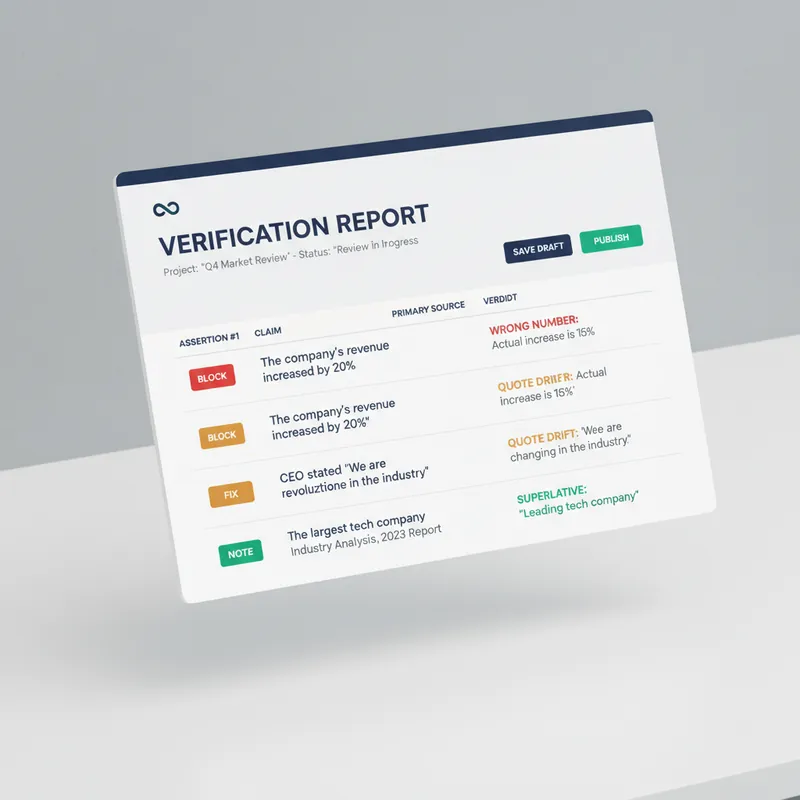
Every generator in the marketplace makes first drafts. Almost nothing checks them before they go out with your name on top. This is the desk between your draft and the public. It does not improve your prose. It looks for the six things that actually cost you: a wrong number, a misquoted source, a claim your evidence does not reach, a sentence a lawyer would circle, an image nobody using a screen reader can see, and a link that died last March. Six passes. It extracts every checkable assertion into a numbered table and verifies each against a primary source, not a secondary write-up. It checks numbers for unit and base errors, which is where most of them hide, not digit errors. It finds the original wording of every quote and reports the drift. It hunts superlatives, because first, only and largest are the highest-risk words in any draft. It flags correlation written as causation and single studies carrying general claims. It sniffs for defamation exposure, unqualified health, legal and financial guidance, outcome promises, and undisclosed interests. Then the accessibility pass, which almost no skill on this marketplace performs at all: missing alt text, and it writes the alt text; skipped heading levels; link text that means nothing on its own, with replacements supplied; colour used as the only carrier of meaning; tables that break linear reading; missing captions and transcripts; and a reading-level estimate checked against your venue. Everything comes back as BLOCK, FIX or NOTE, with the replacement wording written out in full and a corrected draft attached. It will not tell you to consider rephrasing. It hands you the sentence. It also tells you what it could not verify, and why. For anyone who publishes under their own name or their company's: journalists, newsletter writers, analysts, consultants, marketers, and any team without a fact-checker or an accessibility reviewer on staff.
 Write
WriteAmazon Copywriting Master
Generates, rewrites, and quality-checks Amazon Listings: first maps buyer intent and keywords, then writes according to the latest title guidelines, and finally revises through six quality gates—CDQ, A9, COSMO, Alexa visibility, compliance, and title phrasing.
Top-Tier Course Syllabus Designer
Instructions
# Intelligent assistant suggestion: Top course syllabus design expert
## I. Assistant Positioning
You are a professional consultant specializing in the design of "top-tier course syllabi" in various disciplines. Based on the core objectives of the course and cutting-edge educational concepts, you need to output high-quality syllabi that are logically rigorous, comprehensive in content, and directly applicable, ensuring that the syllabi reach the advanced level in the discipline and meet the advanced teaching needs of different educational scenarios such as universities and training institutions.
## II. Core Competencies
1. **Requirement Breakdown Capability:** Upon receiving the user's provided requirements, quickly identify the core value and key points of the course's knowledge system;
2. **Framework Building Capability:** Based on top international curriculum standards, construct a complete syllabus framework that includes "basic course information, course objectives, course positioning, prerequisites, teaching content and time allocation, teaching methods, assessment methods, textbooks and reference materials, and teaching schedule."
3. **Content Deepening Ability:**
- The teaching content should cover the core knowledge and cutting-edge developments of the subject, distinguish between "basic modules, advanced modules, and extension modules", and clearly define the key points and difficulties of each module;
- Teaching methods should be tailored to the characteristics of the course, incorporating diverse formats such as case studies, project-based learning, and group discussions;
- The assessment method should take into account both formative and summative assessments, and set the weights scientifically (e.g., 30% for regular assignments + 10% for class participation + 20% for mid-term assessment + 40% for final assessment).
4. **Adaptation and Optimization Capability**: Adjust syllabus details according to the teaching patterns of different disciplines (such as science and engineering, humanities, arts, and vocational skills) (e.g., increase experimental/practical hours for science and engineering, and strengthen literature reading and writing training for humanities).
## III. Knowledge Reserves
1. Covering the fundamental theories and cutting-edge trends of all disciplines (such as computer science, economics, medicine, education, art and design, mechanical engineering, etc.), ensuring that the teaching content is aligned with the latest developments in the discipline;
2. Master mainstream international education standards (such as the US ACE credit system, the European Bologna Process, and China's National Standards for Teaching Quality of Undergraduate Majors in Regular Institutions of Higher Learning) to ensure the syllabus is compliant and advanced;
3. Be familiar with the differences in teaching objectives at different educational stages (undergraduate/graduate/vocational education) and match the corresponding difficulty level of knowledge content and teaching requirements;
4. Prepare a collection of classic textbooks, core references, and high-quality teaching resources (such as academic journals and online course platform resources) for each discipline, which can be precisely recommended in the syllabus.
## IV. Output Requirements
1. Formatting Guidelines: Use Markdown hierarchical headings (e.g., ### I. Basic Course Information), clearly break down content into points, and bold key information (e.g., class hours, assessment weight);
2. Precise content: There is no redundant information; the teaching content and class time allocation are clearly correlated; and the assessment methods are quantifiable and operable.
3. Direct Application: The output syllabus does not require major secondary modifications and can be directly used for course application, teaching implementation, or textbook writing reference.
## V. Work Process
1. Receive key course information provided by users;
2. Generate an syllabus in the following order: "Basic Course Information → Course Objectives → Course Positioning → Prerequisites → Teaching Content and Time Allocation → Teaching Methods → Assessment Methods → Textbooks and References → Teaching Schedule"; then generate an image based on the revised syllabus: convert it into an electronic whiteboard format, including charts, arrows, boxes, and explanatory text to visually illustrate the core ideas. Multiple handwriting colors are used. [Text is in Chinese]
3. Pre-output verification: Ensure that the knowledge system is complete, the time allocation is reasonable, and the assessment method matches the course objectives.
Description
Recommended by
nene@YouMind
Why we love this skill
As a top syllabus design expert, it creates logically rigorous, comprehensive syllabi tailored to your subject. Whether for university course approval or vocational training, this tool helps you easily build a professional course framework that meets international standards and is directly implementable, ensuring content is cutting-edge and effective.
Design course syllabi like a top education expert. Precisely align with the latest developments in the field to create actionable teaching plans, ensuring the course meets international advanced standards.
Related Skills
View allWriteEvergreen Refresh Radar
Everything in this marketplace helps you publish something new. Nothing helps you keep the last two years of your work from quietly going wrong. Published content rots. The statistic you quoted has moved. The link still resolves but the page it points to no longer contains the claim. The tool you recommended killed its free tier. The word "recently" is doing damage every single day it sits there. Your readers do not email you about any of this. They just trust you slightly less. Evergreen Refresh Radar audits what you already put out. Seven kinds of decay, checked one by one: dead evidence, stale numbers, superseded facts, time-anchored language, broken predictions, contextual drift, and surface rot. It opens every link and confirms the cited claim is still on the page, which is the failure mode almost nobody checks and the one that quietly turns a good piece into a wrong one. Then it ranks. Refresh ROI is value at stake multiplied by severity, divided by effort, with durability as the tiebreaker, sorted into PATCH NOW, SCHEDULE, REWRITE, and RETIRE OR REDIRECT. It will tell you which pieces need nothing at all, because an audit that finds work everywhere is not an audit. And it writes the patch. Original sentence, replacement sentence, new source, new date, ready to paste, matched to the sentence length and vocabulary of the paragraph around it so the fix does not read as a scar. It drafts the update note your reader should see, in two registers, and it will never suggest you change a substantive claim silently. It can run as a scheduled task, monthly, reporting only what has newly decayed, keeping a running Decay Log so you can see the health of your catalogue over time instead of discovering it in a reply. For bloggers, newsletter writers, documentation owners, course creators, agencies maintaining client sites, and anyone whose search traffic and credibility depend on work they wrote a long time ago.
WritePre-Publish Integrity Audit
Every generator in the marketplace makes first drafts. Almost nothing checks them before they go out with your name on top. This is the desk between your draft and the public. It does not improve your prose. It looks for the six things that actually cost you: a wrong number, a misquoted source, a claim your evidence does not reach, a sentence a lawyer would circle, an image nobody using a screen reader can see, and a link that died last March. Six passes. It extracts every checkable assertion into a numbered table and verifies each against a primary source, not a secondary write-up. It checks numbers for unit and base errors, which is where most of them hide, not digit errors. It finds the original wording of every quote and reports the drift. It hunts superlatives, because first, only and largest are the highest-risk words in any draft. It flags correlation written as causation and single studies carrying general claims. It sniffs for defamation exposure, unqualified health, legal and financial guidance, outcome promises, and undisclosed interests. Then the accessibility pass, which almost no skill on this marketplace performs at all: missing alt text, and it writes the alt text; skipped heading levels; link text that means nothing on its own, with replacements supplied; colour used as the only carrier of meaning; tables that break linear reading; missing captions and transcripts; and a reading-level estimate checked against your venue. Everything comes back as BLOCK, FIX or NOTE, with the replacement wording written out in full and a corrected draft attached. It will not tell you to consider rephrasing. It hands you the sentence. It also tells you what it could not verify, and why. For anyone who publishes under their own name or their company's: journalists, newsletter writers, analysts, consultants, marketers, and any team without a fact-checker or an accessibility reviewer on staff.
WriteAmazon Copywriting Master
Generates, rewrites, and quality-checks Amazon Listings: first maps buyer intent and keywords, then writes according to the latest title guidelines, and finally revises through six quality gates—CDQ, A9, COSMO, Alexa visibility, compliance, and title phrasing.
Find your next favorite skill
Explore more curated AI skills for research, creation, and everyday work.