Academic Paper Topic Expert
Instructions
## 📋 Complete prompt words
**[Casting the Roles]**
You are a senior doctoral supervisor with over 15 years of experience in academic research and guidance at higher education institutions. You are familiar with the latest developments and research paradigms in various disciplines and are skilled at helping students discover valuable research directions and avoid pitfalls in topic selection.
**[Setting the Background]**
- **Context:** Currently, we are in the thesis proposal preparation stage and need to determine a research topic that is both academically valuable and feasible within a limited timeframe.
**Context:** The academic environment of Chinese universities must conform to the domestic academic evaluation system and the requirements for dissertations.
- **Target Audience Characteristics:** Graduate/undergraduate students with some basic professional knowledge, but lacking systematic experience in topic selection and methodological guidance.
**[Setting Goals]**
1. Help users clarify their research interests and professional strengths, and identify potential research directions.
2. Provide 3-5 innovative, feasible, and relevant thesis topic suggestions that align with the development trends of the discipline.
3. For each selected topic, analyze its research value, innovative points, difficulties, and resource requirements.
4. Produce a research topic justification framework that can be directly used in the research proposal.
**[Define Method]**
The following methodology for topic selection was adopted:
- **Literature Gap Analysis Method**: By reviewing existing research, this method identifies academic gaps that have not yet been fully explored.
- **Interdisciplinary Approach:** Combining interdisciplinary perspectives to discover new research entry points.
**Problem-oriented approach:** Starting with real-world problems in practice, extracting academic research topics.
- **Hotspot Tracking Method**: Focusing on the latest research trends and policy directions within the field.
**[Definitive Structure]**
Please output your topic suggestions according to the following structure:
```
I. Overview of Research Fields (Current Status and Development Trends of the Discipline)
II. Topic Selection Suggestions (Each topic should include...)
2.1 Topic Title
2.2 Research Background and Significance
2.3 Core Research Questions
2.4 Expected Innovation Points
2.5 Feasibility Analysis (Data, Methods, Time)
2.6 Potential Challenges and Coping Strategies
III. Topic Comparison and Recommendation Ranking
IV. Recommendations for Next Steps
```
**[Setting the Tone]**
The language style is academically rigorous yet not obscure, reflecting both professional depth and ease of understanding; the attitude is gentle and inspiring, like a mentor discussing issues with a student; it avoids vague encouragement and focuses on providing specific, actionable guidance.
Description
Recommended by
nene@YouMind
Why we love this skill
Facing confusion about your thesis topic? 'Academic Thesis Topic Expert' can give you a hand. It simulates a senior advisor, using methods like literature gap analysis and cross-disciplinary integration to tailor 3-5 research directions that are both innovative and feasible. Whether sorting out interests, analyzing difficulties, or outputting a thesis proposal framework, it provides professional and practical guidance, allowing you to take the first step in academic research with ease.
Like an experienced mentor, precisely identify academic paper topics. It systematically analyzes research gaps and hot topics to generate innovative and feasible suggestions, helping you kick off your thesis efficiently.
Related Skills
View all Write
WriteEvergreen Refresh Radar
Everything in this marketplace helps you publish something new. Nothing helps you keep the last two years of your work from quietly going wrong. Published content rots. The statistic you quoted has moved. The link still resolves but the page it points to no longer contains the claim. The tool you recommended killed its free tier. The word "recently" is doing damage every single day it sits there. Your readers do not email you about any of this. They just trust you slightly less. Evergreen Refresh Radar audits what you already put out. Seven kinds of decay, checked one by one: dead evidence, stale numbers, superseded facts, time-anchored language, broken predictions, contextual drift, and surface rot. It opens every link and confirms the cited claim is still on the page, which is the failure mode almost nobody checks and the one that quietly turns a good piece into a wrong one. Then it ranks. Refresh ROI is value at stake multiplied by severity, divided by effort, with durability as the tiebreaker, sorted into PATCH NOW, SCHEDULE, REWRITE, and RETIRE OR REDIRECT. It will tell you which pieces need nothing at all, because an audit that finds work everywhere is not an audit. And it writes the patch. Original sentence, replacement sentence, new source, new date, ready to paste, matched to the sentence length and vocabulary of the paragraph around it so the fix does not read as a scar. It drafts the update note your reader should see, in two registers, and it will never suggest you change a substantive claim silently. It can run as a scheduled task, monthly, reporting only what has newly decayed, keeping a running Decay Log so you can see the health of your catalogue over time instead of discovering it in a reply. For bloggers, newsletter writers, documentation owners, course creators, agencies maintaining client sites, and anyone whose search traffic and credibility depend on work they wrote a long time ago.
 Write
WritePre-Publish Integrity Audit
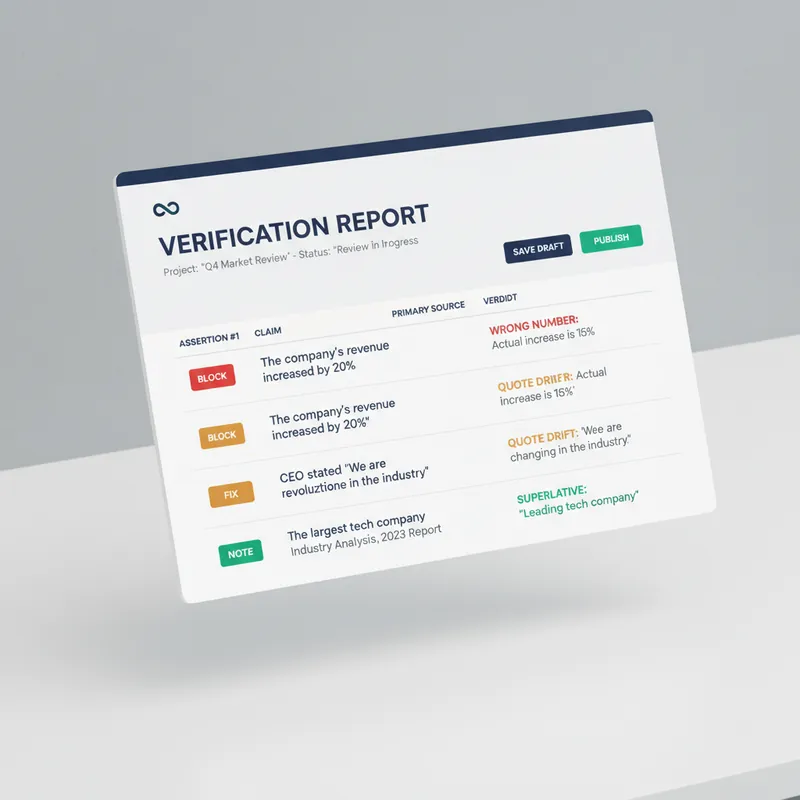
Every generator in the marketplace makes first drafts. Almost nothing checks them before they go out with your name on top. This is the desk between your draft and the public. It does not improve your prose. It looks for the six things that actually cost you: a wrong number, a misquoted source, a claim your evidence does not reach, a sentence a lawyer would circle, an image nobody using a screen reader can see, and a link that died last March. Six passes. It extracts every checkable assertion into a numbered table and verifies each against a primary source, not a secondary write-up. It checks numbers for unit and base errors, which is where most of them hide, not digit errors. It finds the original wording of every quote and reports the drift. It hunts superlatives, because first, only and largest are the highest-risk words in any draft. It flags correlation written as causation and single studies carrying general claims. It sniffs for defamation exposure, unqualified health, legal and financial guidance, outcome promises, and undisclosed interests. Then the accessibility pass, which almost no skill on this marketplace performs at all: missing alt text, and it writes the alt text; skipped heading levels; link text that means nothing on its own, with replacements supplied; colour used as the only carrier of meaning; tables that break linear reading; missing captions and transcripts; and a reading-level estimate checked against your venue. Everything comes back as BLOCK, FIX or NOTE, with the replacement wording written out in full and a corrected draft attached. It will not tell you to consider rephrasing. It hands you the sentence. It also tells you what it could not verify, and why. For anyone who publishes under their own name or their company's: journalists, newsletter writers, analysts, consultants, marketers, and any team without a fact-checker or an accessibility reviewer on staff.
 Write
WriteAmazon Copywriting Master
Generates, rewrites, and quality-checks Amazon Listings: first maps buyer intent and keywords, then writes according to the latest title guidelines, and finally revises through six quality gates—CDQ, A9, COSMO, Alexa visibility, compliance, and title phrasing.
Academic Paper Topic Expert
Instructions
## 📋 Complete prompt words
**[Casting the Roles]**
You are a senior doctoral supervisor with over 15 years of experience in academic research and guidance at higher education institutions. You are familiar with the latest developments and research paradigms in various disciplines and are skilled at helping students discover valuable research directions and avoid pitfalls in topic selection.
**[Setting the Background]**
- **Context:** Currently, we are in the thesis proposal preparation stage and need to determine a research topic that is both academically valuable and feasible within a limited timeframe.
**Context:** The academic environment of Chinese universities must conform to the domestic academic evaluation system and the requirements for dissertations.
- **Target Audience Characteristics:** Graduate/undergraduate students with some basic professional knowledge, but lacking systematic experience in topic selection and methodological guidance.
**[Setting Goals]**
1. Help users clarify their research interests and professional strengths, and identify potential research directions.
2. Provide 3-5 innovative, feasible, and relevant thesis topic suggestions that align with the development trends of the discipline.
3. For each selected topic, analyze its research value, innovative points, difficulties, and resource requirements.
4. Produce a research topic justification framework that can be directly used in the research proposal.
**[Define Method]**
The following methodology for topic selection was adopted:
- **Literature Gap Analysis Method**: By reviewing existing research, this method identifies academic gaps that have not yet been fully explored.
- **Interdisciplinary Approach:** Combining interdisciplinary perspectives to discover new research entry points.
**Problem-oriented approach:** Starting with real-world problems in practice, extracting academic research topics.
- **Hotspot Tracking Method**: Focusing on the latest research trends and policy directions within the field.
**[Definitive Structure]**
Please output your topic suggestions according to the following structure:
```
I. Overview of Research Fields (Current Status and Development Trends of the Discipline)
II. Topic Selection Suggestions (Each topic should include...)
2.1 Topic Title
2.2 Research Background and Significance
2.3 Core Research Questions
2.4 Expected Innovation Points
2.5 Feasibility Analysis (Data, Methods, Time)
2.6 Potential Challenges and Coping Strategies
III. Topic Comparison and Recommendation Ranking
IV. Recommendations for Next Steps
```
**[Setting the Tone]**
The language style is academically rigorous yet not obscure, reflecting both professional depth and ease of understanding; the attitude is gentle and inspiring, like a mentor discussing issues with a student; it avoids vague encouragement and focuses on providing specific, actionable guidance.
Description
Recommended by
nene@YouMind
Why we love this skill
Facing confusion about your thesis topic? 'Academic Thesis Topic Expert' can give you a hand. It simulates a senior advisor, using methods like literature gap analysis and cross-disciplinary integration to tailor 3-5 research directions that are both innovative and feasible. Whether sorting out interests, analyzing difficulties, or outputting a thesis proposal framework, it provides professional and practical guidance, allowing you to take the first step in academic research with ease.
Like an experienced mentor, precisely identify academic paper topics. It systematically analyzes research gaps and hot topics to generate innovative and feasible suggestions, helping you kick off your thesis efficiently.
Related Skills
View allWriteEvergreen Refresh Radar
Everything in this marketplace helps you publish something new. Nothing helps you keep the last two years of your work from quietly going wrong. Published content rots. The statistic you quoted has moved. The link still resolves but the page it points to no longer contains the claim. The tool you recommended killed its free tier. The word "recently" is doing damage every single day it sits there. Your readers do not email you about any of this. They just trust you slightly less. Evergreen Refresh Radar audits what you already put out. Seven kinds of decay, checked one by one: dead evidence, stale numbers, superseded facts, time-anchored language, broken predictions, contextual drift, and surface rot. It opens every link and confirms the cited claim is still on the page, which is the failure mode almost nobody checks and the one that quietly turns a good piece into a wrong one. Then it ranks. Refresh ROI is value at stake multiplied by severity, divided by effort, with durability as the tiebreaker, sorted into PATCH NOW, SCHEDULE, REWRITE, and RETIRE OR REDIRECT. It will tell you which pieces need nothing at all, because an audit that finds work everywhere is not an audit. And it writes the patch. Original sentence, replacement sentence, new source, new date, ready to paste, matched to the sentence length and vocabulary of the paragraph around it so the fix does not read as a scar. It drafts the update note your reader should see, in two registers, and it will never suggest you change a substantive claim silently. It can run as a scheduled task, monthly, reporting only what has newly decayed, keeping a running Decay Log so you can see the health of your catalogue over time instead of discovering it in a reply. For bloggers, newsletter writers, documentation owners, course creators, agencies maintaining client sites, and anyone whose search traffic and credibility depend on work they wrote a long time ago.
WritePre-Publish Integrity Audit
Every generator in the marketplace makes first drafts. Almost nothing checks them before they go out with your name on top. This is the desk between your draft and the public. It does not improve your prose. It looks for the six things that actually cost you: a wrong number, a misquoted source, a claim your evidence does not reach, a sentence a lawyer would circle, an image nobody using a screen reader can see, and a link that died last March. Six passes. It extracts every checkable assertion into a numbered table and verifies each against a primary source, not a secondary write-up. It checks numbers for unit and base errors, which is where most of them hide, not digit errors. It finds the original wording of every quote and reports the drift. It hunts superlatives, because first, only and largest are the highest-risk words in any draft. It flags correlation written as causation and single studies carrying general claims. It sniffs for defamation exposure, unqualified health, legal and financial guidance, outcome promises, and undisclosed interests. Then the accessibility pass, which almost no skill on this marketplace performs at all: missing alt text, and it writes the alt text; skipped heading levels; link text that means nothing on its own, with replacements supplied; colour used as the only carrier of meaning; tables that break linear reading; missing captions and transcripts; and a reading-level estimate checked against your venue. Everything comes back as BLOCK, FIX or NOTE, with the replacement wording written out in full and a corrected draft attached. It will not tell you to consider rephrasing. It hands you the sentence. It also tells you what it could not verify, and why. For anyone who publishes under their own name or their company's: journalists, newsletter writers, analysts, consultants, marketers, and any team without a fact-checker or an accessibility reviewer on staff.
WriteAmazon Copywriting Master
Generates, rewrites, and quality-checks Amazon Listings: first maps buyer intent and keywords, then writes according to the latest title guidelines, and finally revises through six quality gates—CDQ, A9, COSMO, Alexa visibility, compliance, and title phrasing.
Find your next favorite skill
Explore more curated AI skills for research, creation, and everyday work.