Echo Pro – Capture, Decode, and Share Your YouMind Thought Trails
Description
Why we love this skill
This skill mines deep thinking patterns from your YouMind footprint, delivering three progressive insights: counterintuitive discoveries, second-order ripple effects, and first principles. It also generates multi-platform content with one click, aiding thought visualization and efficient sharing.
You save, highlight, write, and think in YouMind every day. These actions may seem random, but they actually trace a thematic thread. Echo helps you hear it. Three-layer insight engine, diving deeper layer by layer: ⚡ Anti-intuitive discoveries – you think you're doing A, but you're actually doing B 🌊 Second-order ripples – what you plant today, what will it grow into in six months 💎 First principles – peel away all the surface layers, and it comes down to that one sentence For yourself, it's an archaeology of thought. For others, it's a story that resonates. One-click sharing mode switch: perspective flip, context completion, term translation. Output to Twitter, Xiaohongshu, WeChat public accounts, video scripts. With continuous use, it remembers your thematic thread. Your digital life creates echoes every day. Echo captures them, amplifies them, and shares them.
Related Skills
View all Research
AI Paper Master
Helps product managers, founders, and app developers understand AI papers through historical causal links, turning those insights into product judgments, technical boundaries, engineering intuition, and opportunity analysis.
 Research
All-Around Movie Buddy Pro
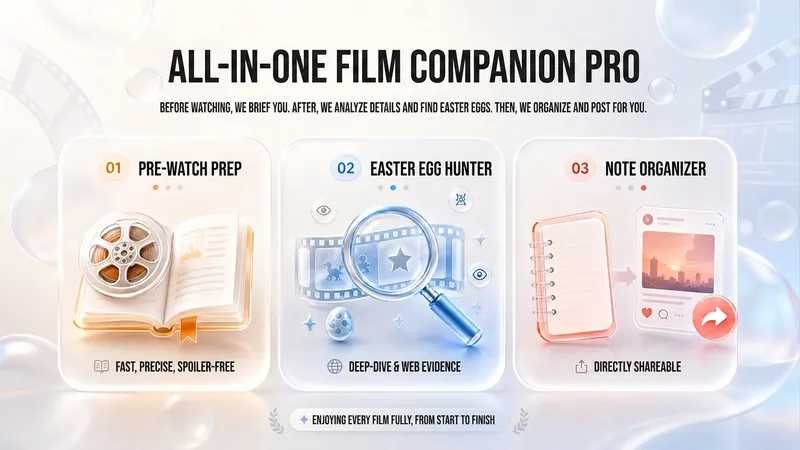
Your all-around movie buddy—worth using for any movie. Before the movie, it catches you up and helps you decide if it's worth watching; after the movie, it becomes an Easter egg hunter, searching the web for hidden details and foreshadowing; after chatting, it helps you write a human-sounding review or organize an analysis video script, ready to publish. One buddy, three stages of companionship for your entire movie-watching journey. 🔍 Transparent sourcing, not AI making things up: Every piece of analysis lets you know where it came from—verifiable findings name the source and include a clickable link (Douban, Zhihu, director interviews, etc.). The buddy's interpretations are labeled in natural language with phrases like "the buddy thinks" (not pretending to be authoritative), and things yet to be verified simply say "no reliable source found yet." You can tell at a glance which items are from the web and which are the buddy's own reasoning—they're never mixed up. Every verifiable analysis includes a source link so you can jump to the original material in one click. 📚 Pre-movie catch-up: fast, accurate, and spoiler-free. No time to watch the previous installments before a sequel? Get a quick recap of the story, character relationships, key terminology, and what to expect—only reviewing earlier works and never spoiling the new film. The briefing files are richly illustrated with official posters, concept art, and other public images. There's also an "Is it worth watching?" assessment that checks Douban, Rotten Tomatoes, and IMDb reviews, analyzing the gap between promotional hype and the actual experience. 🥚 Post-movie Easter egg hunter for satisfying deep dives. After the movie, if you're left wondering "What did that detail mean?" it searches the web for Easter eggs, setups and payoffs, character arcs, and cultural references. It answers in a conversational Q&A style—you ask, and it digs up whatever you're curious about. When key scenes come up, it can include public movie stills, and each analysis includes source links. 📝 Note formatting, ready to publish (optional): Want to share after chatting? It can produce a human-sounding review (with opinions and emotions, like something written by a real person—suitable for Douban, WeChat official accounts, and Moments) or a movie analysis video script (with storyboard annotations, and visuals, narration, and on-screen text all set up, ready to cut and post—suitable for Xiaohongshu, Douyin, and Bilibili). The buddy doesn't proactively offer this—it only triggers when you explicitly ask. 🎬 Covers most movies, animation, and TV series. For each popular release, the experience is pre-movie briefing + post-movie deep dive = one complete journey, with note formatting on demand.
 Research
Four-Question Reading Coach
Provide a book title (and optionally your occupation, position, or identity). Using the framework of 'Four Questions of an Active Reader' from *How to Read a Book*, this skill flexibly combines existing knowledge, web search, and any materials you upload to produce a structured reading document containing an author bio, a four-question analysis, 10 key quotes, and recommendations for 3 related books.
Echo Pro – Capture, Decode, and Share Your YouMind Thought Trails
Description
Why we love this skill
This skill mines deep thinking patterns from your YouMind footprint, delivering three progressive insights: counterintuitive discoveries, second-order ripple effects, and first principles. It also generates multi-platform content with one click, aiding thought visualization and efficient sharing.
You save, highlight, write, and think in YouMind every day. These actions may seem random, but they actually trace a thematic thread. Echo helps you hear it. Three-layer insight engine, diving deeper layer by layer: ⚡ Anti-intuitive discoveries – you think you're doing A, but you're actually doing B 🌊 Second-order ripples – what you plant today, what will it grow into in six months 💎 First principles – peel away all the surface layers, and it comes down to that one sentence For yourself, it's an archaeology of thought. For others, it's a story that resonates. One-click sharing mode switch: perspective flip, context completion, term translation. Output to Twitter, Xiaohongshu, WeChat public accounts, video scripts. With continuous use, it remembers your thematic thread. Your digital life creates echoes every day. Echo captures them, amplifies them, and shares them.
Related Skills
View allResearchAI Paper Master
Helps product managers, founders, and app developers understand AI papers through historical causal links, turning those insights into product judgments, technical boundaries, engineering intuition, and opportunity analysis.
ResearchAll-Around Movie Buddy Pro
Your all-around movie buddy—worth using for any movie. Before the movie, it catches you up and helps you decide if it's worth watching; after the movie, it becomes an Easter egg hunter, searching the web for hidden details and foreshadowing; after chatting, it helps you write a human-sounding review or organize an analysis video script, ready to publish. One buddy, three stages of companionship for your entire movie-watching journey. 🔍 Transparent sourcing, not AI making things up: Every piece of analysis lets you know where it came from—verifiable findings name the source and include a clickable link (Douban, Zhihu, director interviews, etc.). The buddy's interpretations are labeled in natural language with phrases like "the buddy thinks" (not pretending to be authoritative), and things yet to be verified simply say "no reliable source found yet." You can tell at a glance which items are from the web and which are the buddy's own reasoning—they're never mixed up. Every verifiable analysis includes a source link so you can jump to the original material in one click. 📚 Pre-movie catch-up: fast, accurate, and spoiler-free. No time to watch the previous installments before a sequel? Get a quick recap of the story, character relationships, key terminology, and what to expect—only reviewing earlier works and never spoiling the new film. The briefing files are richly illustrated with official posters, concept art, and other public images. There's also an "Is it worth watching?" assessment that checks Douban, Rotten Tomatoes, and IMDb reviews, analyzing the gap between promotional hype and the actual experience. 🥚 Post-movie Easter egg hunter for satisfying deep dives. After the movie, if you're left wondering "What did that detail mean?" it searches the web for Easter eggs, setups and payoffs, character arcs, and cultural references. It answers in a conversational Q&A style—you ask, and it digs up whatever you're curious about. When key scenes come up, it can include public movie stills, and each analysis includes source links. 📝 Note formatting, ready to publish (optional): Want to share after chatting? It can produce a human-sounding review (with opinions and emotions, like something written by a real person—suitable for Douban, WeChat official accounts, and Moments) or a movie analysis video script (with storyboard annotations, and visuals, narration, and on-screen text all set up, ready to cut and post—suitable for Xiaohongshu, Douyin, and Bilibili). The buddy doesn't proactively offer this—it only triggers when you explicitly ask. 🎬 Covers most movies, animation, and TV series. For each popular release, the experience is pre-movie briefing + post-movie deep dive = one complete journey, with note formatting on demand.
ResearchFour-Question Reading Coach
Provide a book title (and optionally your occupation, position, or identity). Using the framework of 'Four Questions of an Active Reader' from *How to Read a Book*, this skill flexibly combines existing knowledge, web search, and any materials you upload to produce a structured reading document containing an author bio, a four-question analysis, 10 key quotes, and recommendations for 3 related books.
Find your next favorite skill
Explore more curated AI skills for research, creation, and everyday work.