Read a Paper in 5 Minutes
Deep reading, source tracing, cross-synthesis
Description
Recommended by
Nico@YouMind
Why we love this skill
This skill uses deep reading, lineage analysis, and synthesis to transform paper research from fragmented to systematic, helping you fully grasp the academic context and discern research authenticity.
Transform paper research from fragmented to systematic. Through deep interpretation, source tracing analysis, and cross-synthesis, it helps you fully grasp the academic context and discern research authenticity.
Related Skills
View all
Research Paper Deconstruction
Submit an empirical research paper and receive a deep deconstruction report to help you master the essence of academic writing. This tool is based on the methodology of 'Deconstructing Papers: Understanding Academic Writing through Close Reading,' systematically analyzing the paper from diagnosing the research question, constructing the GAP, connecting theory and materials, to sentence-by-sentence close reading of key paragraphs, layer by layer, revealing the internal logic and writing techniques of the paper. You will receive a structured analysis report that includes an assessment of the specificity and essential nature of the research question, tracking of the GAP logical chain and identification of its strategy type, as well as a detailed examination of the quality of the 'two-way' connection between theory and real-world materials. The report will also specially select the strongest and weakest paragraphs, providing sentence-by-sentence logical function annotations and technique comments, and offering specific revision suggestions for areas that can be improved. This report not only helps you understand the writing secrets of high-level papers but also points out common writing mistakes, allowing you to learn while reading and improve while analyzing. Whether evaluating the depth of the research question, optimizing the narrative of the literature review, or enhancing the rigor of the discussion section, this tool provides powerful guidance to help you write more insightful and persuasive academic works.
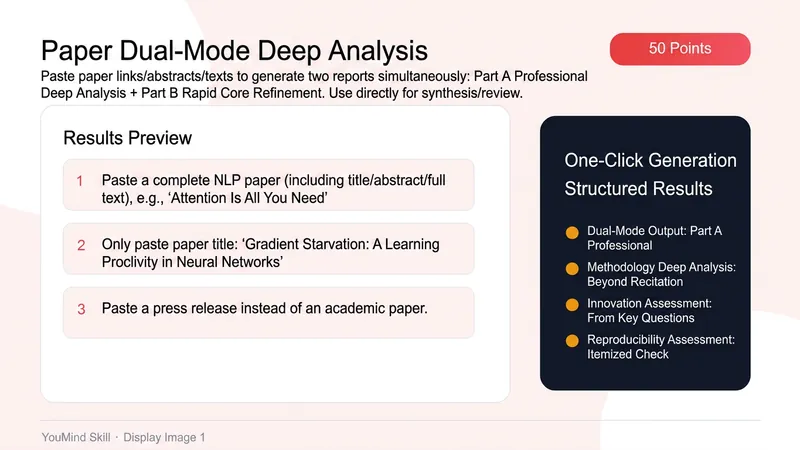
Dual-Mode Deep Read for Papers
A 30-page paper, and your advisor expects you to present it at tomorrow's group meeting. A literature review requires reading 50 papers, but deep understanding of each is impossible. Worse still — after spending two hours grinding through one paper, you only remember 'it seems important,' but the specific innovation, methodological flaws, and quotable insights are all gone. Paste the paper content and get two reports at once: Part A is a professional-level analysis for researchers in your field — from deep methodological analysis to quantitative evaluation of innovations to a critical perspective. Part B is a concise version for yourself, your advisor, or cross-disciplinary colleagues to grasp the core value in 3 minutes, including curated quotable quotes. ✨ Core Capabilities 1. Dual-mode output: Part A professional depth + Part B quick extraction, one paper, two reports 2. Deep methodological analysis: goes beyond restating methods to analyze design cleverness, core assumptions, and alternatives 3. Quantitative innovation evaluation: scores across problem, method, data, and conclusion dimensions — no vague praise 4. Reproducibility assessment: itemized checks for missing information (unreleased code/data/parameters) 5. Critical perspective: methodological flaws, overclaims, overlooked factors, each with original text evidence 6. Quotable quote extraction: retains original English sentences + Chinese paraphrases, ready for literature reviews 📱 Use Cases - Graduate group meeting paper presentations: Part A directly expands into slides, Part B as opening introduction - Literature reviews/thesis proposals: batch-read related papers to quickly build a field map - Cross-disciplinary collaboration: let collaborators understand core papers in your field in 3 minutes - Research blogs/social media: Part B with slight edits becomes a paper interpretation post Together with 'Paper Speed Reading Notes' and 'Academic Illustrations,' it forms a research trio — speed reading for overview, deep reading to master key points, and illustrations to showcase core findings.

Literature Review & Insight
Built with a three-layer analysis engine, this Skill helps you move beyond tedious literature organization and generate in-depth reviews with one click. Precisely extract core arguments, uncover research trends, and stay up to date with the latest developments in your field.
Read a Paper in 5 Minutes
Deep reading, source tracing, cross-synthesis
Description
Recommended by
Nico@YouMind
Why we love this skill
This skill uses deep reading, lineage analysis, and synthesis to transform paper research from fragmented to systematic, helping you fully grasp the academic context and discern research authenticity.
Transform paper research from fragmented to systematic. Through deep interpretation, source tracing analysis, and cross-synthesis, it helps you fully grasp the academic context and discern research authenticity.
Related Skills
View allResearch Paper Deconstruction
Submit an empirical research paper and receive a deep deconstruction report to help you master the essence of academic writing. This tool is based on the methodology of 'Deconstructing Papers: Understanding Academic Writing through Close Reading,' systematically analyzing the paper from diagnosing the research question, constructing the GAP, connecting theory and materials, to sentence-by-sentence close reading of key paragraphs, layer by layer, revealing the internal logic and writing techniques of the paper. You will receive a structured analysis report that includes an assessment of the specificity and essential nature of the research question, tracking of the GAP logical chain and identification of its strategy type, as well as a detailed examination of the quality of the 'two-way' connection between theory and real-world materials. The report will also specially select the strongest and weakest paragraphs, providing sentence-by-sentence logical function annotations and technique comments, and offering specific revision suggestions for areas that can be improved. This report not only helps you understand the writing secrets of high-level papers but also points out common writing mistakes, allowing you to learn while reading and improve while analyzing. Whether evaluating the depth of the research question, optimizing the narrative of the literature review, or enhancing the rigor of the discussion section, this tool provides powerful guidance to help you write more insightful and persuasive academic works.
Dual-Mode Deep Read for Papers
A 30-page paper, and your advisor expects you to present it at tomorrow's group meeting. A literature review requires reading 50 papers, but deep understanding of each is impossible. Worse still — after spending two hours grinding through one paper, you only remember 'it seems important,' but the specific innovation, methodological flaws, and quotable insights are all gone. Paste the paper content and get two reports at once: Part A is a professional-level analysis for researchers in your field — from deep methodological analysis to quantitative evaluation of innovations to a critical perspective. Part B is a concise version for yourself, your advisor, or cross-disciplinary colleagues to grasp the core value in 3 minutes, including curated quotable quotes. ✨ Core Capabilities 1. Dual-mode output: Part A professional depth + Part B quick extraction, one paper, two reports 2. Deep methodological analysis: goes beyond restating methods to analyze design cleverness, core assumptions, and alternatives 3. Quantitative innovation evaluation: scores across problem, method, data, and conclusion dimensions — no vague praise 4. Reproducibility assessment: itemized checks for missing information (unreleased code/data/parameters) 5. Critical perspective: methodological flaws, overclaims, overlooked factors, each with original text evidence 6. Quotable quote extraction: retains original English sentences + Chinese paraphrases, ready for literature reviews 📱 Use Cases - Graduate group meeting paper presentations: Part A directly expands into slides, Part B as opening introduction - Literature reviews/thesis proposals: batch-read related papers to quickly build a field map - Cross-disciplinary collaboration: let collaborators understand core papers in your field in 3 minutes - Research blogs/social media: Part B with slight edits becomes a paper interpretation post Together with 'Paper Speed Reading Notes' and 'Academic Illustrations,' it forms a research trio — speed reading for overview, deep reading to master key points, and illustrations to showcase core findings.
Literature Review & Insight
Built with a three-layer analysis engine, this Skill helps you move beyond tedious literature organization and generate in-depth reviews with one click. Precisely extract core arguments, uncover research trends, and stay up to date with the latest developments in your field.
Find your next favorite skill
Explore more curated AI skills for research, creation, and everyday work.