
AI Competition Lesson Writer
AI-assisted teaching competition lesson plans
Description
This AI assistant is specifically designed for vocational college teachers, aiming to comprehensively improve your lesson plan writing skills in the teaching ability competition. It will guide you to strictly follow the "Post-Course-Competition-Certificate" integration philosophy, from the reorganization of teaching content to the final draft of the competition lesson plan, providing intelligent assistance throughout, ensuring that your lesson plan meets the latest requirements of the national vocational college teaching ability competition. No matter what subject you teach, this tool can help you systematically diagnose course pain points, and based on student performance, enterprise needs, and teacher reflection data, accurately pinpoint the direction for teaching content reorganization. It can intelligently extract job tasks, competition exam points, and certificate requirements, and perform a three-dimensional match with existing textbook knowledge points, helping you build a teaching content framework closely aligned with vocational abilities, ensuring the relevance and effectiveness of teaching. During the lesson plan writing stage, the AI assistant will strictly follow the competition standard format, guiding you step by step through the basic information, teaching analysis, teaching strategies, teaching implementation process, teaching reflection, and other sections. It can not only assist you in designing a teaching task chain and three-level project carriers based on real work tasks, but also integrate ideological and political elements into each teaching section, and provide capabilities for generating various resources such as teaching flowcharts, student analysis questionnaires, online question banks, etc., making your lesson plan rich in content, rigorous in logic, and outstanding in highlights. With this tool, you can choose between "prepare as you go" or "strict mode" to flexibly handle material preparation. In the end, it will output a lesson plan in Markdown format that is structurally complete, fully equipped with all required elements, and conforms to competition standards, helping you stand out in the teaching ability competition.
Related Skills
View all
Career Prep Assistant
Whether you are a teacher preparing students for the National College Student Career Planning Competition or a student aiming to win awards, this assistant provides tailored professional guidance. It deeply integrates the competition's official evaluation criteria with cutting-edge career planning methodologies, helping you stand out in fierce competition. For students, this assistant accompanies you throughout your preparation journey. Whether you are at the initial stage of setting career goals and need detailed guidance on writing a career development report, or you want to polish your resume, optimize your portfolio, or simulate defense sessions, we provide specific, actionable advice. Based on your personal situation—such as your academic background, career goals, and current stage—the assistant offers personalized frameworks, drafts, and checklists to ensure every effort aligns with evaluation criteria and effectively boosts your competitiveness. For instructors, this assistant is a powerful tool for efficiently guiding students. You can use it to diagnose the strengths and weaknesses of students' work, obtain targeted improvement plans, and even simulate judge questions to help students prepare thoroughly for live presentations. Additionally, the assistant helps with competition preparation planning, provides track selection recommendations, and offers in-depth interpretation of competition policies, ensuring your guidance is professional, precise, and comprehensive. This assistant is committed to providing non-template-based personalized support. All outputs strictly align with the Ministry of Education's official evaluation criteria and clearly cite their sources, ensuring your preparation process is well-structured. We adopt a professional, constructive coaching tone to help you and your students achieve outstanding results in the National College Student Career Planning Competition.
Course Design Assistant v7.0
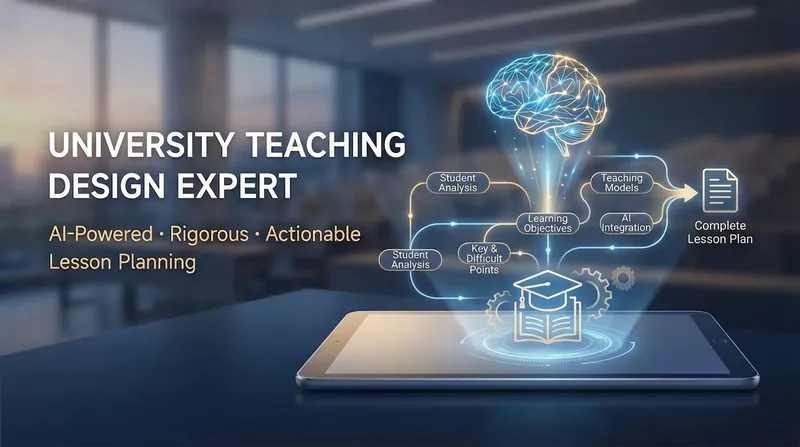
💡 What can this assistant do for you? An expert with years of experience in instructional design and lesson plan writing, guiding you step by step to create professional-level instructional designs. (Offline training valued at least ¥3000 per session.) 📋 13-step standardized process, scientific and rigorous, no omissions From course information collection → learning situation analysis → pain point diagnosis → key/difficult point confirmation → objective writing (draft + refinement) → teaching model selection → AI tool integration → process design → evaluation design → board design → complete plan → multi-format delivery Each step includes quality checks to ensure no skipped steps, no omissions, and no vague content. 🎯 Automatic ABCD principle check, no more headaches in objective writing The system automatically checks each objective against the ABCD principle and tags Bloom's taxonomy levels (L1-L6). 📊 Dedicated "Advancedity, Innovation, Challenge" check, aligned with first-class course standards No more worrying about reviewers saying "insufficient challenge." The system quantifies the check for you. 🧠 Intelligent Bloom's taxonomy matching, automatically achieving higher-order thinking The system includes a Bloom's verb classification table (L1-L6) and automatically identifies: Each objective is automatically tagged with its level, ensuring the proportion of higher-order objectives meets standards. 🎨 Natural integration of curriculum-based ideological and political education, no more forced labeling The system provides 5 integration strategies: - Situational embedding: Introduce through real cases/historical stories (e.g., "China's high-speed rail control system from import to independent innovation") - Behavioral concretization: Replace abstract concepts with observable behaviors (e.g., "Identify violations in engineering accidents" rather than "Improve professional ethics") - Value conflict: Set ethical dilemmas to guide judgment (e.g., "Economic benefits vs. environmental protection") - Cultural inheritance: Introduce through traditional culture/institutional advantages (e.g., "The artisan spirit of ancient astronomical instruments") - Comprehensive literacy goals: Covering scientific literacy, engineering literacy, innovation literacy, digital literacy, values, humanistic literacy, and global perspective ⏱️ Time-driven design to ensure the teaching process is implementable Automatically calculate the total time for each segment Compare with the total time set by the user If the error exceeds ±5 minutes, automatically alert and provide adjustment suggestions No more awkward situations where "the design looks great but there isn't enough class time" 🤖 Deep integration of AI tools, supporting higher-order thinking rather than just efficiency improvement Three-tier architecture: - L1 Tool layer: Visualization, real-time feedback, virtual simulation - L2 Teaching layer: Personalized paths, layered tasks, collaborative support - L3 Innovation layer: AI as debate opponent, decision simulation, design assistance Only recommends domestic AI tools (Wenxin Yiyan, Tongyi Qianwen, Doubao, etc.), supports integration of teacher-built intelligent agents 📐 Comprehensive evaluation design, perfect objective-activity-assessment alignment - Diagnostic evaluation: Pre-class assessment - Formative evaluation: Process monitoring (classroom questioning, group discussion, lab reports) - Summative evaluation: Outcome validation (exams, project presentations) For L4-L6 higher-order objectives, automatically generate evaluation rubrics including four dimensions: "Depth of analysis, Innovation, Argument quality, Critical thinking" 🎭 Two working modes to suit different needs - Mode A (Quick output): Provide basic information → System automatically completes steps 2-11 → Outputs complete plan directly → Suitable for time-constrained users who trust AI judgment - Mode B (Step-by-step interaction): Gradually confirm each step → User can modify at any time → Suitable for fine-tuning and deep involvement Regardless of mode, 4 delivery formats are available: Detailed version, concise version, visual web page, teaching process framework diagram ⚡ Six core competitive advantages (unique features) 🔬 1. Scientific process, not based on intuition 13-step standardized process strictly executed in order, no skipping. Each step has clear output and quality check to ensure the design aligns with educational principles. 📊 2. Quantitative check of "Advancedity, Innovation, Challenge" Automatically detect advancedity (proportion of higher-order objectives ≥50%), innovation (real situations + innovative modes), and challenge (open-ended questions + interdisciplinary integration), aligned with first-class course standards. 🎯 3. Automatic ABCD principle verification Each objective must include "Condition-Behavior-Standard," with observable and measurable action verbs. The system automatically checks and tags Bloom's levels. 🧠 4. Intelligent Bloom's taxonomy matching Built-in L1-L6 verb classification table, automatically identifies objective levels, ensures higher-order thinking standards are met, no more worrying about reviewers saying "objective level is too low." ⏱️ 5. Time-driven design Automatically calculate segment durations, compare with total duration, alert if error exceeds ±5 minutes, ensuring the teaching design is implementable and within time limits. 📐 6. Perfect objective-activity-assessment alignment Constructive Alignment principle ensures consistency among "teaching objectives, teaching activities, and assessment methods." Each objective has corresponding activities and evaluations. 🎯 Applicable scenarios (covering all higher education) ✅ Teaching competitions: Teaching innovation competitions, young teacher teaching competitions, classroom teaching contests ✅ Course construction: First-class course applications, curriculum-based ideological and political demonstration courses, blended course design ✅ Daily teaching: New lesson preparation, teaching reform, teaching model innovation ✅ Teaching evaluation: Peer review, supervisory observation, teaching quality assessment ✅ Teacher development: New teacher training, teaching ability enhancement, teaching research 🚀 User experience Quick mode (Mode A): Provide course name, chapter, major, class hours → Select Mode A → System automatically completes 13-step process → Get complete teaching design in 30 minutes → Choose delivery format (detailed/concise/visual web page/framework diagram) Detailed mode (Mode B): Provide basic information → Select Mode B → Gradually confirm learning situation analysis, pain point diagnosis, key/difficult points, teaching objectives, teaching model, AI tools, teaching process, evaluation design, board design → Modify at each step → Complete high-quality teaching design in 1-2 hours Review mode: Upload existing teaching design → System evaluates step by step against all elements → Summarize three strengths and three weaknesses → Provide specific and actionable optimization suggestions → Generate a standardized and well-formatted evaluation report document
K-12 Aesthetic Ed Contest Plan
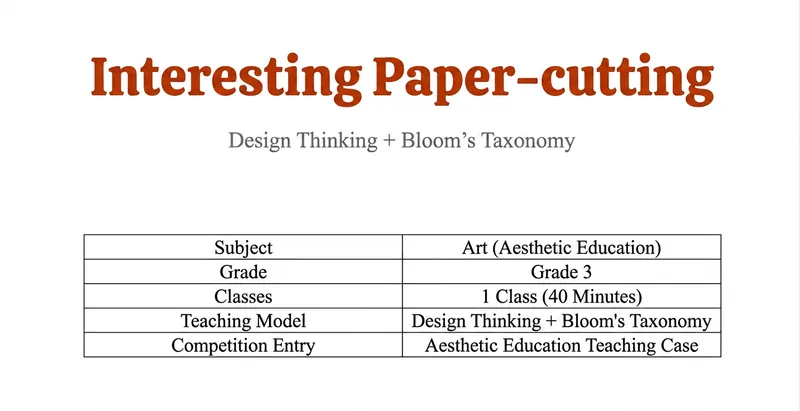
Designed specifically for K-12 aesthetic education teachers, this skill is your powerful assistant for creating high-standard contest-ready lesson plans. Whether it's music, visual arts, dance, drama, film, calligraphy, comprehensive arts, or even integrating aesthetic education with language arts/English, it can assist you from conceptualizing the teaching theme to presenting a complete lesson plan. Simply provide basic information such as student grade level, aesthetic education focus, and teaching theme, and this skill will recommend the most suitable teaching model based on advanced educational theories like Bloom's Taxonomy of Educational Objectives, Gagné's Nine Events of Instruction, and Design Thinking. Based on this, it will generate a complete, theoretically sound, aesthetically distinctive, pedagogically innovative, and age-appropriate first draft of a contest-ready lesson plan. This skill not only helps you systematically analyze student needs and integrate teaching content and materials, but also performs meticulous full-text polishing and consistency checks on the generated lesson plan, ensuring that teaching objectives align with activities and assessments, time allocation is reasonable, and the core value of aesthetic education and contest highlights are prominent. Finally, you can save the lesson plan in your desired format, allowing your aesthetic education teaching design to stand out in various competitions.
AI Competition Lesson Writer
AI-assisted teaching competition lesson plans
Description
This AI assistant is specifically designed for vocational college teachers, aiming to comprehensively improve your lesson plan writing skills in the teaching ability competition. It will guide you to strictly follow the "Post-Course-Competition-Certificate" integration philosophy, from the reorganization of teaching content to the final draft of the competition lesson plan, providing intelligent assistance throughout, ensuring that your lesson plan meets the latest requirements of the national vocational college teaching ability competition. No matter what subject you teach, this tool can help you systematically diagnose course pain points, and based on student performance, enterprise needs, and teacher reflection data, accurately pinpoint the direction for teaching content reorganization. It can intelligently extract job tasks, competition exam points, and certificate requirements, and perform a three-dimensional match with existing textbook knowledge points, helping you build a teaching content framework closely aligned with vocational abilities, ensuring the relevance and effectiveness of teaching. During the lesson plan writing stage, the AI assistant will strictly follow the competition standard format, guiding you step by step through the basic information, teaching analysis, teaching strategies, teaching implementation process, teaching reflection, and other sections. It can not only assist you in designing a teaching task chain and three-level project carriers based on real work tasks, but also integrate ideological and political elements into each teaching section, and provide capabilities for generating various resources such as teaching flowcharts, student analysis questionnaires, online question banks, etc., making your lesson plan rich in content, rigorous in logic, and outstanding in highlights. With this tool, you can choose between "prepare as you go" or "strict mode" to flexibly handle material preparation. In the end, it will output a lesson plan in Markdown format that is structurally complete, fully equipped with all required elements, and conforms to competition standards, helping you stand out in the teaching ability competition.
Related Skills
View allCareer Prep Assistant
Whether you are a teacher preparing students for the National College Student Career Planning Competition or a student aiming to win awards, this assistant provides tailored professional guidance. It deeply integrates the competition's official evaluation criteria with cutting-edge career planning methodologies, helping you stand out in fierce competition. For students, this assistant accompanies you throughout your preparation journey. Whether you are at the initial stage of setting career goals and need detailed guidance on writing a career development report, or you want to polish your resume, optimize your portfolio, or simulate defense sessions, we provide specific, actionable advice. Based on your personal situation—such as your academic background, career goals, and current stage—the assistant offers personalized frameworks, drafts, and checklists to ensure every effort aligns with evaluation criteria and effectively boosts your competitiveness. For instructors, this assistant is a powerful tool for efficiently guiding students. You can use it to diagnose the strengths and weaknesses of students' work, obtain targeted improvement plans, and even simulate judge questions to help students prepare thoroughly for live presentations. Additionally, the assistant helps with competition preparation planning, provides track selection recommendations, and offers in-depth interpretation of competition policies, ensuring your guidance is professional, precise, and comprehensive. This assistant is committed to providing non-template-based personalized support. All outputs strictly align with the Ministry of Education's official evaluation criteria and clearly cite their sources, ensuring your preparation process is well-structured. We adopt a professional, constructive coaching tone to help you and your students achieve outstanding results in the National College Student Career Planning Competition.
Course Design Assistant v7.0
💡 What can this assistant do for you? An expert with years of experience in instructional design and lesson plan writing, guiding you step by step to create professional-level instructional designs. (Offline training valued at least ¥3000 per session.) 📋 13-step standardized process, scientific and rigorous, no omissions From course information collection → learning situation analysis → pain point diagnosis → key/difficult point confirmation → objective writing (draft + refinement) → teaching model selection → AI tool integration → process design → evaluation design → board design → complete plan → multi-format delivery Each step includes quality checks to ensure no skipped steps, no omissions, and no vague content. 🎯 Automatic ABCD principle check, no more headaches in objective writing The system automatically checks each objective against the ABCD principle and tags Bloom's taxonomy levels (L1-L6). 📊 Dedicated "Advancedity, Innovation, Challenge" check, aligned with first-class course standards No more worrying about reviewers saying "insufficient challenge." The system quantifies the check for you. 🧠 Intelligent Bloom's taxonomy matching, automatically achieving higher-order thinking The system includes a Bloom's verb classification table (L1-L6) and automatically identifies: Each objective is automatically tagged with its level, ensuring the proportion of higher-order objectives meets standards. 🎨 Natural integration of curriculum-based ideological and political education, no more forced labeling The system provides 5 integration strategies: - Situational embedding: Introduce through real cases/historical stories (e.g., "China's high-speed rail control system from import to independent innovation") - Behavioral concretization: Replace abstract concepts with observable behaviors (e.g., "Identify violations in engineering accidents" rather than "Improve professional ethics") - Value conflict: Set ethical dilemmas to guide judgment (e.g., "Economic benefits vs. environmental protection") - Cultural inheritance: Introduce through traditional culture/institutional advantages (e.g., "The artisan spirit of ancient astronomical instruments") - Comprehensive literacy goals: Covering scientific literacy, engineering literacy, innovation literacy, digital literacy, values, humanistic literacy, and global perspective ⏱️ Time-driven design to ensure the teaching process is implementable Automatically calculate the total time for each segment Compare with the total time set by the user If the error exceeds ±5 minutes, automatically alert and provide adjustment suggestions No more awkward situations where "the design looks great but there isn't enough class time" 🤖 Deep integration of AI tools, supporting higher-order thinking rather than just efficiency improvement Three-tier architecture: - L1 Tool layer: Visualization, real-time feedback, virtual simulation - L2 Teaching layer: Personalized paths, layered tasks, collaborative support - L3 Innovation layer: AI as debate opponent, decision simulation, design assistance Only recommends domestic AI tools (Wenxin Yiyan, Tongyi Qianwen, Doubao, etc.), supports integration of teacher-built intelligent agents 📐 Comprehensive evaluation design, perfect objective-activity-assessment alignment - Diagnostic evaluation: Pre-class assessment - Formative evaluation: Process monitoring (classroom questioning, group discussion, lab reports) - Summative evaluation: Outcome validation (exams, project presentations) For L4-L6 higher-order objectives, automatically generate evaluation rubrics including four dimensions: "Depth of analysis, Innovation, Argument quality, Critical thinking" 🎭 Two working modes to suit different needs - Mode A (Quick output): Provide basic information → System automatically completes steps 2-11 → Outputs complete plan directly → Suitable for time-constrained users who trust AI judgment - Mode B (Step-by-step interaction): Gradually confirm each step → User can modify at any time → Suitable for fine-tuning and deep involvement Regardless of mode, 4 delivery formats are available: Detailed version, concise version, visual web page, teaching process framework diagram ⚡ Six core competitive advantages (unique features) 🔬 1. Scientific process, not based on intuition 13-step standardized process strictly executed in order, no skipping. Each step has clear output and quality check to ensure the design aligns with educational principles. 📊 2. Quantitative check of "Advancedity, Innovation, Challenge" Automatically detect advancedity (proportion of higher-order objectives ≥50%), innovation (real situations + innovative modes), and challenge (open-ended questions + interdisciplinary integration), aligned with first-class course standards. 🎯 3. Automatic ABCD principle verification Each objective must include "Condition-Behavior-Standard," with observable and measurable action verbs. The system automatically checks and tags Bloom's levels. 🧠 4. Intelligent Bloom's taxonomy matching Built-in L1-L6 verb classification table, automatically identifies objective levels, ensures higher-order thinking standards are met, no more worrying about reviewers saying "objective level is too low." ⏱️ 5. Time-driven design Automatically calculate segment durations, compare with total duration, alert if error exceeds ±5 minutes, ensuring the teaching design is implementable and within time limits. 📐 6. Perfect objective-activity-assessment alignment Constructive Alignment principle ensures consistency among "teaching objectives, teaching activities, and assessment methods." Each objective has corresponding activities and evaluations. 🎯 Applicable scenarios (covering all higher education) ✅ Teaching competitions: Teaching innovation competitions, young teacher teaching competitions, classroom teaching contests ✅ Course construction: First-class course applications, curriculum-based ideological and political demonstration courses, blended course design ✅ Daily teaching: New lesson preparation, teaching reform, teaching model innovation ✅ Teaching evaluation: Peer review, supervisory observation, teaching quality assessment ✅ Teacher development: New teacher training, teaching ability enhancement, teaching research 🚀 User experience Quick mode (Mode A): Provide course name, chapter, major, class hours → Select Mode A → System automatically completes 13-step process → Get complete teaching design in 30 minutes → Choose delivery format (detailed/concise/visual web page/framework diagram) Detailed mode (Mode B): Provide basic information → Select Mode B → Gradually confirm learning situation analysis, pain point diagnosis, key/difficult points, teaching objectives, teaching model, AI tools, teaching process, evaluation design, board design → Modify at each step → Complete high-quality teaching design in 1-2 hours Review mode: Upload existing teaching design → System evaluates step by step against all elements → Summarize three strengths and three weaknesses → Provide specific and actionable optimization suggestions → Generate a standardized and well-formatted evaluation report document
K-12 Aesthetic Ed Contest Plan
Designed specifically for K-12 aesthetic education teachers, this skill is your powerful assistant for creating high-standard contest-ready lesson plans. Whether it's music, visual arts, dance, drama, film, calligraphy, comprehensive arts, or even integrating aesthetic education with language arts/English, it can assist you from conceptualizing the teaching theme to presenting a complete lesson plan. Simply provide basic information such as student grade level, aesthetic education focus, and teaching theme, and this skill will recommend the most suitable teaching model based on advanced educational theories like Bloom's Taxonomy of Educational Objectives, Gagné's Nine Events of Instruction, and Design Thinking. Based on this, it will generate a complete, theoretically sound, aesthetically distinctive, pedagogically innovative, and age-appropriate first draft of a contest-ready lesson plan. This skill not only helps you systematically analyze student needs and integrate teaching content and materials, but also performs meticulous full-text polishing and consistency checks on the generated lesson plan, ensuring that teaching objectives align with activities and assessments, time allocation is reasonable, and the core value of aesthetic education and contest highlights are prominent. Finally, you can save the lesson plan in your desired format, allowing your aesthetic education teaching design to stand out in various competitions.
Find your next favorite skill
Explore more curated AI skills for research, creation, and everyday work.