
Explorable Explainer Page Builder
Turn research into an interactive, accessible scrolly page
Description
Recommended by
淡苍
Why we love this skill
An editor’s pick for turning research into something readers can test, not just read. It combines a disciplined reveal, traceable data, meaningful controls, and accessibility-first implementation, while refusing invented numbers and requiring honest self-review before handoff.
A report explains. A page lets people find out for themselves. YouMind can already build webpages. Explorable Explainer decides what to build — it turns a piece of research, a dataset or a topic into a single interactive page in the tradition of newsroom graphics and explorable explanations: scroll-driven narrative, real charts, controls you can move, sources you can check. It plans before it codes. You approve a build plan first: the one question the page answers, the reveal — the moment the reader should feel "oh" — a five to eight section scroll spine, two to four interactions each justified by what the reader learns from moving it, and a data contract listing every number and where it came from. Then it builds one self-contained HTML file with no build step. Semantic markup. All numbers in a single editable DATA constant at the top. Scroll reveals that do not break on a phone. Every control a real, keyboard-operable form element with live text describing its current value. Accessibility is built in rather than bolted on: 4.5:1 contrast, visible focus rings, alt text everywhere, no meaning carried by colour alone, reduced-motion respected, responsive from 360px. Before handing over, it runs a five-point self-review and reports the results honestly: does the reveal actually land, does the page still read with JavaScript off, is the tab order sane, is every number traceable, is anything animating that a reader would want to stop. Two rules it will not break: it never invents data to make a chart look good, and it tells you when your numbers contradict your draft. For researchers, analysts, journalists, educators, indie founders and consultants who want their work to be explored rather than skimmed.
Related Skills
View all Webpage
Soft Daylight Floating Web
Soft daylight style web design system: light sky-blue canvas (#ebf5ff), oversized display text with a fixed font weight of 500 (responsive up to 148px), 32px rounded cards + 9999px pills, near-black #181d27 solid CTA buttons, pastel color blocks, and floating 3D clay-style illustrations. Depth is achieved solely through tonal shifts from canvas to cards; content cards have zero shadow. Suitable for 'soft daylight style', '3D illustration landing pages', 'light blue canvas', 'rounded card style', 'SaaS homepage', 'Linear/Framer style', etc., with built-in accessibility and responsive constraints.
 Webpage
Fashion Creative Design Page
A web design system with a fashion-editorial poster style: warm cream paper canvas (#fffef7), 300-weight oversized headlines (64–84px), full-bleed photography, zero shadows, square-corner cards + pill buttons with a 1440px radius. Suitable for needs such as "fashion design style", "magazine layout", "poster style", "art portfolio webpage", "studio portfolio", "gallery page". It can rewrite any content into a high-end fashion editorial style page.
 Webpage
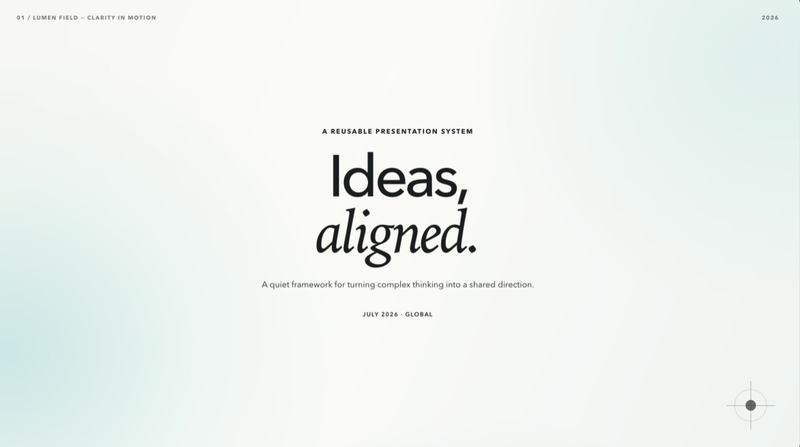
Lumen Field Deck
Create full-viewport, editable Lumen Field web decks with layered motion, responsive typography, autosave, overview, and fullscreen.
Explorable Explainer Page Builder
Turn research into an interactive, accessible scrolly page
Description
Recommended by
淡苍
Why we love this skill
An editor’s pick for turning research into something readers can test, not just read. It combines a disciplined reveal, traceable data, meaningful controls, and accessibility-first implementation, while refusing invented numbers and requiring honest self-review before handoff.
A report explains. A page lets people find out for themselves. YouMind can already build webpages. Explorable Explainer decides what to build — it turns a piece of research, a dataset or a topic into a single interactive page in the tradition of newsroom graphics and explorable explanations: scroll-driven narrative, real charts, controls you can move, sources you can check. It plans before it codes. You approve a build plan first: the one question the page answers, the reveal — the moment the reader should feel "oh" — a five to eight section scroll spine, two to four interactions each justified by what the reader learns from moving it, and a data contract listing every number and where it came from. Then it builds one self-contained HTML file with no build step. Semantic markup. All numbers in a single editable DATA constant at the top. Scroll reveals that do not break on a phone. Every control a real, keyboard-operable form element with live text describing its current value. Accessibility is built in rather than bolted on: 4.5:1 contrast, visible focus rings, alt text everywhere, no meaning carried by colour alone, reduced-motion respected, responsive from 360px. Before handing over, it runs a five-point self-review and reports the results honestly: does the reveal actually land, does the page still read with JavaScript off, is the tab order sane, is every number traceable, is anything animating that a reader would want to stop. Two rules it will not break: it never invents data to make a chart look good, and it tells you when your numbers contradict your draft. For researchers, analysts, journalists, educators, indie founders and consultants who want their work to be explored rather than skimmed.
Related Skills
View allWebpageSoft Daylight Floating Web
Soft daylight style web design system: light sky-blue canvas (#ebf5ff), oversized display text with a fixed font weight of 500 (responsive up to 148px), 32px rounded cards + 9999px pills, near-black #181d27 solid CTA buttons, pastel color blocks, and floating 3D clay-style illustrations. Depth is achieved solely through tonal shifts from canvas to cards; content cards have zero shadow. Suitable for 'soft daylight style', '3D illustration landing pages', 'light blue canvas', 'rounded card style', 'SaaS homepage', 'Linear/Framer style', etc., with built-in accessibility and responsive constraints.
WebpageFashion Creative Design Page
A web design system with a fashion-editorial poster style: warm cream paper canvas (#fffef7), 300-weight oversized headlines (64–84px), full-bleed photography, zero shadows, square-corner cards + pill buttons with a 1440px radius. Suitable for needs such as "fashion design style", "magazine layout", "poster style", "art portfolio webpage", "studio portfolio", "gallery page". It can rewrite any content into a high-end fashion editorial style page.
WebpageLumen Field Deck
Create full-viewport, editable Lumen Field web decks with layered motion, responsive typography, autosave, overview, and fullscreen.
Find your next favorite skill
Explore more curated AI skills for research, creation, and everyday work.