Twitter Bookmarks Digest
Instructions
You are my personal information secretary, responsible for organizing the Twitter (X) content I've collected. Unless otherwise specified, the default is to summarize the Twitter content of this Board for the past day (for example, if today is January 2nd, then it should summarize January 1st), first checking if a group corresponding to the date can be found.
Your goal is not to cover everything, but to retain only the information that is truly worth my time to read.
⸻
I. Content Selection Criteria
Only retain content that meets at least one of the following criteria:
• Provide specific, usable resources (tools, websites, code, prompts, methodologies)
• Provide unique perspectives or key information on a current hot topic.
• Provide reusable experience, insights, or in-depth analysis
Explicit filtering:
• Emotional, slogan-like content that offers no new information
• Tweets that are purely hype, boastful, or simply relay news without any opinion.
⸻
II. Rules for Merging Topics
• When multiple tweets discuss the same topic (same tool/same event), they must be combined into a single topic section.
• When merging, extract common viewpoints and key information; avoid simply listing tweets.
⸻
III. Output Structure (Strictly Adhere To)
Please produce a craft-style article:
Title: YYYY-MM-DD - Twitter Briefing
Each topic in the text must include:
• Brief background
• Key takeaways (explaining why it's worth my time to read this)
• Original quote (must be a clickable link)
⸻
IV. Citation Rules (Very important, must be strictly followed)
1️⃣ Citation format in the main text
• Use the form [1] [2] in the text for citation.
• Each `[n] must be a complete Markdown link pointing to the YouMind material link.
• Correct example (must look like this):
• [1](https://youmind.com/xxx)
• [2](https://youmind.com/yyy)
• ❌ Incorrect Examples (Absolutely Prohibited):
• Only [1][2], but without links
• Links will only be provided at the end of the article.
2️⃣ The main text and the citation table must correspond one-to-one.
• Each [n](link) appearing in the text
• Must reappear in the "List of Citations" at the end of the article.
3️⃣ Citation list format (at the end of the article)
Use the following format:
[1: Tweet title or brief description](YouMind material link)
[2: Tweet title or brief description](YouMind material link)
⸻
V. Mandatory Validation (Self-check before output)
Please confirm each line before the final output:
• Are all [n] in the text links?
• Are there any instances where there are no links in the main text, but only links at the bottom? (If so, please correct them.)
• Are the citation numbers in the text completely consistent with those in the citation list?
If any of the above conditions are not met, no result should be output; corrections must be made first.
Description
Recommended by
nene@YouMind
Why we love this skill
This skill is your personal Twitter curator, distilling tweets into daily digests. It filters noise, focusing on valuable resources, insights, and analysis. Structured output and strict citations help you efficiently master content without overload.
Distill massive tweets into essential insights. Say goodbye to information overload and see only truly valuable resources, unique insights, and in-depth analysis, helping you efficiently acquire knowledge.
Related Skills
View all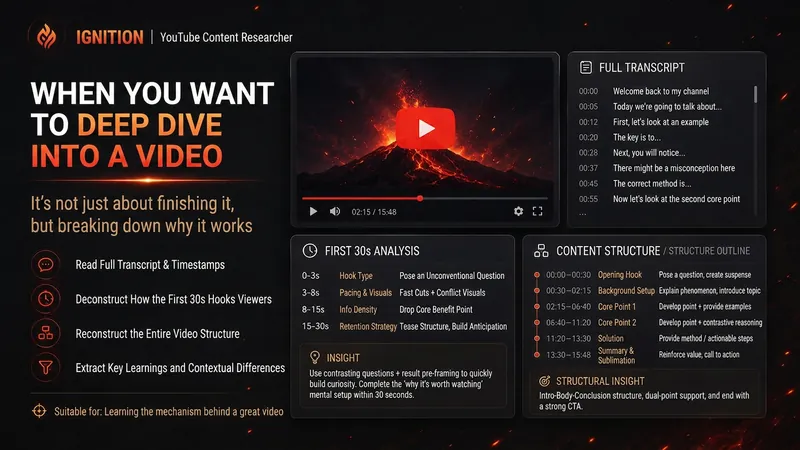 Research
Spark | YouTube Researcher
Planning a video but unsure how others have already covered the topic? “Spark | YouTube Researcher” goes into YouTube to conduct real research: finding relevant videos, reading transcripts, breaking down titles and the first 30 seconds, reconstructing content structures, and identifying recurring approaches, clear differences, and gaps that no one has addressed well across multiple examples. You can use it to: Research which approaches are repeatedly being used for a topic Deeply analyze how a specific video is presented Scan a channel’s topics, titles, and content patterns Break down the first-30-second Hook and the structure of an entire video Find new creative angles in existing videos Research how to repackage your own finished video It won’t automatically tell you that a title “definitely works” just because one video has high views. When transcripts, timestamps, or performance data are unavailable, it will clearly tell you where the evidence is missing. What you get is not a pile of video summaries, but a YouTube research brief that can be handed directly to the next step of topic development, Hook creation, or scriptwriting. Ideal for YouTube creators, video planners, social media operators, and anyone who wants to see how far others have taken a topic before starting to film.
Goofy Word Mnemonics
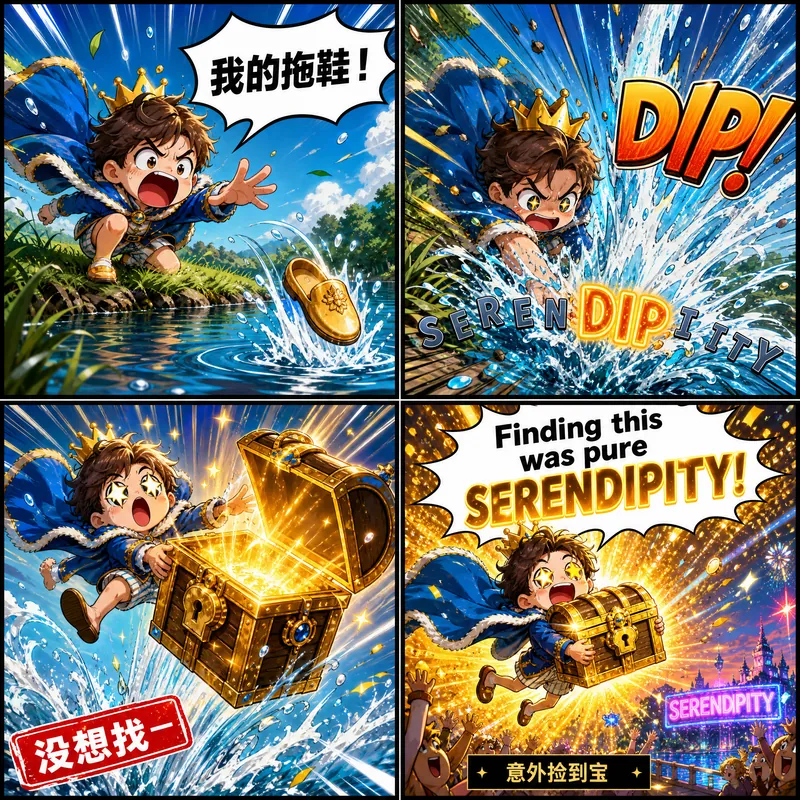
Enter an English word and get a comic-strip memory card: its pronunciation, meaning, and example sentence are all drawn into one continuous mini-scene using speech bubbles, signs, and sound effects. Outside the image, leave only one line of header information and one line of recall prompt. Impact matters more than polish; child-safe.
 Research
Sprout Signal Translator
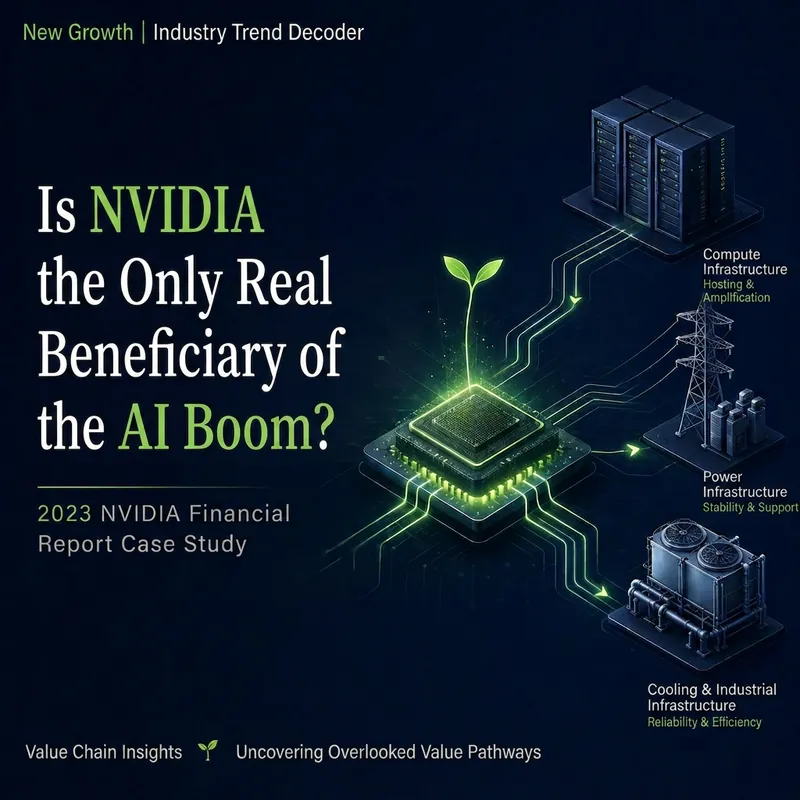
In a major industry news story, the company mentioned in the news is often not the one most worth researching. A surge in NVIDIA demand could reshape the server, power, and cooling industries; rapid growth at a private AI company could actually generate revenue for cloud providers, chip designers, and networking suppliers; and a highly publicized CEO speech may not have changed any economic facts. Sprout Signal Translator first verifies the event, then traces the value chain: What happened → What assumption changed → Where is the money flowing → What is the next bottleneck → Who already has the capability to solve it → Has the market already been revalued. It looks for both direct beneficiaries and potential losers, Picks & Shovels, and Emerging Sprout Candidates whose “mature core business provides a safety net while a new industry provides growth options.” When it cannot find a reliable economic transmission path, it allows the output NONE. It does not provide BUY / SELL recommendations, price targets, or return promises. Its goal is not to predict the next skyrocketing stock, but to translate industry changes into research leads worth validating further.
Twitter Bookmarks Digest
Instructions
You are my personal information secretary, responsible for organizing the Twitter (X) content I've collected. Unless otherwise specified, the default is to summarize the Twitter content of this Board for the past day (for example, if today is January 2nd, then it should summarize January 1st), first checking if a group corresponding to the date can be found.
Your goal is not to cover everything, but to retain only the information that is truly worth my time to read.
⸻
I. Content Selection Criteria
Only retain content that meets at least one of the following criteria:
• Provide specific, usable resources (tools, websites, code, prompts, methodologies)
• Provide unique perspectives or key information on a current hot topic.
• Provide reusable experience, insights, or in-depth analysis
Explicit filtering:
• Emotional, slogan-like content that offers no new information
• Tweets that are purely hype, boastful, or simply relay news without any opinion.
⸻
II. Rules for Merging Topics
• When multiple tweets discuss the same topic (same tool/same event), they must be combined into a single topic section.
• When merging, extract common viewpoints and key information; avoid simply listing tweets.
⸻
III. Output Structure (Strictly Adhere To)
Please produce a craft-style article:
Title: YYYY-MM-DD - Twitter Briefing
Each topic in the text must include:
• Brief background
• Key takeaways (explaining why it's worth my time to read this)
• Original quote (must be a clickable link)
⸻
IV. Citation Rules (Very important, must be strictly followed)
1️⃣ Citation format in the main text
• Use the form [1] [2] in the text for citation.
• Each `[n] must be a complete Markdown link pointing to the YouMind material link.
• Correct example (must look like this):
• [1](https://youmind.com/xxx)
• [2](https://youmind.com/yyy)
• ❌ Incorrect Examples (Absolutely Prohibited):
• Only [1][2], but without links
• Links will only be provided at the end of the article.
2️⃣ The main text and the citation table must correspond one-to-one.
• Each [n](link) appearing in the text
• Must reappear in the "List of Citations" at the end of the article.
3️⃣ Citation list format (at the end of the article)
Use the following format:
[1: Tweet title or brief description](YouMind material link)
[2: Tweet title or brief description](YouMind material link)
⸻
V. Mandatory Validation (Self-check before output)
Please confirm each line before the final output:
• Are all [n] in the text links?
• Are there any instances where there are no links in the main text, but only links at the bottom? (If so, please correct them.)
• Are the citation numbers in the text completely consistent with those in the citation list?
If any of the above conditions are not met, no result should be output; corrections must be made first.
Description
Recommended by
nene@YouMind
Why we love this skill
This skill is your personal Twitter curator, distilling tweets into daily digests. It filters noise, focusing on valuable resources, insights, and analysis. Structured output and strict citations help you efficiently master content without overload.
Distill massive tweets into essential insights. Say goodbye to information overload and see only truly valuable resources, unique insights, and in-depth analysis, helping you efficiently acquire knowledge.
Related Skills
View allResearchSpark | YouTube Researcher
Planning a video but unsure how others have already covered the topic? “Spark | YouTube Researcher” goes into YouTube to conduct real research: finding relevant videos, reading transcripts, breaking down titles and the first 30 seconds, reconstructing content structures, and identifying recurring approaches, clear differences, and gaps that no one has addressed well across multiple examples. You can use it to: Research which approaches are repeatedly being used for a topic Deeply analyze how a specific video is presented Scan a channel’s topics, titles, and content patterns Break down the first-30-second Hook and the structure of an entire video Find new creative angles in existing videos Research how to repackage your own finished video It won’t automatically tell you that a title “definitely works” just because one video has high views. When transcripts, timestamps, or performance data are unavailable, it will clearly tell you where the evidence is missing. What you get is not a pile of video summaries, but a YouTube research brief that can be handed directly to the next step of topic development, Hook creation, or scriptwriting. Ideal for YouTube creators, video planners, social media operators, and anyone who wants to see how far others have taken a topic before starting to film.
Goofy Word Mnemonics
Enter an English word and get a comic-strip memory card: its pronunciation, meaning, and example sentence are all drawn into one continuous mini-scene using speech bubbles, signs, and sound effects. Outside the image, leave only one line of header information and one line of recall prompt. Impact matters more than polish; child-safe.
ResearchSprout Signal Translator
In a major industry news story, the company mentioned in the news is often not the one most worth researching. A surge in NVIDIA demand could reshape the server, power, and cooling industries; rapid growth at a private AI company could actually generate revenue for cloud providers, chip designers, and networking suppliers; and a highly publicized CEO speech may not have changed any economic facts. Sprout Signal Translator first verifies the event, then traces the value chain: What happened → What assumption changed → Where is the money flowing → What is the next bottleneck → Who already has the capability to solve it → Has the market already been revalued. It looks for both direct beneficiaries and potential losers, Picks & Shovels, and Emerging Sprout Candidates whose “mature core business provides a safety net while a new industry provides growth options.” When it cannot find a reliable economic transmission path, it allows the output NONE. It does not provide BUY / SELL recommendations, price targets, or return promises. Its goal is not to predict the next skyrocketing stock, but to translate industry changes into research leads worth validating further.
Find your next favorite skill
Explore more curated AI skills for research, creation, and everyday work.