Ximo Pro: AI Detection Bypass
Ximo Pro: AI Detection Bypass
Showcase
Description
AI Detection Countermeasure Engine — Deep rewriting based on three-layer statistical features (structural fragmentation + vocabulary purification with 30+ prohibited word hard interception + perplexity/burstiness optimization) + four-dimensional diagnostic scoring + native adaptation for 5 major platforms (Xiaohongshu, WeChat Official Accounts, Twitter, Zhihu, Academic). Before-and-after rewriting comparison scores, estimated detection pass rate over 95%. It's not just superficial word swapping—it thoroughly washes away the AI traces, revealing the genuine human-written undertones.
Why we love this skill
This skill uniquely features a 'three-layer deep ink-washing engine' that thoroughly removes AI traces from multiple dimensions including structure, vocabulary, and statistics, and intelligently adapts to different platforms, allowing your content to easily pass AI detection and achieve truly human-like expression.
Related Skills
View all Write
WriteHandwriting Pro — Write in Your Style
One Skill handles all writing problems. A. Imitate yourself — Paste a piece of your writing, AI extracts your 6-dimensional writing DNA, all output becomes 'your voice'; B. Imitate anyone — Switch between 8 major known styles with one click (Banfo, Luke Wen, Beast Ye, Jiubian, Wang Xiaobo, Wang Zengqi…), and you can paste any favorite author's text to learn on the spot; C. Quickly remove AI flavor — Three rounds of deep proofreading (restructure → reword → re-rhythm), without changing style, just clean it up, fast and stable. 3999 credits = unlimited style library + style transfer + de-AI flavor, a three-in-one great value.
 Write
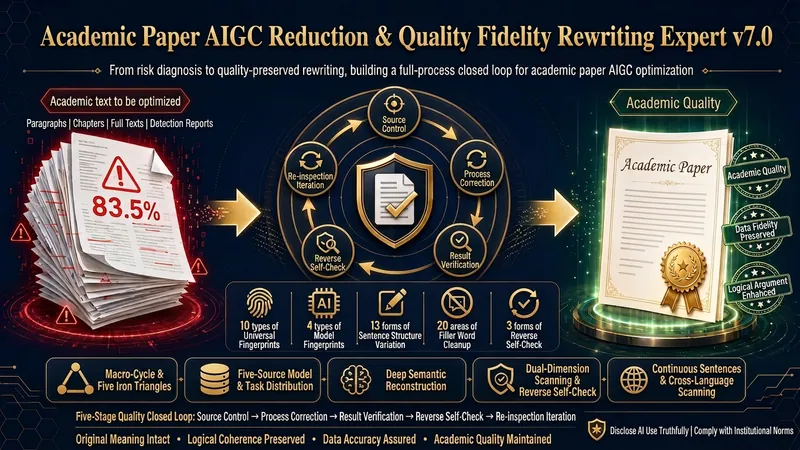
WriteAIGC Reduction & Rewrite v7.0
📚 Academic Paper AIGC Reduction and Quality-Preserving Rewriting Expert v7.0 Designed for graduate students, researchers, and paper authors, this academic text optimization skill operates on a core closed loop of 'source control → process correction → result verification → reverse self-check → iterative re-check'. It systematically diagnoses and optimizes issues such as templated expressions, mechanical logic, vague content, inaccurate terminology, and style inconsistencies while preserving original meaning, technical terms, data, and core conclusions. 🔍📝 🌟 Core Capabilities 🔬 Multi-layer Risk Diagnosis Covers 10 types of universal text fingerprints and assists in identifying common expression patterns of models such as ChatGPT, Claude, DeepSeek, and Wenxin Yiyan. 🧠 Deep Semantic Restructuring Goes beyond synonym replacement to rebuild more natural and in-depth academic reasoning by adjusting proposition expression, information order, argument approach, and evidence organization. ✍️ Quality-Preserving Rewriting Comprehensively applies 13 sentence transformation strategies and 20 methods for cleaning high-frequency templated expressions, improving mechanical sentence structures, repetitive connectors, and overly rigid formatting. 📊 Full-text Structure Diagnosis Through macro-cycle and five key triangles, checks whether research problems, theory, literature review, methods, results, conclusions, and innovation form a complete closed loop. 🧩 Fine-grained Section Adaptation Develops differentiated diagnostic and rewriting strategies for abstract, introduction, literature review, research methods, results, discussion, and conclusion respectively. 🌐 Cross-language Risk Scanning Assists in identifying translationese, passive voice stacking, long sentence nesting, and mixed Chinese-English formatting abnormalities to make Chinese academic expression more natural and accurate. 🔄 Reverse Self-check Loop After rewriting, re-verifies from three aspects: technique distribution, new text fingerprints, and information integrity, to avoid 'becoming more templated' or losing key content. 🛡️ Academic Integrity Protection Does not fabricate literature, data, cases, or policy evidence; separately marks information requiring author verification and reminds users to honestly disclose AI usage. 🎯 Use Cases ✅ Single paragraph or partial section optimization ✅ Targeted modification of marked paragraphs from inspection reports ✅ Polishing of abstract, introduction, literature review, discussion, and conclusion ✅ Full-text AIGC risk feature diagnosis ✅ Language and structure adaptation for target journals ✅ Pre-submission quality review and consistency check 📦 Final Deliverables 📄 Quality-preserving rewritten text 🔎 Risk and issue diagnosis report 🛠️ Rewriting strategy and technique description ✅ Reverse self-check and information integrity report 💡 Items requiring author verification and subsequent revision suggestions 🎓 Original meaning preserved · Logic intact · No fabricated data · Academic quality maintained ⚠️ This skill aims to improve academic expression quality and reduce text risk features. It does not guarantee passage through any specific detection platform or achieving a particular detection score.

AI Writing Naturalizer
Remove signs of AI-generated writing. Use it to edit or review text so it sounds more natural and human-written. Based on Wikipedia’s comprehensive guide to “Signs of AI writing.” Detect and fix the following patterns: exaggerated symbolism, promotional language, shallow -ing analysis, vague attribution, overuse of em dashes, the rule of three, AI vocabulary, negative parallelism, and excessive connective phrases.
Information
- Version
- v3
- Last updated
- Runtime credits
- Usage-based
- Models
- Auto