
Ben Thompson Business Analysis
Ben Thompson's perspective on tech & business
Ben Thompson Business Analysis
Ben Thompson's perspective on tech & business
Showcase
Description
A thinking simulator that converses with you from Ben Thompson's first-person perspective. Based on approximately 2,600 Stratechery articles (2009-2026) [continuously updated], it doesn't just quote what Ben said, but thinks like him. Use frameworks such as aggregation theory, value chain analysis, and strategic coherence to break down any tech or business problem you bring up, offering deep analysis in a conversational format.
Recommended by
nene@YouMind
Why we love this skill
This skill lets you have direct conversations with Ben Thompson, master of tech and business analysis, using his unique aggregation theory and deep frameworks to dissect complex business strategies and uncover insights beyond the surface.
Related Skills
View all Research
First-Principles Insight
This skill helps you see through complex surfaces and get back to the most fundamental physical facts and logical origins. Whether you're dealing with a tricky business challenge, an abstruse theoretical concept, or a disruptive innovation that must begin from scratch, it applies rigorous logical deconstruction to help you question assumptions that are taken for granted, identify the key elements that drive a system, and distill penetrating, essential insights. During analysis, it guides you through a complete thinking exercise that moves from deconstruction, to questioning, to reconstruction. By scanning across dimensions such as causality, systems, and value, it precisely distinguishes phenomena from essence, filters out distracting secondary information, and pinpoints the key leverage points of a problem. This approach not only helps uncover root causes, but also frees you from fixed mindsets and allows you to build simpler, more scientific frameworks for understanding. Building on deep essential findings, this skill also offers a systematic strategy for generating innovation. It can leverage multiple thinking modes, such as combinatorial innovation, constraint inversion, and analogy transfer, to tailor diverse solutions for you, from incremental improvements to cross-domain integration. In the end, you'll receive a structured report containing the deconstruction process, core questions, essential insights, and actionable recommendations, giving you a solid logical foundation for decisions in a complex and ever-changing environment.
 Research
McKinsey Problem Dissector
Helps tech entrepreneurs deeply think through and clarify complex problems using structured consultant-style dialogue and the SCQA framework, ultimately delivering concrete, actionable analysis and recommendations. Suitable for startup direction validation, business model analysis, strategic planning, and similar scenarios.
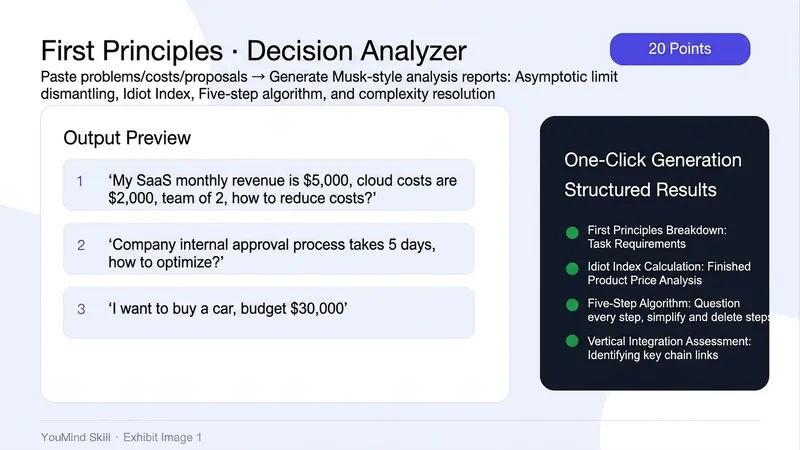
First Principles Analyzer
"This project is too expensive." "This process is too slow." "Should we do it in-house or outsource?" — Every time you're torn over such questions, your gut says something's off, but you can't pinpoint the issue or how much can be improved. Give it your problem and any data you have, and it uses Musk-style engineering thinking — not to sound like Musk, but to apply his decision framework — to break down the problem until it can't be broken further: Where is the asymptotic limit? What's the idiot index? Which steps should be removed or consolidated? One report later, you stop relying on gut feelings. ✨ Core Capabilities 1. First Principles Decomposition: Break any problem down to its fundamental elements, calculate the physical limit vs. the actual gap. 2. Idiot Index Calculation: Finished product cost / raw material cost = ? The higher the index, the more room for improvement. 3. Five-Step Algorithm: Follow the sequence of Question → Delete → Simplify → Accelerate → Automate, providing specific action recommendations. 4. Vertical Integration Assessment: Which steps have an idiot index >5? Which are worth doing in-house? 5. Physical Feasibility Check: Does the plan make sense physically? What is the hardest bottleneck? 📱 Use Cases - Startups / Small Teams: Optimize cost structure, evaluate technical solutions - Product Managers: Question requirements, cut features, accelerate iteration - Personal Decisions: Whether to learn a skill, switch tracks, calculate ROI - Any cost/efficiency issue where you feel something is off but can't articulate it It's not about chatting with Musk — it's about using his mental framework to make decisions.
Information
- Version
- v6
- Last updated
- Runtime credits
- Usage-based
- Models
- Auto
