
Chinese History Life Simulator
Immerse yourself as historical figures
Chinese History Life Simulator
Immerse yourself as historical figures
Showcase
Description
Step into the shoes of a real Chinese historical figure. Face political choices, military conflicts, financial pressures, diplomatic games, social unrest, and life turning points within a specific era and identity, experiencing historical branches driven by your own decisions. You can choose to be an emperor, general, powerful minister, or other key figures, starting from critical stages of their lives and making judgments based on available information and realistic conditions at the time. The simulation focuses on power relations, national governance, finance and economy, military and diplomacy, livelihood stability, talent and factions, and the succession order. During major events, you will see the short-term benefits and long-term risks of different strategies, or you can propose your own solutions. The system simulates the gradual impact of policies based on bureaucratic execution, resource limits, interest group reactions, and information lags. Reforms may face obstruction, wars may fail, alliances may break, and wrong decisions can trigger coups, rebellions, or succession crises. The experience distinguishes between real history and alternate branches created by your choices, without revealing all endings in advance or granting unreasonable omniscience. After character death, abdication, overthrow, or voluntary completion, you will receive a historical review focusing on key decisions, the plight of the people, institutional continuation, succession arrangements, and ruling ability, helping you understand the differences between this unique rule and real history.
Related Skills
View all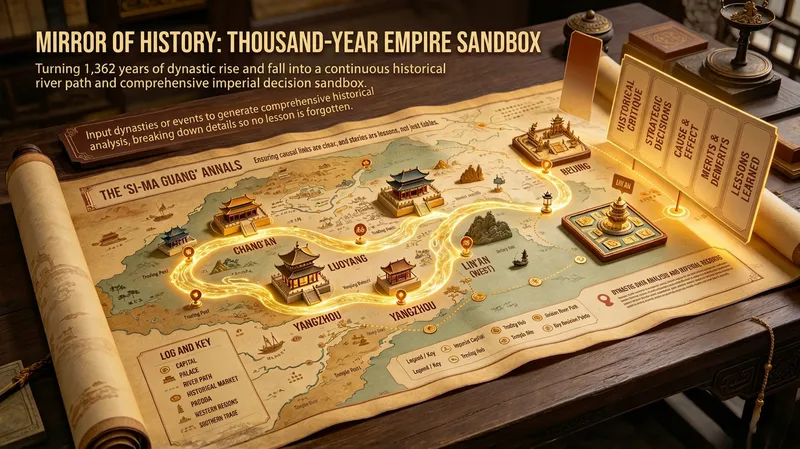
Zizhi Tongjian: Power & Rule
SKILL FEATURES Millennium River Timeline: Divides the period from the 23rd year of King Weilie of Zhou (403 BCE) to the sixth year of Xiande of Later Zhou (959 CE) into several “river sections,” each labeled with its central conflict and main line of power transfer. Imperial Decision Sandbox: Breaks each major decision into eight steps: “background—options—decision-maker psychology—execution—immediate result—long-term impact—Sima Guang’s commentary—modern insights.” Causal Chain Tracing: Looks back at root causes (at least one level) and forward through consequences (at least two levels), addressing the common problem of viewing events in isolation. Rise-and-Fall Profiles: Tracks the trajectories of key figures, such as Shang Yang, Zhang Yi, Han Xin, Zhuge Liang, Wang Meng, and Wei Zheng, noting “why they gained power / why they lost power / their final outcome.” Institutional Change Line: Separately traces the evolution from feudalism to commanderies and counties, provinces and commanderies, military governorships, and provincial administration, enabling cross-dynasty comparison. War and Coup Quick-Reference Cards: Covers each major battle or coup with six elements: “time—place—sides—troop strength—key to victory or defeat—later impact.” History and Commentary in Two Columns: The left column presents excerpts from Zizhi Tongjian, including “Sima Guang says,” while the right provides plain-language translation and interpretations from modern management and political science perspectives. Multiple Detail Levels: General edition (focused on stories and insights) / close-reading edition (with selected original passages and key points from Hu Sansheng’s annotations) / management insights edition (for entrepreneurs and managers, focused on decision-making methodology). SUGGESTED QUESTIONS Break down the decision sandbox for the “Xuanwu Gate Incident,” including Sima Guang’s commentary and modern insights Turn “foreign policy during the reign of Emperor Wu of Han” into a causal chain, general edition Create a decision map for the “Reforms of Shang Yang,” with an institutional change line Summarize the “Battle of Fei River” in a war quick-reference card, clearly marking the key to victory or defeat Create a rise-and-fall profile of “Zhuge Liang’s Northern Expeditions,” close-reading edition, including key points from Hu Sansheng’s annotations Analyze “the relationship between Emperor Taizong of Tang and Wei Zheng” from the management insights perspective, with transferable principles

AI Murder Mystery
You’re not here to “create a character.” You’re here to take over a life already in motion. AI Murder Mystery first generates a strange alternate world at random: maps, factions, undercurrents, disasters, paths—all of it already exists before you. Then it gives you only three starting characters from different factions. You pick one, and take over that person’s life. After choosing, you get a one-time chance to rename yourself at the start. But the original name doesn’t disappear. It stays in the file like an old wound, waiting to be unearthed someday by an old acquaintance, an official record, a wanted poster, a family tree, or a murder case. The game uses an old-school MOD-style progression: by default, each round only gives you events, choices, and reminders. But behind the scenes, a full world system is running—attributes, inventory, equipment, property, factions, maps, relationships, time, phases, logs, and a complete world save. Every choice you make changes the path ahead; every choice you miss also leaves its mark. There’s no fixed protagonist here, and no guaranteed good luck. The world, factions, characters, and fate are all completely random. All you can do is try to live the life you want before fate closes in. Or become a final record that future generations dare not finish reading.

A Life in One Continuous Shot
Condense the life of an ancient historical figure into a cinematic, 30-second, one-continuous-shot biographical video prompt, ready for use with video models that support native audio generation. Whether the subject is Li Bai, Yue Fei, Sima Qian, Wang Yangming, Li Qingzhao, Leonardo da Vinci, or another historical figure, the prompt draws from their documented life and presents a continuous journey from youth to old age. As the camera moves, the subject naturally evolves in appearance, build, hairstyle, clothing, status, temperament, and the objects they carry. The script emphasizes a true long-take experience: the camera continuously circles, tracks, dives, or moves through the scene, while transitions between life stages are achieved through physical occlusion and replacement using bamboo shadows, banners, corridor columns, moonlight, mist, scrolls, and other elements in the setting. This avoids abrupt jump cuts and creates a coherent chain of visually and causally connected transformations. Each stage incorporates the year, age, environment, historically accurate clothing and props, and active physical movements, ultimately coming together as a complete life epic. The skill also selects historically documented poems, famous quotations, or recorded remarks associated with the subject, weaving them into a spiritual arc from departure and hardship to awakening and final destination. These are paired with classical-style narration, ambient sound effects, and background music suited to the figure’s character. The default approach combines cinematic realism with classical Chinese aesthetics, while also supporting visual style adjustments such as ink wash, gongbi painting, paper cutting, shadow puppetry, and 3D Chinese animation. It is suitable for video scripts about biographies of ancient figures, a person’s entire life, and epic life stories.
Information
- Version
- v2
- Last updated
- Runtime credits
- Usage-based
- Models
- Auto
- Use cases
- Learning & educationLifestyle & entertainment
- What you get
- Report
