Guided Article Writing
From inspiration to draft with your authentic voice
Guided Article Writing
From inspiration to draft with your authentic voice
Showcase
Description
Helps you develop a vague inspiration, real experience, or existing materials into a Chinese article that preserves your personal voice. Whether you are sharing trending opinions, observations, methods, or emotional expressions, you can start from topic selection or jump straight in with an outline, draft, or dictated text. During the writing process, it helps you clarify your scenario and angle, polishing topics based on your target audience, platform, and purpose. It draws relevant notes, old articles, and scattered thoughts from your personal knowledge base while distinguishing raw materials from summarized content. You can provide an outline first, then express your thoughts via voice-to-text or by pasting a draft, with every step confirmed by you before proceeding. When finalizing the draft, the focus is on cutting repetition, fixing slips of the tongue, and smoothing logic and transitions. It preserves your facts, viewpoints, tone, and conversational feel without fabricating experiences, numbers, or conclusions. Once the article is confirmed, it provides natural, non-exaggerated title options suitable for publishing on WeChat Official Accounts and other Chinese content platforms.
Recommended by
Dancang
Why we love this skill
Guides writing through a seven-step confirmation process from idea and materials to titles, providing structured direction while strictly preserving your authentic voice. Excellent at streamlining spoken drafts without fabrication or excessive polishing, ensuring the final piece sounds genuinely human.
Best for
Content creators who want to turn inspirations, experiences, or existing materials into Chinese articles that preserve their personal voice.
How to use this Skill
Provide your input
Provide an inspiration, real experience, outline, draft, or voice notes, along with your target audience, publishing platform, and writing goal.
Run the Skill
Collaborates with you step-by-step to define topics, organize materials, refine outlines, and polish drafts, waiting for your confirmation at each stage without adding unverified facts or opinions.
Review your result
Receive a Chinese article that preserves your personal voice, facts, and conversational tone, along with multiple natural title suggestions based on the finalized content.
Related Skills
View all Write
Human-Voice WeChat Writing
Turn a hot event, social phenomenon, workplace or relationship issue, personal experience, industry observation, product material, or existing draft into a WeChat Official Account article with a clear stance, genuine emotion, and shareable tension. Instead of settling for a safe “everyone has a point” perspective, it helps you find an angle that fits your target readers, identify the real conflicts and pain points, and use specific scenes, everyday details, and memorable judgments to make the article sound like it was written by a real person with experience, preferences, and an honest awareness of their limits. Along with a ready-to-publish article, it also produces a publication blurb of no more than 120 characters. This is not a summary of the full piece, but a hook designed to spark curiosity and suspense with as few words as possible, encouraging people who see it in their feeds to open the article. Throughout the process, it also applies originality and citation controls: the article does not use long passages copied from third parties; wherever possible, information is paraphrased, and any necessary quotations are kept brief with sources listed together at the end. This helps avoid being classified by the platform as low-originality content that may receive less distribution. It also organizes the creative decisions, title directions, and core points of the article, then prepares authorial responses for realistic comment scenarios such as factual challenges, opposing views, personal experience sharing, and out-of-context quotations. This makes it easier to handle discussion after publication. For hot topics, controversial events, and high-risk subjects such as law, medicine, and finance, it distinguishes known facts, reasonable inferences, and the author’s judgment, avoids fabricated information, and flags details that still need additional sources or verification. It is suited to WeChat Official Account writers, independent media editors, and content teams working on social observation, workplace expression, relationship perspectives, personal growth, and industry commentary. It is especially useful when you want to move beyond overly neutral writing and an AI-like voice without relying on personal attacks, exaggerated claims, or unnecessary conflict to gain attention.
 Write
Notes to Article with Checklist
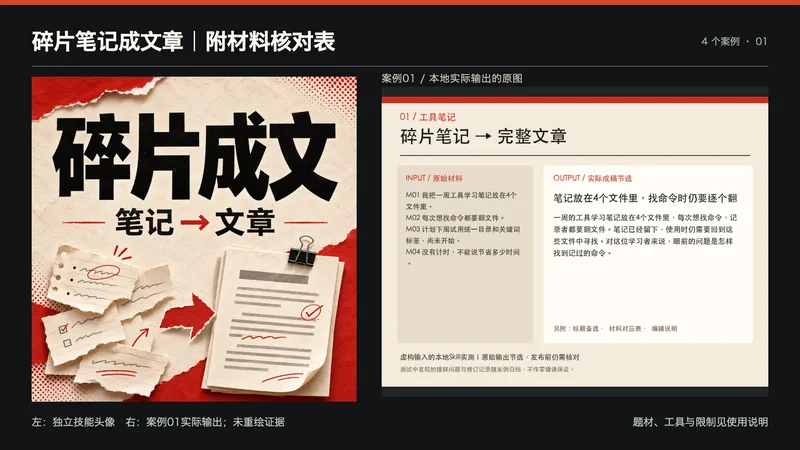
Target Audience: Creators who already have scattered notes, interview texts, or oral transcripts and want to organize them into articles. What You Need to Provide: Raw materials, target audience, purpose, length, and expressions you wish to keep. How It Works: Number the materials, distinguishing between factual statements, opinions, and plans; draft around a central thread, then re-check numbers, speakers, and evidence gaps. Final Delivery: 3 headline options, complete Chinese text, material correspondence table, and items to confirm with editing notes. Directly outputs copyable text by default; file saving depends on the runtime environment. Steps to Use: Paste materials and specify the audience and word count; read the article after running, check materials against the correspondence table, and revise before use. The core feature only requires a text model, GPT is recommended; current YouMind tests use GPT-6.1 Sol, and actual results depend on runtime configuration. The four display images are excerpts from real local Skill test outputs with fictitious inputs, formatted for presentation and not real customer cases; phrasing issues found in tests have been archived, and articles still require manual verification. The platform has completed one text case test, which does not guarantee stable success in all scenarios. Not Suitable For: Generating genuine interviews out of thin air, providing unprovided personal experiences, replacing fact-checking, or automatic publishing. Insufficient materials will shorten the content and list gaps without expanding to fabricate facts. Display Note: The first image shows a side-by-side layout of the independent Skill avatar and the actual output of case 01 for horizontal thumbnail display; it is not a new case, nor did an image-generation model redraw the evidence. The other three correspond to cases 02 through 04.

Viral Chinese Content Creator
Transform a topic, keyword, link, or scattered notes into engaging, shareable long-form Chinese content tailored for platforms like WeChat, Xiaohongshu, Zhihu, and Douyin to boost clicks, reads, and shares. Even with a vague direction, it identifies distinct angles by factoring in target audiences, real-world scenarios, and viral contexts. If you provide specific experiences, brand details, or restricted words, it respects those facts without altering them. The final draft goes beyond simple opinions by starting with relatable dialogues, actions, times, and objects, developing conflicts, causes, and deeper insights, and concluding with actionable solutions. Balancing click-through appeal with reader resonance, it generates multiple emotional, informative, and identity-driven titles, adapting the tone for your platform and word-count needs. The final output is a well-structured, natural-sounding Chinese article with specific talking points and reusable topic ideas, perfect for content creators, media operators, and teams producing ongoing brand content.
Information
- Version
- v2
- Last updated
- Runtime credits
- Usage-based
- Models
- Auto
- Use cases
- Writing & content
- What you get
- Article
