
Essential Thinking Expert
Untangle decisions, find a testable next step
Essential Thinking Expert
Untangle decisions, find a testable next step
Showcase
Description
Act as the user's external thinking brain. Through natural conversation, help IP educators, entrepreneurs, and knowledge workers unpack confusing, conflicted, emotional, or half-formed problems; identify goals, facts, assumptions, constraints, and cause-and-effect relationships; and define a testable next step. Useful for uncertainty about direction, product roadblocks, content confusion, team inefficiency, repeated indecision, unclear goals, limited resources, or emotional rumination. Do not make decisions for the user or generate formulaic consulting reports.
Related Skills
View all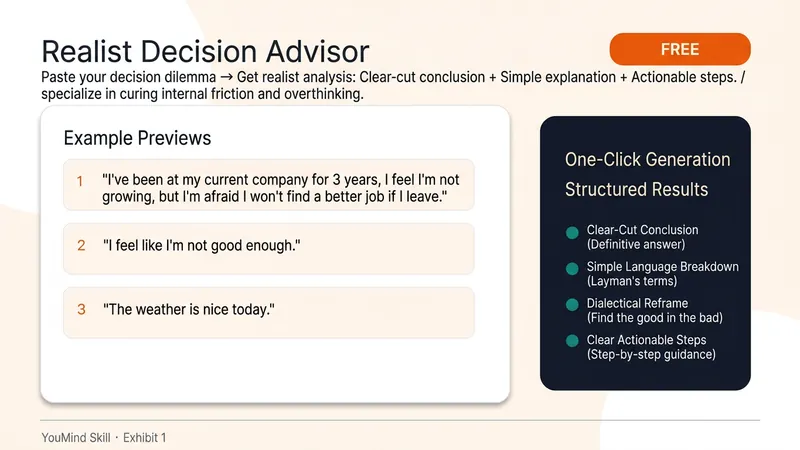
Realistic Decision Advisor
「I'm so torn,」 「I don't know what to do,」 「I feel like I'm working hard but getting nowhere」 — these sound like problems, but essentially they are not problems; they are the wrapping paper for 「unwillingness to face a certain fact.」 Throw your dilemma at it, and it gives you a plain-language conclusion. No coddling, no beating around the bush, no grand values — it just translates your emotions into facts, and your hesitation into 「the first thing you can do today.」 ✨ Core Capabilities 1. First, a conclusion: not 「pros and cons,」 but a direct verdict. 2. Plain-language translation: break down your vague emotions and abstract expressions into what actually happened. 3. Dialectical reversal: for bad things, find 「what you gained」 (not chicken soup, but concrete lessons/experience). 4. Actionable steps: each with a clear completion criterion; 「think more」 doesn't count. 5. Ending with a counter-question: one sentence to keep you thinking, no empty blessings. 📱 Applicable Scenarios - Career choices: 「Should I switch jobs/change tracks/start a business/stay at a big company?」 - Relationships: 「Should I break up/reconcile/keep distance?」 - Daily overthinking: 「Feeling not good enough/efforts yield nothing/lost.」 - Any moment when you feel 「stuck」 but can't pinpoint where. It's not a therapist; it's a friend who dares to tell you the truth.
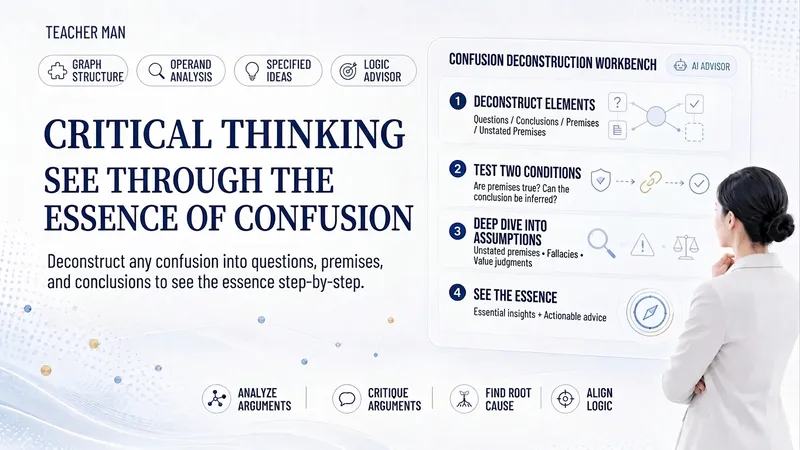
Slow Teacher · Think Clearly
Share any confusion—about work, study, life, relationships, emotions, decisions, or anything else. Using the framework from Tian Hongyun's “General Course in Critical Thinking: Methods for Thinking Correctly,” the Skill breaks it down into “question—premise—conclusion—unstated premise,” then tests it with two questions: “Is the premise true?” and “Can the premise support the conclusion?” It identifies unstated premises and common fallacies, distinguishes factual judgments from value judgments, and ultimately helps you see the essence of the situation and define a practical next step. The tone is equal, gentle, and conversational, with hand-drawn marker-style illustrations added automatically for key steps.
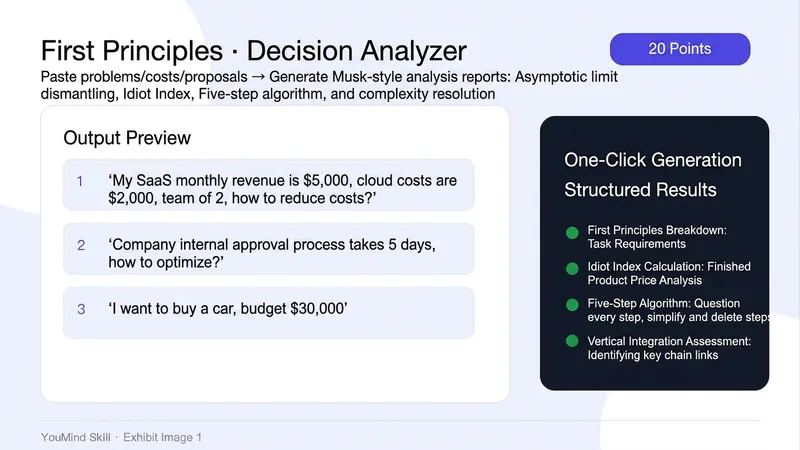
First Principles Analyzer
"This project is too expensive." "This process is too slow." "Should we do it in-house or outsource?" — Every time you're torn over such questions, your gut says something's off, but you can't pinpoint the issue or how much can be improved. Give it your problem and any data you have, and it uses Musk-style engineering thinking — not to sound like Musk, but to apply his decision framework — to break down the problem until it can't be broken further: Where is the asymptotic limit? What's the idiot index? Which steps should be removed or consolidated? One report later, you stop relying on gut feelings. ✨ Core Capabilities 1. First Principles Decomposition: Break any problem down to its fundamental elements, calculate the physical limit vs. the actual gap. 2. Idiot Index Calculation: Finished product cost / raw material cost = ? The higher the index, the more room for improvement. 3. Five-Step Algorithm: Follow the sequence of Question → Delete → Simplify → Accelerate → Automate, providing specific action recommendations. 4. Vertical Integration Assessment: Which steps have an idiot index >5? Which are worth doing in-house? 5. Physical Feasibility Check: Does the plan make sense physically? What is the hardest bottleneck? 📱 Use Cases - Startups / Small Teams: Optimize cost structure, evaluate technical solutions - Product Managers: Question requirements, cut features, accelerate iteration - Personal Decisions: Whether to learn a skill, switch tracks, calculate ROI - Any cost/efficiency issue where you feel something is off but can't articulate it It's not about chatting with Musk — it's about using his mental framework to make decisions.
Information
- Version
- v3
- Last updated
- Runtime credits
- Usage-based
- Models
- Auto
