
Duan Yongping Stock Selection
Good Business, Good Company, Good Price
Duan Yongping Stock Selection
Good Business, Good Company, Good Price
Showcase
Description
An A-share research assistant grounded in value investing. It analyzes business models, competitive moats, financial quality, and valuation to help investors identify outstanding companies with long-term compounding potential.
Related Skills
View all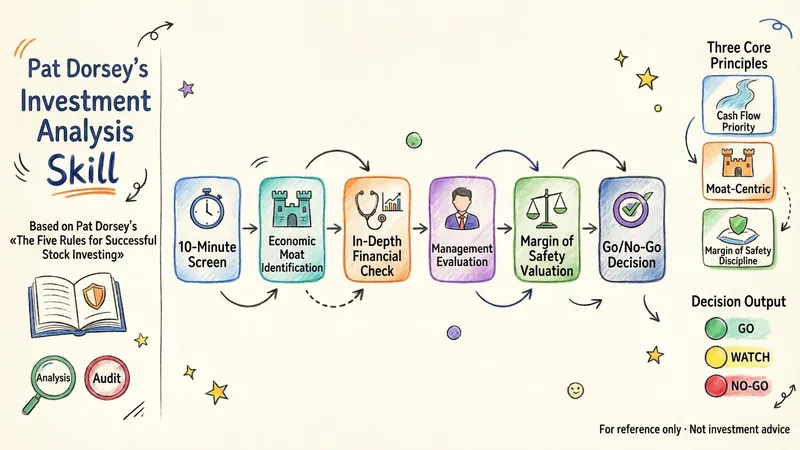
Dorsey Investment Analyzer V2
A structured investment analysis Skill based on Pat Dorsey's 'The Little Book That Builds Wealth' methodology. It provides users with Go/No-Go investment decision assistance through a six-phase workflow (Fast Screening → Moat → Financial Health Check → Management Assessment → Valuation → Decision). Core features: Cash Flow Priority, Moat Centricity, Margin of Safety Discipline, Dual-Core Adversarial Engine (Analysis Executor + Quality Auditor), Strict Step-by-Step Mechanism. Suitable for individual stock investment analysis, quick screening, complete investment report generation, and other scenarios.
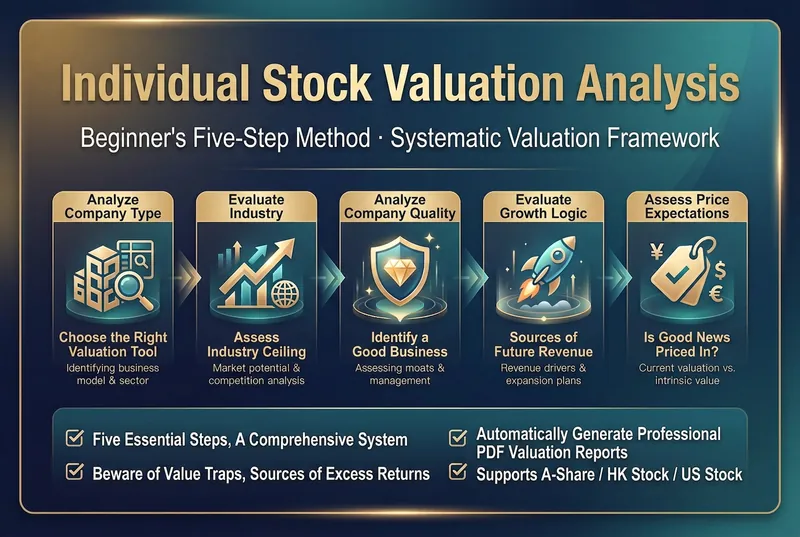
Stock Valuation Analysis
The two biggest fears in stock investing are buying a bad company and overpaying for a good one. Many investors, when they get a stock, first check its PE and PB ratios, compare them with peers, and draw conclusions—this is the biggest misconception in valuation. • 📝 Focusing only on numbers, not the company: Is a low PE always cheap? A low PE for a cyclical stock at the peak of its cycle can actually be a trap; for a growth stock, a high PE isn't necessarily expensive. With the wrong yardstick, you can't measure correctly. • 🤔 Discussing valuation without considering the industry: A contract manufacturer and a tech platform may both have a PE of 20, but their meanings are vastly different. Without first understanding the industry ceiling and business model, any valuation number is a castle in the air. • 📉 Ignoring value traps: A low valuation could be a sign of fundamental deterioration, not an investment opportunity. If the company quality is poor, no matter how 'cheap' it looks, it could still be a trap. • 🎯 Overlooking expectation gaps: Stock price movements don't depend on the absolute level of performance, but on the relative difference between performance and market expectations. If profits rise 30% but the market expected 50%, the stock can still fall. • 📊 Being too precise in valuation can itself be a mistake: Valuation is a range, not an exact number. Better to be roughly right than precisely wrong. This skill is designed to solve these problems. It is based on the 'Five-Step Valuation Method' framework and uses a systematic five-step process that cannot be skipped. It guides you from company type, industry ceiling, company quality, growth logic, and price expectations, progressing step by step to complete a full, professional individual stock valuation analysis. Finally, it outputs a structured valuation report and a downloadable PDF file. It applies to A-shares, Hong Kong stocks, and U.S. stocks.
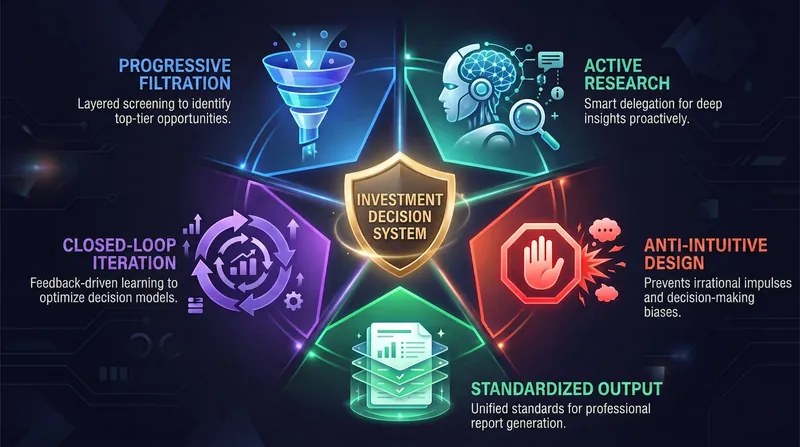
Stock Picking Decision Engine
Every investor has experienced these moments: • 📝 Impulse buying that ends in regret — you see a stock rise for three days, your hand itches, you place an order, and end up buying at the top. • 🤔 Deciding without enough research — you read one analysis article and think you 'get it,' but you can't even explain how the company makes money. • 💸 Not knowing when to sell — you won't sell when you're winning, you can't accept selling at a loss, and in the end you get hurt on both sides. • 🎭 Being swept up by market sentiment — you panic when others panic, get greedy when others get greedy, and forever chase rallies and dump stocks on declines. • 🔄 Repeating the same mistakes — with no review system, every trade starts from scratch. The investment decision system was created to solve these problems. It is not a tool that helps you find reasons to buy; it is a decision brake system that helps you identify the moments when you 'shouldn't buy.' There is only one core principle: a good company ≠ a good stock.
Information
- Version
- v3
- Last updated
- Runtime credits
- Usage-based
- Models
- Auto
