
Test Paper Cleanup & Review
Turn readable questions into practice sheets
Test Paper Cleanup & Review
Turn readable questions into practice sheets
Showcase
Description
After a test paper is recognized, are question numbers skipped, options missing, or answers mismatched? This Skill helps turn readable test paper images, scanned pages, or existing OCR text into an easy-to-edit practice sheet, while listing items that need to be checked separately. You’ll get: ① Editable practice sheet: preserves sections, original question numbers, options, and answer blanks. ② Source answer table: matches answers from the provided materials by section and question number, with unmatched answers listed separately. ③ Error and omission review list: flags suspected missing questions, missing options, unclear symbols, and matching conflicts. ④ Processing scope notes: clearly states which pages were read and which have not yet been processed. When the original page is visible, the content is checked against the source. When only OCR text is available, the Skill checks structural issues only and does not guess or fill in missing content. For questions about identifying incorrect characters, incorrect options are preserved without changing the intended meaning. Suitable for teachers, parents, and people organizing study materials. For the first run, processing 1–3 pages is recommended. The output is provided as copyable Markdown text. Reading quality depends on the original image quality and the host’s capabilities. Zero errors are not guaranteed. The Skill does not solve questions, grade answers, or automatically generate Word attachments. The examples use self-created materials and contain no real student information.
Related Skills
View all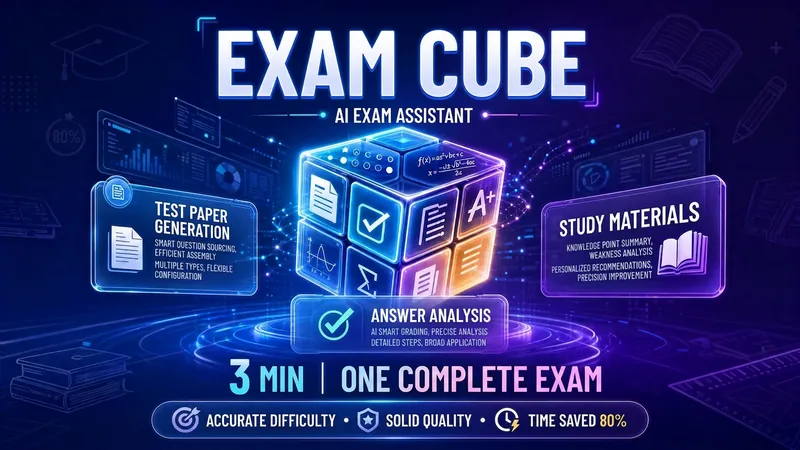
Exam Cube
Exam Cube is an intelligent exam generation system designed specifically for college teachers. Simply provide your syllabus, past exam papers, and other necessary materials, and it will automatically generate: ✅ Professional Exams - Rich question types, graded difficulty, full coverage of key points, reflecting higher-order, innovative, and challenging standards ✅ Detailed Answers - Multiple solution methods, scoring criteria, estimated score rate, difficulty grading ✅ Review Materials - Key points summary, formula sheets, practice problems, complementary to the exam without repetition 🔍 Built-in Quality Audit to Ensure Professional Standards · Coverage Check: Ensures 100% coverage of core syllabus knowledge points · Difficulty Distribution Verification: Automatically calibrates to 30% easy / 50% medium / 20% difficult · Three-Document Cross-Checking: Consistent terminology and logical rigor across exam, answers, and review materials · Duplicate Detection: Avoids similarity with past exams, ensures A/B papers have ≥70% difference 🎓 Adaptable to All Disciplines, Meeting College Standards · STEM Fields: Emphasizes formula derivation, unit conventions, engineering applications · Humanities: Focuses on argument structure, source citation, critical thinking · Medicine/Law: Case analysis conforms to professional standards and ethics · Arts/Design: Practical assignments with descriptive scoring criteria 🎯 Precise Difficulty Control, Reflecting Higher-Order, Innovative, and Challenging Standards · Average score precisely controlled between 75-85 points, reflecting student performance levels · Difficult questions demonstrate higher-order thinking (cross-chapter synthesis), innovation (new context application), and challenge (deep understanding) · Adapts question strategy based on school characteristics and student background 🔄 Flexible Iteration and Optimization, Eliminate Repetitive Work · Local adjustments: Single question replacement, chapter question count adjustments, overall difficulty fine-tuning · A/B paper generation: Consistent difficulty, aligned key points, content difference ≥70% · Tolerance for incomplete materials: Generate questions from available materials, then teachers can filter Say goodbye to late-night exam creation! Let teaching return to teaching itself! Complete in 3 minutes what traditionally takes 6-8 hours, improving efficiency by 95%+ A tailored intelligent exam generation system for college teachers, designed to solve the pain points of traditional exam preparation: time-consuming, difficult to balance professional standards and personalized needs. This system intelligently analyzes key point distribution, identifies subject characteristics, and quickly generates a professional, standardized exam paper, detailed answers, and complementary review materials based on your provided syllabus, textbooks, past exams, and other materials. You only need to input course information and teaching materials, and the system will automatically extract core knowledge points, accurately construct the exam according to preset or customized parameters such as question type, difficulty, and score distribution. It ensures comprehensive coverage of key points, reasonable difficulty distribution, effectively avoids question repetition, and supports generating questions with higher-order, innovative, and challenging standards, truly reflecting the depth and breadth of college teaching. The system features a powerful quality audit mechanism that performs multi-dimensional checks on generated exams, including key point coverage, difficulty distribution, question repetition, and language standardization, ensuring rigorous and error-free content. It also conducts cross-checking among the three documents (exam, answers, review materials), ensuring consistent terminology and complementary content, forming a logically tight and professionally reliable set of assessment materials. Furthermore, the system supports flexible iterative optimization. You can adjust exam details at any time, such as replacing specific questions, adding or reducing chapter question counts, or fine-tuning overall difficulty. Moreover, it can generate A/B papers with consistent difficulty and key point structure based on the current exam, meeting diverse examination needs, freeing college teachers from tedious exam preparation work and allowing them to focus on improving teaching quality.
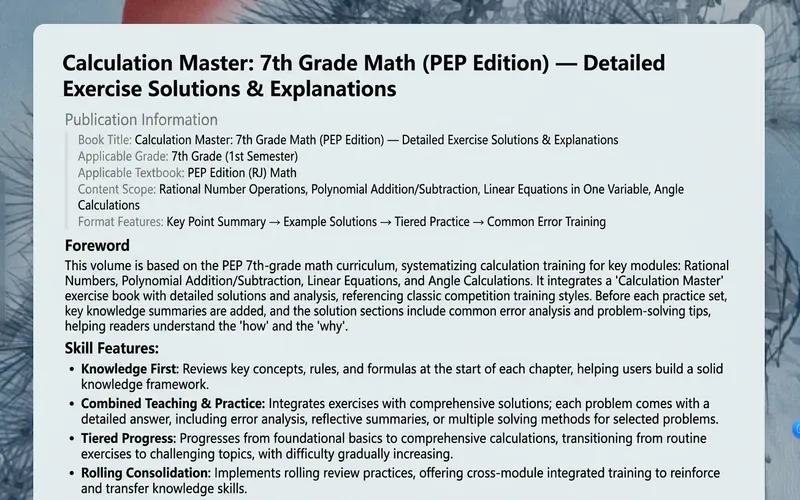
Publishing Skill
Transform scattered exercises, answers, handouts, and teaching notes into a well-structured, publication-ready supplementary book. This is not 'AI organizing your documents'. It is a five-step publishing-grade workflow: Data inventory and multi-source reading → Target book style analysis → Content integration and structure design → Chapter-by-chapter writing → Full book quality check and delivery. Each step involves professional judgment, not a one-time prompt generation. Core capabilities: • Multi-source data integration: Extract exercises, answers, knowledge points, and teaching sections from PDFs, images, and documents. Identify their relationships (which is the question, which is the answer, which is the style reference) and reorganize them into a complete book. • Internalized supplementary book structure: Built-in typical organization logic—knowledge point review → typical example explanation → leveled practice → answer key with detailed solutions → error analysis/reflection summary/guidance/multiple solution methods → rolling review. • Formula repair: Mathematical formulas extracted from PDFs may become garbled. The skill infers the original expression from context and rewrites it in standard LaTeX. This is one of the most painful parts of publishing supplementary books. • Question-answer matching and merging: Automatically match exercises and answers scattered across different files. Supports two organization modes: integrated instruction and practice, or separate question and answer sections. • Publication-grade structure: Output includes title page, preface, table of contents, chapter-by-chapter text (knowledge points + practice + detailed solutions + teaching sections), and afterword. Use cases: - Middle school math teachers organize years of accumulated exercise handouts into formal supplementary books. - Supplementary book authors/editors quickly integrate scattered materials into a manuscript. - Training institution internal handouts upgraded to standardized publications. Upload your materials, tell it the positioning of the target book, and let it handle the rest. The output is a high-quality Markdown manuscript, including preface, table of contents, chapter-by-chapter content, detailed solutions, and explanations.
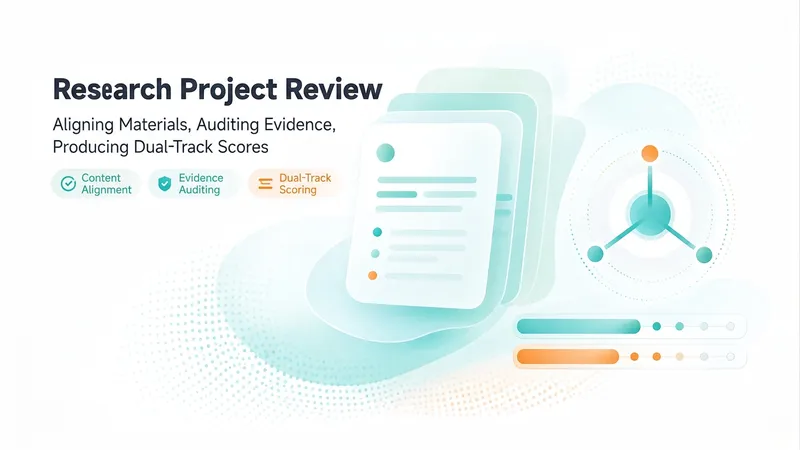
Research Review Assistant
An expert assistant for university-level research project reviews. Provide the materials for N projects in a given category. Each project includes three types of files: a proposal, a form-check summary or interim review form, and supporting evidence. File names may be scrambled, mismatched, or changed, and files may be DOCX, XLSX, PDF, or image files. Supporting evidence may be bundled into one file or provided as multiple separate files. This Skill then completes the following steps: ① Content-anchor alignment—extracts the project or center name, principal investigator, affiliated school, and project period from within the documents; matches the three-part file set for each project; and flags items requiring review when file names do not match their contents. ② Evidence normalization—whether bundled or separate, breaks materials into “atomic evidence items” and creates a coded ledger for each item with one of four status labels: complete, needs verification, missing, or questionable. This avoids judging the strength of the evidence by file count. ③ Three-dimensional item-by-item audit—evaluates each piece of evidence for relevance, authenticity, and completeness, then reconciles it against the commitments in the proposal and the self-reported results in the interim review form. ④ Dual-track scoring and comparative ranking—uses the five weighted criteria in Appendix 2 as the reporting standard and the five dimensions of the interim review as a reference standard. The two systems remain independent and are not combined, and all projects are ranked and grouped into tiers. ⑤ Delivers a structured review draft with “score + review comments” that can be pasted directly into the official form, and can generate an interactive scoring webpage when needed. Huali’s current standards are used by default. Users can confirm or revise the criteria, weights, and reference materials before work begins, or upload replacements. There are two confirmation checkpoints: first for alignment and the evidence ledger, then for scoring and ranking. When materials cannot be identified, the user is prompted to confirm. For project completion reviews, two additional hard requirements apply: first, the correspondence between the proposal’s expected outcomes and the documented evidence must be verified. If the evidence does not include an expected outcome listed in the proposal, the project automatically fails. Second, template issues are distinguished between using the completely wrong template, which results in failure, and partial formatting inconsistencies, which result in only a small deduction.
Information
- Version
- v2
- Last updated
- Runtime credits
- Usage-based
- Models
- Auto