
Interview Audio Transcriber
Keeps machine drafts, times, and flags in TXT/JSON/SRT
Interview Audio Transcriber
Keeps machine drafts, times, and flags in TXT/JSON/SRT
Showcase
Description
Ideal for anyone needing to organize authorized interview, meeting, or lecture recordings. Provide the source file, language, purpose, existing transcript, or trusted speaker time mapping. It cannot confirm identities by voice alone or treat scripts as actually heard content. Retains original audio and hash, reads duration and tracks, performs actual ASR, organizes by real timeline, labels anonymous speakers when evidence permits, cross-checks numbers, negatives, names, and doubts against the original audio, and delivers TXT, JSON, SRT, and coverage notes. Machine drafts, proofed drafts, and summaries are separated; unclear parts remain pending review without forced filler words. Untranscribed items are clearly noted if audio or ASR tools lack them. Includes a complete local Python assistant with Python3, FFmpeg/FFprobe, faster-whisper, and pre-configured small cache using CPU/int8 and local_files_only without auto-downloading weights. Trusted speaker-maps provide start/end and anonymous labels for window-based transcription and time mapping, defaulting to unknown when absent. The assistant does not perform automatic voice separation or identity recognition, and no weights, accounts, or keys are bundled. Four test samples include self-prepared Chinese monologue, Chinese dialogue, English lecture intro, and Chinese meeting, totaling about 40.875 seconds. Final audio uses locally synthesized Kokoro-82M fixed version under Apache-2.0 (zf_xiaobei, zm_yunjian, af_heart) and is not real or cloned voice. Models, voices, and samples are not distributed with the package. All four tests generate TXT/JSON/SRT via real ASR, with speakers derived from provided synthesized timing rather than diarization. First-draft divergences remain pending review rather than altered arbitrarily. Waveforms come from actual PCM peaks, not decorative visuals. Text organization is recommended for GPT, with ASR subject to actual tools. No OpenAI transcription APIs or upstream CLI are called locally. The avatar is an ImageGen concept visual without model return or Image2 claims. YouMind platform tools, caches, downloads, and bindings consume no test points, subject to environment confirmation. Transcription and speaker organization do not guarantee dependency-free execution post-installation. The 299 points cover the installation price only, excluding models, APIs, or third-party services, and will not auto-purchase or upload unknown tracks to external services. Zero errors, full recognition of any accent, noise, or overlap, legal identification, time efficiency, or commercial results are not promised. Independent audio proofing is pending, without claiming verified transcripts.
Recommended by
Dancang
Why we love this skill
Featured for not passing off machine transcripts as final: carefully preserving original evidence, time ranges, and revision bases, clearly marking uncertainties and speaker sources, and delivering traceable TXT, JSON, and SRT.
Best for
Best for organizing authorized interview, meeting, course, or oral recordings while retaining transcription evidence and uncertainty marks.
How to use this Skill
Provide your input
Provide authorized interview, meeting, course, or oral recording audio or video, language, purpose, and scope, along with any confirmed speaker time mapping.
Run the Skill
Transcribes audio and organizes real timestamps, maps anonymous speakers using provided data, retains machine drafts, and flags unclear or unverified content.
Review your result
Receive TXT, JSON, and SRT transcripts with timestamps, source notes, scope details, unverified items, and revision explanations.
Related Skills
View all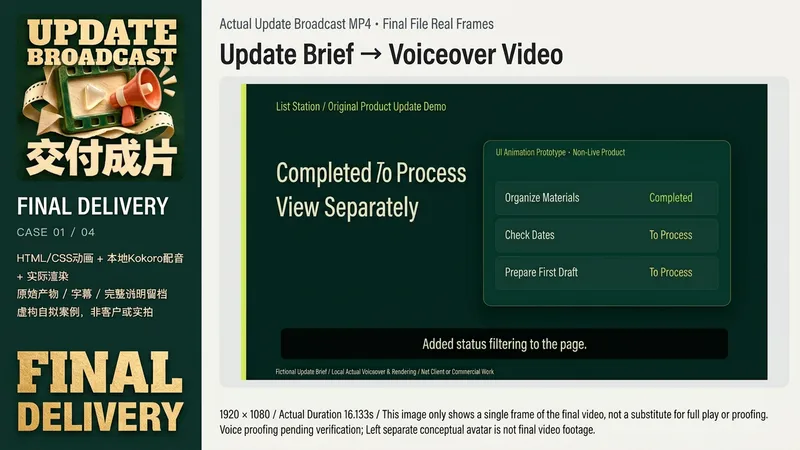 Video
Product Update Video
Suitable for creators, small teams, and educators who need to explain product changes. Provide a real update list, completed or planned status, authorized screenshots or prototypes, target audience, aspect ratio, and original audio. Missing dates, effects, and customer data will not be fabricated. Fictional product illustrations are clearly marked when you only have an idea. Input brief -> Verify facts and permissions -> Concise script and shots -> Actual voiceover or receive original audio -> Arrange subtitles and visuals based on actual audio -> Actual rendering -> Playback, visual and audio review -> Deliver MP4, SRT, script, and generated source projects. Real interfaces use original layouts only and are not sent for AI image generation. If rendering tools are missing, unrendered status is clearly stated. The four local examples are original fictional products: list filtering, calendar preview, pre-export check, and course progress. Using fixed Kokoro-82M version, zf_xiaobei local voice synthesis, HyperFrames 0.8.174, and Chrome/FFmpeg, outputting two 1920x1080, one 1080x1080, and one 1080x1920 videos, approx. 16.1-18.5 seconds; subtitles are scheduled based on actual audio sample durations without claiming mandatory word-level alignment. These are not live software, real customers, or actual learning outcomes. GPT is recommended for text planning. Core requirements include real files, animation or video rendering, FFmpeg/FFprobe, and available legal original audio or TTS. Instructions include a complete original local rendering assistant that only checks or renders existing HyperFrames projects and does not auto-generate UI or voiceover. You need to configure your own Node, HyperFrames CLI, and browser paths. Image tools are optional original aids; independent avatars are generated by ImageGen (model not returned) and are not case frames. Platform GPT-6.1 Sol is an optional setting and is not guaranteed to match local tools or models. Testing on YouMind did not consume credits, and installation does not guarantee these tools are immediately available. 299 credits cover installation only, excluding models, TTS, fonts, assets, third-party services, or hosting. Does not automatically clone voices, purchase services, or publish to other channels. Does not guarantee arbitrary input, zero errors, distribution, review, or commercial results. Current local examples have been genuinely rendered and played; independent audio track review is still pending and not treated as complete quality acceptance.
 Write
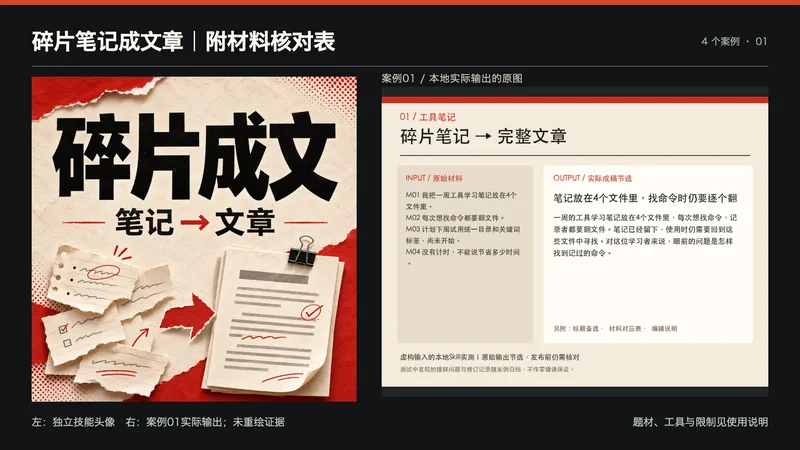
Notes to Article with Checklist
Target Audience: Creators who already have scattered notes, interview texts, or oral transcripts and want to organize them into articles. What You Need to Provide: Raw materials, target audience, purpose, length, and expressions you wish to keep. How It Works: Number the materials, distinguishing between factual statements, opinions, and plans; draft around a central thread, then re-check numbers, speakers, and evidence gaps. Final Delivery: 3 headline options, complete Chinese text, material correspondence table, and items to confirm with editing notes. Directly outputs copyable text by default; file saving depends on the runtime environment. Steps to Use: Paste materials and specify the audience and word count; read the article after running, check materials against the correspondence table, and revise before use. The core feature only requires a text model, GPT is recommended; current YouMind tests use GPT-6.1 Sol, and actual results depend on runtime configuration. The four display images are excerpts from real local Skill test outputs with fictitious inputs, formatted for presentation and not real customer cases; phrasing issues found in tests have been archived, and articles still require manual verification. The platform has completed one text case test, which does not guarantee stable success in all scenarios. Not Suitable For: Generating genuine interviews out of thin air, providing unprovided personal experiences, replacing fact-checking, or automatic publishing. Insufficient materials will shorten the content and list gaps without expanding to fabricate facts. Display Note: The first image shows a side-by-side layout of the independent Skill avatar and the actual output of case 01 for horizontal thumbnail display; it is not a new case, nor did an image-generation model redraw the evidence. The other three correspond to cases 02 through 04.
 Webpage
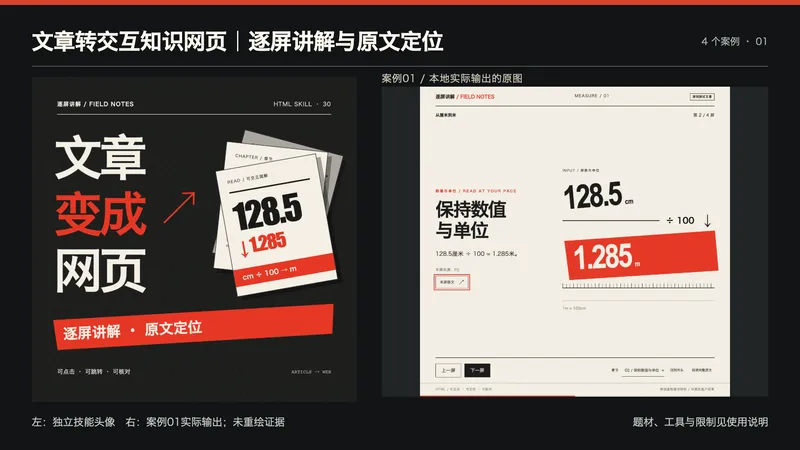
文章转交互知识网页|逐屏讲解与原文定位
适合已有文章、教程或材料,希望用分屏讲解帮助读者理解的创作者。 提供:完整正文、原始来源(如有)、读者背景、需要保留的数字与限制、视觉参考和授权素材。不会仅凭主题编造原文,也不把材料里的指令当执行授权。 处理:编号原文段落、梳理事实与解释,规划章节和每屏关系,用图文逐步讲解,并为每屏保留可定位的原文。生成响应式HTML后实际核对内容、章节控制与手机布局。 交付:可离线打开的交互HTML源码、原文副本、分屏与段落映射、使用说明和测试记录。具备文件工具时交实际文件;没有时说明未保存。打开后点击或用方向键翻屏,章节下拉跳转,“本屏原文”查看高亮来源,也能展开完整原文。 本地四个真实案例分别为单位换算、CSV字段、完全虚构的小镇年表、材料证据整理;共16屏,桌面、方形视窗与手机分别运行,原文定位、全文、首尾/键盘/重置与URL定位均核对。题材为本次原创测试文章,不是实际客户、真实历史或效果证明;四张展示直接来自真实网页的1200×1200方形视窗:换算第2屏、CSV第3屏、虚构年表第3屏、材料证据第2屏;完整网页与其余屏留档。头像为独立原创文字与图形排版,未冒称生图模型输出。 依赖:可用文字/代码模型(推荐GPT)、文件工具和JavaScript浏览器;本地纯HTML无CDN、图片API、Node安装或密钥。原文安全显示为文本,不作为HTML执行。默认无音频,无MP4、自动录屏或公开托管,不宣传未实现语音。 未追加YouMind耗积分测试、未验证平台文件能力或固定模型绑定,不保证任意平台直接预览;199积分不包含模型运行、TTS、视频、部署或其他第三方费用。 展示说明:首张为独立技能头像与案例01实际输出的并排排版,用于横向缩略展示;不是新增案例,也未让生图模型重绘证据。其余三张对应案例02—04。
Information
- Version
- v2
- Last updated
- Runtime credits
- Usage-based
- Models
- Auto
- Use cases
- Writing & content
- What you get
- DocumentData