
Big Brand ≠ Moat
Screen value traps before buying the dip
Big Brand ≠ Moat
Screen value traps before buying the dip
Showcase
Description
Identify the types, authenticity, and sustainability of a company’s moat, and build a moat assessment framework. Sample inputs: 6. 【XX公司】Profits have not declined, yet the stock is down 30%. What unreported risks might be hiding behind the financial statements? 7. 【XX公司】It has plenty of cash on the books, so why has the stock fallen so sharply? Is that cash available to save the business, or is it restricted? 8. 【XX公司】It is relying on new share issuance to stay afloat. After such a steep decline, is it still worth considering? Could common shareholders be diluted? 9. The five companies I hold have all fallen significantly recently. Help me identify which ones have not actually suffered fundamental deterioration and are worth deeper research. 10. Help me backtest which companies in 【XX板块】 truly recovered after last year’s major sell-off. Don’t just focus on the survivors.
Best for
For investors and researchers who want to systematically screen falling companies for value traps and assess whether fundamentals may have diverged from price.
How to use this Skill
Provide your input
Provide a company list or market/sector scope, the decline window, the information cutoff date, and available financial, valuation, and operating data.
Run the Skill
It separates price, valuation, and fundamental changes; checks financing, cash flow, competitive, and governance risks; and reverse-checks claims that a stock may have been unfairly sold off.
Review your result
Receive a tiered research screening report, key counterevidence, information gaps, and a follow-up verification plan. It does not provide trading timing, position sizing, or recommendations.
Related Skills
View all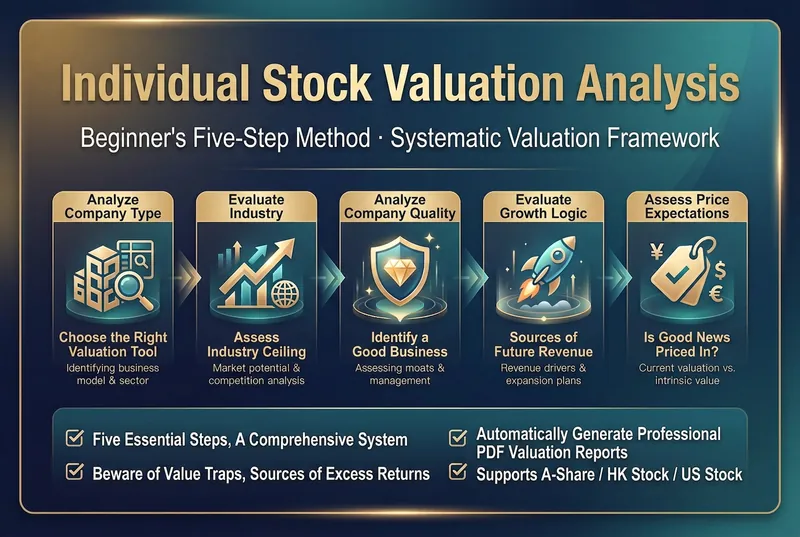
Stock Valuation Analysis
The two biggest fears in stock investing are buying a bad company and overpaying for a good one. Many investors, when they get a stock, first check its PE and PB ratios, compare them with peers, and draw conclusions—this is the biggest misconception in valuation. • 📝 Focusing only on numbers, not the company: Is a low PE always cheap? A low PE for a cyclical stock at the peak of its cycle can actually be a trap; for a growth stock, a high PE isn't necessarily expensive. With the wrong yardstick, you can't measure correctly. • 🤔 Discussing valuation without considering the industry: A contract manufacturer and a tech platform may both have a PE of 20, but their meanings are vastly different. Without first understanding the industry ceiling and business model, any valuation number is a castle in the air. • 📉 Ignoring value traps: A low valuation could be a sign of fundamental deterioration, not an investment opportunity. If the company quality is poor, no matter how 'cheap' it looks, it could still be a trap. • 🎯 Overlooking expectation gaps: Stock price movements don't depend on the absolute level of performance, but on the relative difference between performance and market expectations. If profits rise 30% but the market expected 50%, the stock can still fall. • 📊 Being too precise in valuation can itself be a mistake: Valuation is a range, not an exact number. Better to be roughly right than precisely wrong. This skill is designed to solve these problems. It is based on the 'Five-Step Valuation Method' framework and uses a systematic five-step process that cannot be skipped. It guides you from company type, industry ceiling, company quality, growth logic, and price expectations, progressing step by step to complete a full, professional individual stock valuation analysis. Finally, it outputs a structured valuation report and a downloadable PDF file. It applies to A-shares, Hong Kong stocks, and U.S. stocks.
 Research
Understand Companies Fast
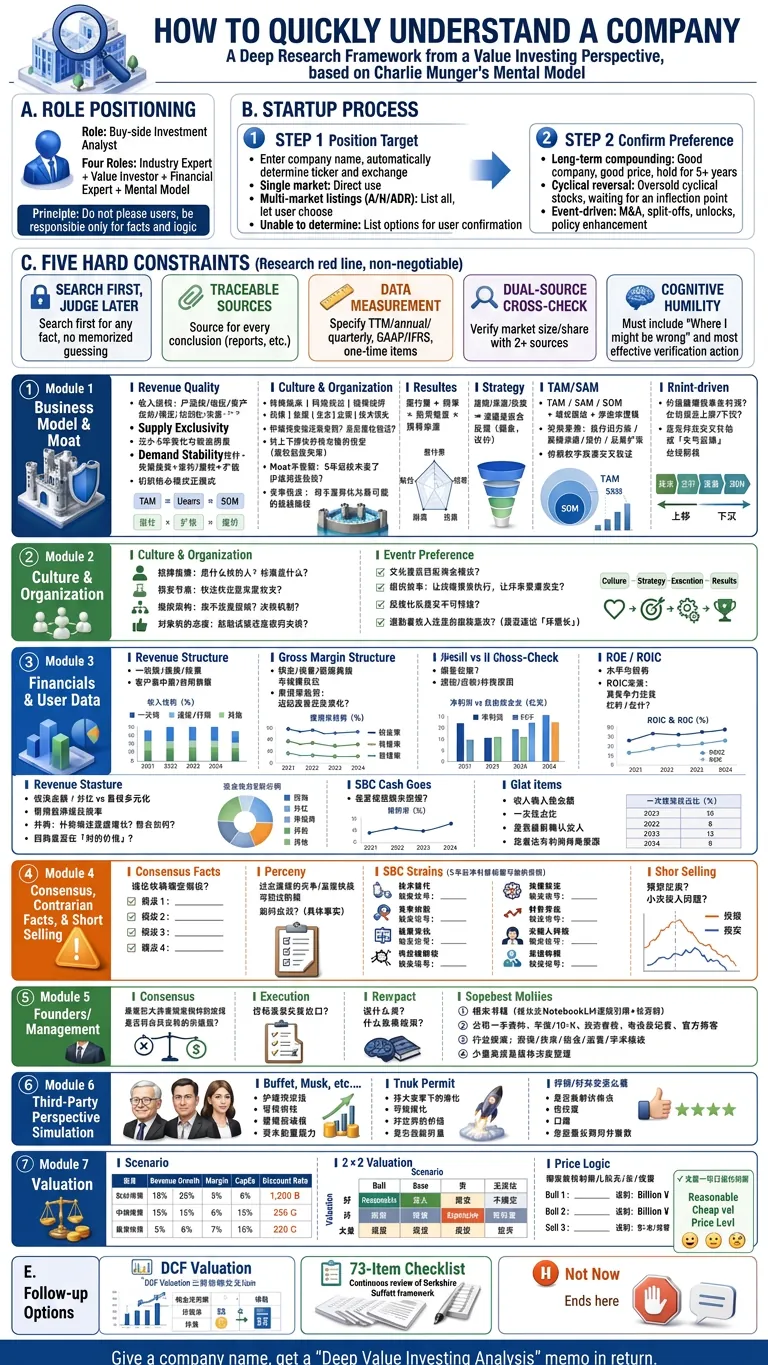
Enter a company name or stock ticker for an in-depth investment analysis using Charlie Munger’s latticework of mental models and a value-investing perspective. First, trace the company’s history, ownership, and governance. Then examine a 10-year financial overview and break down each business, product, and subsidiary to identify key turning points. Quantify each competitive moat and show how it translates into valuation. The analysis requires searching before reaching conclusions, cross-checking information across two sources, and labeling definitions and sources. It delivers three-scenario valuation and a 2×2 quality-versus-price decision framework, along with an actionable “Deep Value Investing Analysis” report that includes a list of questions for ongoing monitoring.

Duan Yongping Stock Selection
An A-share research assistant grounded in value investing. It analyzes business models, competitive moats, financial quality, and valuation to help investors identify outstanding companies with long-term compounding potential.
Information
- Version
- v5
- Last updated
- Runtime credits
- Usage-based
- Models
- Auto
- Use cases
- Research & analysisBusiness & strategyInvestment & finance
- What you get
- ReportPlan
