Xiaoxiaodong × Journal × P089
By Xiaoxiaodong
Xiaoxiaodong × Journal × P089
By Xiaoxiaodong
Description
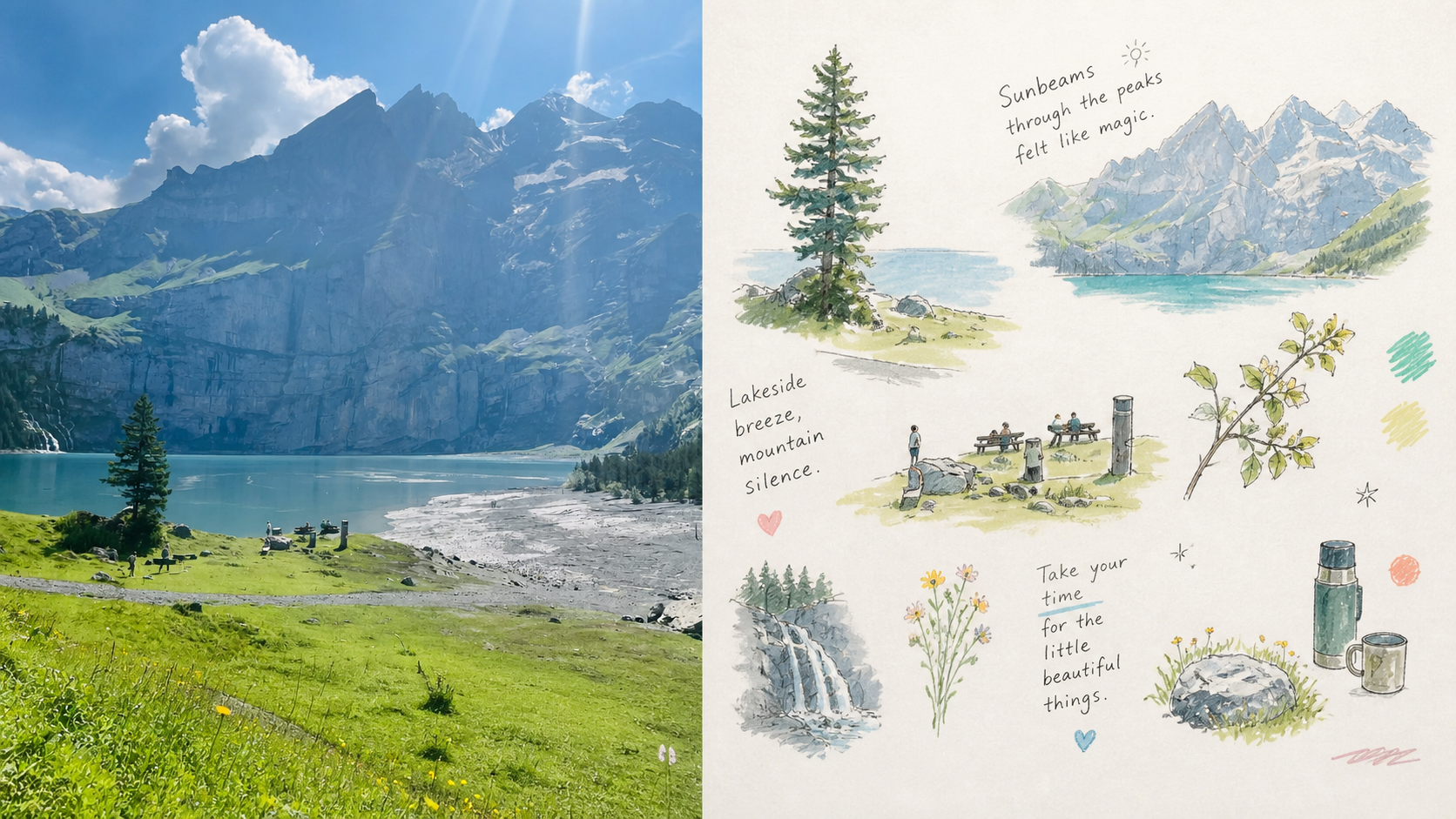
P089 has been experimenting with an AI image style I really love lately. It doesn’t simply turn a photo into a full-bleed scene. Instead: The top half preserves the original photo, while the bottom half automatically creates a set of “floating lifestyle vignette journal” elements. I’ve tried it with all kinds of completely different images: 🥐 Comforting brunches 🌸 Wild roadside flowers 🎒 Everyday essentials 🐱 Sleeping cats 🛋️ Cozy rooms It makes the feeling of everyday life instantly more vivid. The most interesting part is that the AI doesn’t rigidly recreate one entire scene. Instead, it breaks the photo into several independent vignettes floating as scattered details: a central subject paired with nearby food, plants, still-life objects, clothing patterns, and other close-ups. Loose, childlike fine lines, watercolor, and colored pencil add gentle touches, while handwritten reflections on daily life and doodled symbols are woven throughout. The whole page feels relaxed, tender, and full of breathing room.
Showcase
1 / 4
Related Skills
View all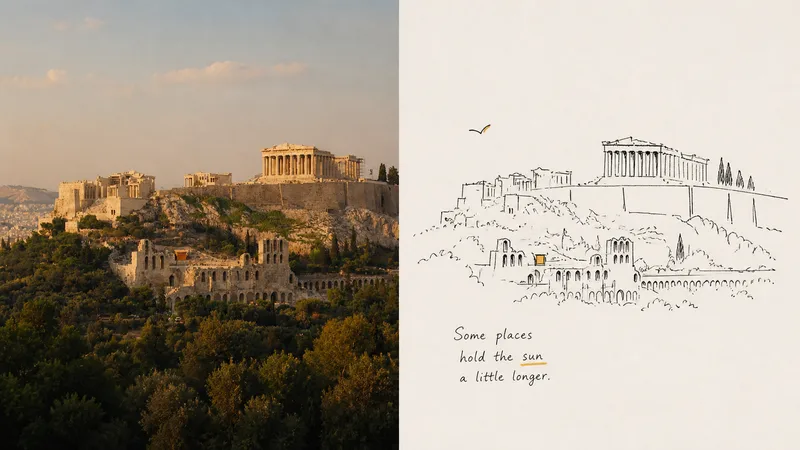 Image
ImageXiaoxiaodong · Line · p062
p062 is for: illustrators / independent publication layout enthusiasts / people who love a spontaneous “sketchbook diary” style of recording Core pain point: AI-generated “line art” always has a boringly precise quality—the lines are too straight and too smooth, like vector graphics traced in CAD, with none of the breath and spirit of drawing by hand on paper. I’ve always felt that the best drawings aren’t necessarily the most accurate. They’re the ones with a relaxed quality, as if you casually sketched a couple of lines and stopped. The most ingenious part of these prompts is that they push AI to learn **“smart clumsiness”**: Run an image through them, and the resulting lines aren’t stiff digital outlines. They look as if you pulled a pocket fountain pen from your bag and casually drew on a napkin or in a sketchbook—every slight hand tremor, loose connection, and even the trace of a mistaken line being corrected remains visible. ⚬ Top half: preserve the original image and apply a layer of transparent, independent-publication photography color grading. ⚬ Bottom half: discard the complexity of the scene and use only ultra-minimal black hand-drawn lines to capture the key person or action. ⚬ Almost no color is used across the image: select the most noticeable color from the original photo—such as a corner of someone’s clothing or a roadside flower—and place it in a tiny area, like a flashback. Everything else is made up of large areas of clean, pale background and negative space. ⚬ One or two slightly quirky, humorous handwritten notes sit beside the image, following the composition. They feel both like snippets from a personal diary and like an interior illustration from an independent art magazine. From a distance, the layout looks highly refined; up close, it’s full of gentle, lively handmade marks.
 Image
Imagexiaoxiaodong P121 | Doodle
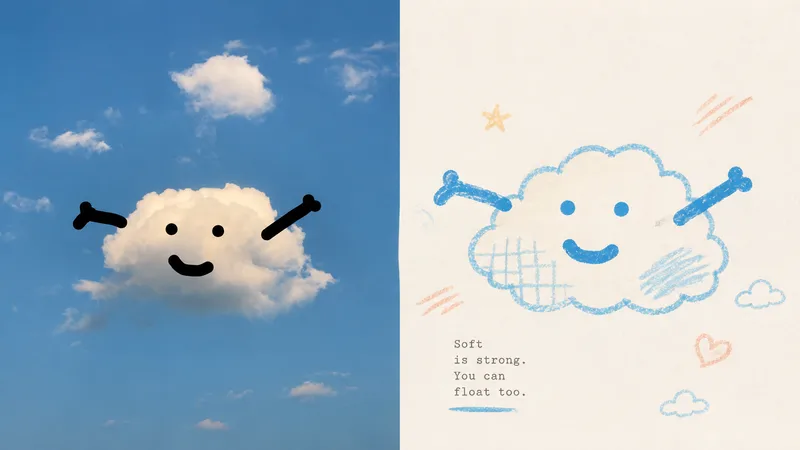
An everyday photo may contain a compelling pose or relationship, yet ordinary composition and a cluttered background can distract from it. Panel 121 preserves the photo’s authentic identity, re-extracts the most recognizable subject, and uses relaxed marker-style doodles, edited handwritten text, and generous negative space to turn a slice of life into a finished work. Best for People, everyday objects, and scenes that need to become independent magazine or lifestyle editorial illustrations. You want to preserve the subject’s outline, pose, and narrative relationships while actively removing most of the background and secondary objects. You like the relaxed feel of naive hand-drawing, while still caring about the mature arrangement of graphics, text, and empty space. You need consistent delivery formats, including top-and-bottom, left-and-right, design-only, multiple aspect ratios, wallpaper, or catalog batches. What it solves Even ordinary photos can establish a new visual focus through reduction, rearrangement, cropping, and changes in scale. Graphics and text first share an invisible grid, visual axes, and a reading path, avoiding “one line of text above, one person below.” Graphic elements occupy only a small proportion of the composition. Negative space provides distance, pauses, and breathing room instead of being filled with random small icons. Comparison images use two strict 50:50 areas and are generated directly from the original image in this run, avoiding a third band and secondary stylization.
 Image
Imagexiaoxiaodong P116 | Doodle
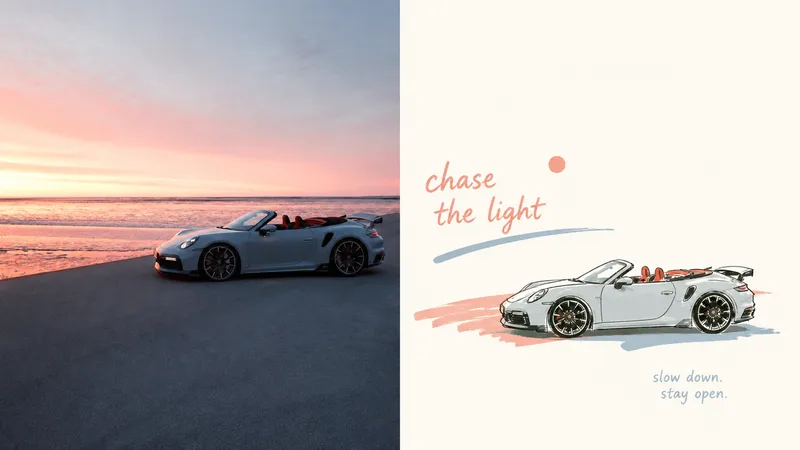
Some photos are truly moving not because of how much information they contain, but because of a single subject, a particular pose, a few colors, and the emotion captured in the image. Panel 116 keeps the real photo in the upper half, then translates the lower half into pastel crayon doodles on an extremely light paper surface: coarse-grain outlines, a few soft color blocks, minimal symbols, and small-scale subjects that leave room to breathe. Ideal for these situations You want to preserve the photo’s identity and natural texture while creating a lighter poster that feels more like an art publication. You don’t want to trace every object, create a realistic redraw, or fill the background with details. You only want to retain the core subject, relationships, and visual memories. You like bright, soothing pastel colors but don’t want anything gloomy, low-contrast, fluorescent, or cheaply candy-colored. You need the same style to produce consistent results across top-and-bottom layouts, left-and-right layouts, pure designs, multiple aspect ratios, four-end wallpapers, or catalog batch processing. What it solves for you It removes secondary information from complex photos so the subject isn’t overwhelmed by details and decoration. It uses clear colored lines and a light paper background to maintain recognizability and keep the subject from blending into the background. It ensures the split composition contains exactly two 50:50 regions, with no title strip, bottom bar, or third section. Each image is generated directly from the current original in a single pass, without sending samples, intermediate results, or work from other Panels back into the model.