
Probation Defense
Turn your probation work into a solid presentation
Probation Defense
Turn your probation work into a solid presentation
Showcase
Description
If you are busy throughout your probation but struggle with what to present during your defense, it is because your scattered tasks have not been connected into a cohesive thread. Probation Defense organizes your work records into a complete presentation draft, covering quantified achievements, methodological takeaways, shortcomings and improvements, and future plans, complete with common panel questions and response strategies. Strict rules apply: achievements are based strictly on the facts you provide without exaggeration or fabrication; fake resumes are not written; passing is not guaranteed.
Best for
Professionals preparing for probation defense who need to organize scattered work into a clear presentation.
How to use this Skill
Provide your input
Provide your job title, department, specific probation work, quantifiable results, and presentation duration. You may also include panel makeup, role requirements, and personal weaknesses. Please desensitize sensitive internal data first.
Run the Skill
The tool organizes scattered tasks into key workflows and structures your achievements, methods, shortcomings, improvements, and post-probation plans based on real facts, while preparing response strategies for common questions.
Review your result
Receive a ready-to-deliver probation defense speech, work summary table, panel Q and A reference, and presentation reminders. Missing data points are marked for your input without fabricating experience or guaranteeing approval.
Related Skills
View all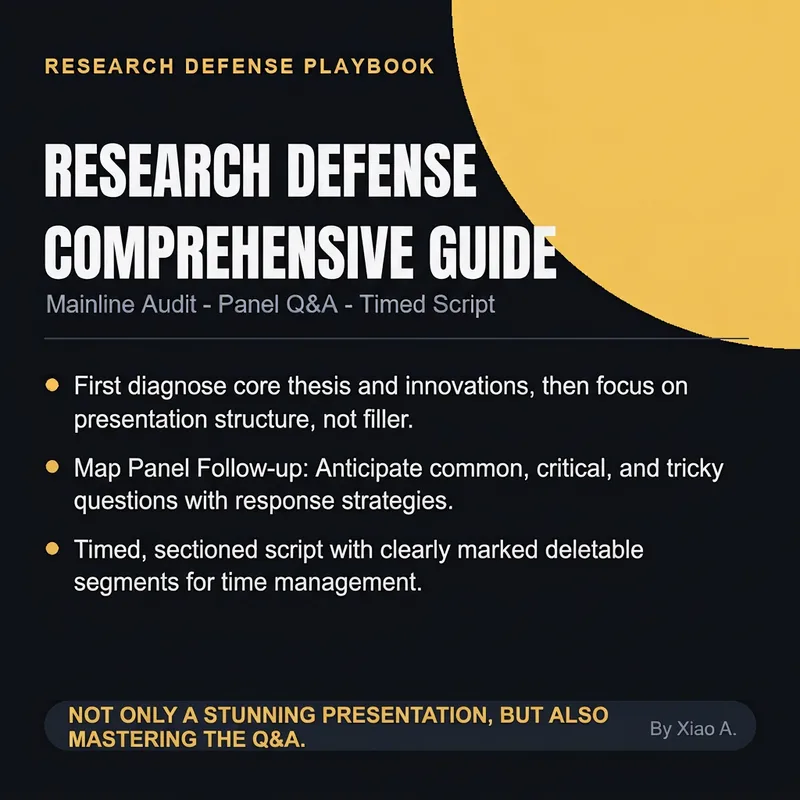 Write
Research Defense Strategy
Most presentation tools only focus on the surface layer—organizing materials into Slides, writing a script, and picking fonts. But academic defenses usually fail for two reasons: a shaky research storyline where innovations are unclear, and getting cornered by committee questions. Summary Goes beyond making your presentation look good to help you successfully defend your work with storyline diagnosis, a panelist question map, and timed scripts. Key Advantages 1. **Deep Diagnosis**: Evaluates whether your research storyline and contributions hold up, including patchiness checks, innovation grading, and vulnerability warnings. 2. **Panelist Q&A Map**: Categorizes questions into mandatory, high-frequency, and tough tiers, providing response frameworks and fallback phrases for tricky spots. 3. **Timed Scripts**: Segments your speech with time markers and optional cuts to prevent overtime without sacrificing core conclusions. 4. **Five Scenario Routes**: Tailored preparation for proposal, midterm, graduation, project completion, and title defense scenarios. 5. **Data Discipline**: No fabricated data or passing guarantees; missing items are marked as pending verification with a pre-defense checklist. Target Audience University faculty, early-career researchers, and graduate students preparing for academic defenses or evaluations who are worried about difficult committee questions.

Structured Interview Def Prep
A general structured interview/defense preparation framework. Suitable for various scenarios such as professional title evaluation, project defense, work report, academic leader selection, etc. Through guided conversation, it quickly generates policy background, answer frameworks, talking points library, contingency strategies, and memo cards, enabling you to handle any defense scenario with ease.
Work Review MAX: Logs→Review
Does your weekly report look like this: “Moved Project A forward this week, participated in discussions for Meeting B, supported the team with Request C, delivered xx documents, and will continue next week.” Your manager glances at it and moves on. It’s not that you didn’t work hard. It’s that you wrote a log, not a review. When evaluators review promotion materials and managers read monthly reports, they care about just five things: ① Why was this work worth doing? (judgment) ② What benchmark shows that the result was good? (data anchoring) ③ Which parts did “you” do, and which were done by the team? (contribution boundaries) ④ What reusable insight did you take away from the work? (growth curve) ⑤ What do you commit to delivering next cycle? (commitment mindset) 99% of review drafts fail to make even one of these clear. They just list features: “Iterated on X,” “launched Y,” “supported Z”—like a robot. This Skill is a structured compiler I refined through frontline business reviews as an AI OPC. Paste in your raw work log exactly as it is—no matter how messy or scattered—and it will produce a complete review that meets senior-level promotion and performance-review standards: 📊 One-line overall assessment (help readers understand your value in 30 seconds) 🎯 Key achievements (STAR + judgment-based narrative, not a feature list) 📈 Data benchmark table (with baselines, definitions, and your share of the contribution) 🧠 Methodology and lessons learned (showing your growth curve) 📅 Next-cycle plan (commitment-letter format, with measurable goals + deadlines + resource needs) ⚠️ Risks and support needed (surfacing risks shows ownership) 📋 Missing-data checklist (everything you need to look up, all at once) Bonus: ✓ Review of 3 key improvement areas (showing which weaknesses in the raw material were addressed) ✓ Defense-risk forecast (which points evaluators may challenge in a promotion review + suggested responses) ✓ Reusable template variables (make a few edits and reuse it next time) How is it different from a typical “AI weekly report” Skill? Others: Rephrase your work log and output it again—it’s still a work log. This one performs structural surgery on it, upgrading it from a “feature-listing format” to a “judgment-based narrative.” What it will never do: ✗ It will not invent data—anything you didn’t provide is marked “needs to be added,” with no made-up numbers ✗ It will not write filler like “As an AI,” “In conclusion,” or “Thank you, leadership” ✗ It will not flatter you or ask, “Can you tell me more?” It gets straight to work Who should use it: People tired of weekly reports and hoping to log off early P6→P7 / M1→M2 / mid-level→senior professionals aiming for promotion Anyone facing a midyear or annual performance review with materials still unwritten Project leads who need to write quarterly reviews for managers, evaluators, or clients Anyone who works hard and wants their work to be truly seen Doing good work doesn’t automatically mean you know how to report it. With the same workload, people who know how to write effective reviews get promoted a year faster. Use it for your next weekly report and make your work visible.
Information
- Version
- v2
- Last updated
- Runtime credits
- Usage-based
- Models
- Auto
- Use cases
- Career development
- What you get
- DocumentScriptPlan
