Project Clarifier
From fuzzy idea to decision-ready brief — zero assumptions
Project Clarifier
From fuzzy idea to decision-ready brief — zero assumptions
Showcase
Description
Project Clarifier - kill silent assumptions before they kill your project Turn a fuzzy idea into a decision-ready, one-page brief. This skill interviews you with the highest-leverage questions first (scope -> audience -> constraints -> success criteria), sorts everything you say into KNOWN / UNKNOWN / ASSUMED, and keeps a numbered Decision Log where nothing is ever silently changed - every decision has a date and a reason, and superseded decisions stay visible. Distilled from a real software project that survived 65 rounds of client review. The one rule that made it work: never assume - ask, or log it. You walk away with: a one-page Project Brief, a Decision Log you can defend months later, and an Open Questions list with explicit defaults and risks. Hand it to any developer, agency, or team and start building on rock instead of sand.
Related Skills
View allDistill Sources into a Cited Brief
**Who it's for.** Researchers, creators and knowledge workers who collect more material than they can ever re-read — and who need conclusions they can safely quote, not another loose summary. **What you provide.** One Board containing your sources (paper PDFs, video or podcast transcripts, web clippings, notes) and one research question. If the question is missing, the Skill asks before it starts. **How it works.** The Skill runs a fixed four-stage method we use in production research work: (1) Register — every source is logged once with its title, fixed version, link and date, so nothing gets quoted from a stray copy. (2) Per-source notes — one maintained note per source; tool checks never count as content review. (3) Distill — long material, especially video transcripts, is compressed into reusable takeaway cards anchored to timestamps and exact locations in the text. (4) Synthesis — cross-source conclusions are written as a brief where every key claim is tagged with its source, version, exact location and evidence strength (Strong / Moderate / Weak). Anything the material doesn't prove is listed as an open question — never papered over with a neighbouring source. **What you get.** A source register, per-source note cards, a cited synthesis brief, an open-questions list, and reusable takeaway cards — all as editable documents in your Board. **Not for.** One-line answers, summarising a single short article (overkill), or questions your Board material doesn't actually cover — the Skill will tell you what's missing instead of inventing an answer.
 Research
Devil's Advocate Simulator
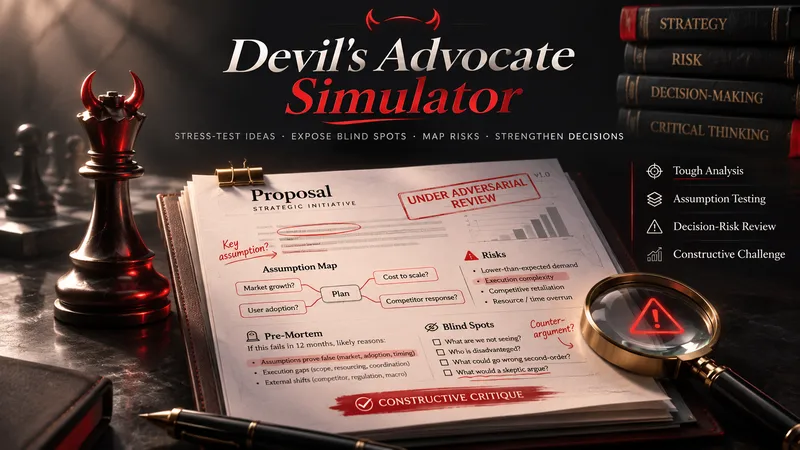
Devil's Advocate Simulator is a red-team analyst for your plans, proposals, and ideas. Give it a business plan, product launch, policy proposal, technical design, or even a personal decision, and it builds the strongest case against it, so you see the blind spots before you commit. What you get is a structured YouMind document, written in your own language: • Overall risk verdict – a clear summary of how fragile or robust the plan is. • Ranked objections – the strongest, plan-specific counter-arguments, sorted by probability × impact, each tied to the weak assumption it attacks. • Real evidence – web research on analogous failures, market data, and regulations, with sources. Anything without a source is honestly labeled as reasoning. • Steelman defenses – the best honest case for your plan against each objection, with a verdict on whether the objection still stands. • Weak assumptions table – what must be true, how fragile it is, and how to test it. • Pre-mortem – a realistic story of how the plan fails a year from now, plus early-warning signals. • What to validate first – the cheapest, highest-value tests to run next. How it works: it first restates your plan and lists its assumptions for a quick checkpoint (skip it with fast mode), then researches, ranks, and writes the report. The default tone is tough but fair; ask for harsh, medium, or gentle. It works in any domain and responds in the language you write in. Best for founders, product managers, strategists, researchers, students, and anyone about to make a decision that is expensive to reverse.
 Write
One Source, Five Formats
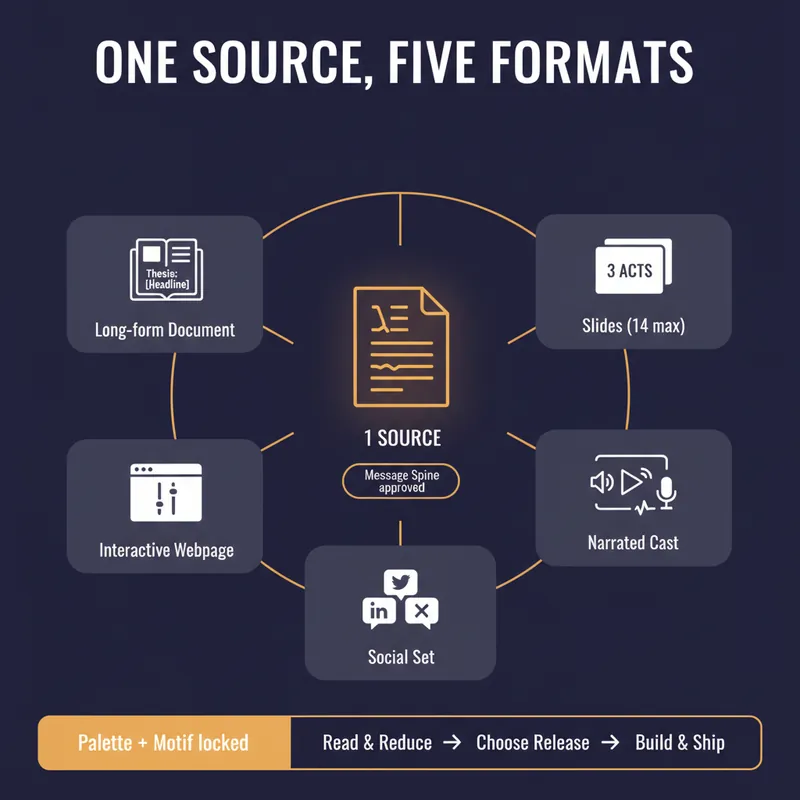
YouMind can produce a document, a slide deck, a narrated video, an interactive webpage and a set of social posts. Most people use one of them, because doing all five by hand means writing the same argument five times and watching it drift a little further each time. This skill stops the drift by refusing to start until you have a spine. Before anything is generated it writes a Message Spine: one thesis under 25 words, three load-bearing points, the single strongest piece of evidence, the one image a reader should still have tomorrow, the change you want in them, and who this is explicitly not for. You approve it. Every format is then built from the spine, never from the previous format, so nothing compounds an earlier compromise. Then it tells you which formats are actually worth making. A short reflective essay makes bad slides. A dense data teardown makes bad audio. It will recommend two formats and explain why the other three would weaken the work, which is the opposite of what a content-multiplier is supposed to say. Each format gets built to its own rules, one at a time, with your confirmation. Slides get one idea per slide and speaker notes that carry the argument. The cast script is written for the ear, with numbers rounded and given a comparison and a deliberate pause before the strongest evidence. The webpage gets exactly one interactive move the flat text could not do. The social set opens each post on a different point so it does not read as three copies of itself, and every post gives away something real instead of begging for a click. One palette, one type treatment, one recurring motif, decided in writing before the first image is generated. You finish with a ship sheet: what goes where, in what order, how many days apart, with what call to action, and the one signal to watch. Plus a consistency check that quotes the thesis sentence from every format and confirms they still agree. It estimates credits before it spends them and never renders a full cast or image set without an explicit yes.
Information
- Version
- v5
- Last updated
- Runtime credits
- Usage-based
- Models
- Auto
