
Signal Room: Interview Synthesis
Turn interview transcripts into evidence-backed insight
Signal Room: Interview Synthesis
Turn interview transcripts into evidence-backed insight
Showcase
Description
YouMind already transcribes your calls, interviews and podcasts. Signal Room is what happens next. Drop in one transcript or twenty and get back a research synthesis an actual analyst would sign: coded themes, verbatim evidence with timestamps, the places people disagree, and a ranked answer to the decision you are trying to make. The method is real qualitative practice, not summarisation: • Open coding that works quote-first — no quote, no code — with codes named in the participant's own words rather than analyst jargon • Every code tagged Behaviour, Belief or Wish, because "I would definitely pay for that" is not the same class of evidence as "I paid for that last month" • Themes stated as falsifiable sentences, with strength counted in participants rather than quotes, and disconfirming evidence hunted for on purpose • A tension map showing where your participants genuinely split and what predicts which side they fall on • An opportunity backlog written as "when [situation], [who] wants [outcome] because [reason]", each rated Strong, Suggestive or Anecdotal • A direct answer to your decision question, with a stated confidence level and what would change it • The three questions this round could not answer, and who to interview next Guardrails that matter: it never invents or polishes a quote, it refuses to report percentages on fewer than twelve participants, it pseudonymises participants by default, and it will tell you to your face when n=1 means you have a hypothesis rather than a finding. For product managers, UX and market researchers, journalists, consultants, founders doing customer discovery, and anyone sitting on hours of recordings and no findings.
Recommended by
nene@YouMind
Why we love this skill
An editor’s pick for rigorous, decision-ready interview synthesis. It keeps every insight tethered to verbatim evidence, separates behavior from belief and wish, surfaces disconfirming evidence and disagreement, and makes sample limits, confidence, and next research unmistakably clear.
Related Skills
View all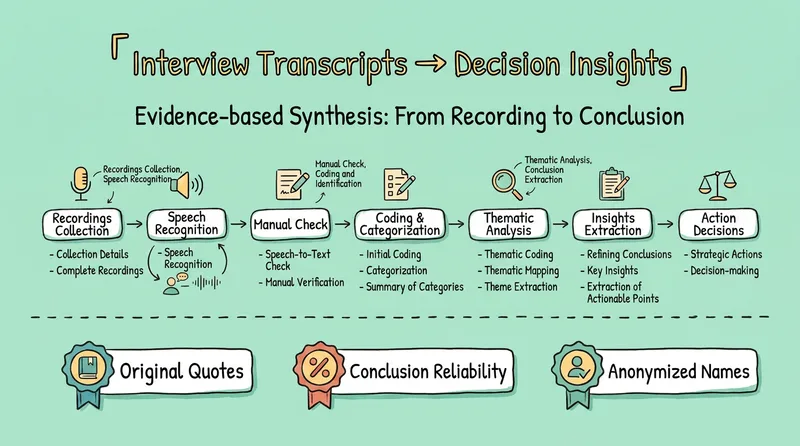 Research
Interview to Insights V3
Turn interview, user research, or focus-group transcripts into an evidence-led research synthesis where every conclusion is traceable to a verbatim quote. Feed it one transcript or twenty, and get coded themes, a tension map, an opportunity backlog, and a direct answer to your decision question—no more hours of recordings with zero findings. For businesses and product teams: skip days of manual analysis and coding. Every claim is anchored to participant quotes with timestamps, making it auditable and traceable and reducing the risk of AI-fabricated insights. Opportunities are framed as "when [situation], [who] wants [outcome] because [reason]", ready to inform product roadmaps and market decisions. For researchers and academics: follow rigorous qualitative research practice rather than simple summarization—quote-first open coding, Behavior/Belief/Wish evidence tagging, falsifiable themes, and deliberate searches for disconfirming evidence. The method is rigorous enough for a research paper. Sample discipline is strict: do not report percentages with fewer than 12 participants, flag n=1 as a hypothesis rather than a finding, and measure conclusion strength by participant count. For product managers, UX and market researchers, journalists, consultants, founders, and anyone with hours of recordings but no research findings.
 Write
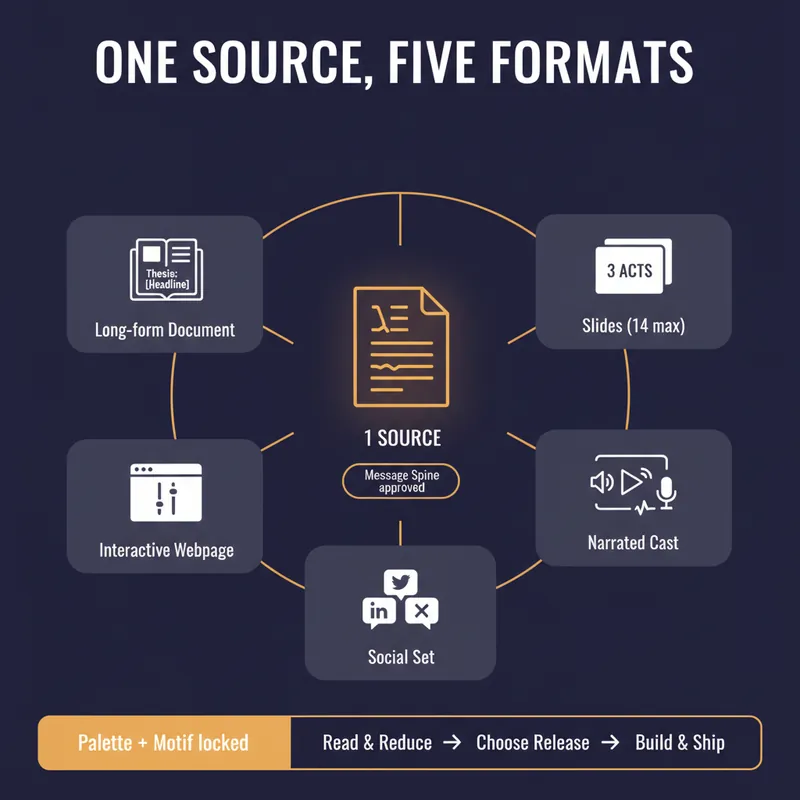
WriteOne Source, Five Formats
YouMind can produce a document, a slide deck, a narrated video, an interactive webpage and a set of social posts. Most people use one of them, because doing all five by hand means writing the same argument five times and watching it drift a little further each time. This skill stops the drift by refusing to start until you have a spine. Before anything is generated it writes a Message Spine: one thesis under 25 words, three load-bearing points, the single strongest piece of evidence, the one image a reader should still have tomorrow, the change you want in them, and who this is explicitly not for. You approve it. Every format is then built from the spine, never from the previous format, so nothing compounds an earlier compromise. Then it tells you which formats are actually worth making. A short reflective essay makes bad slides. A dense data teardown makes bad audio. It will recommend two formats and explain why the other three would weaken the work, which is the opposite of what a content-multiplier is supposed to say. Each format gets built to its own rules, one at a time, with your confirmation. Slides get one idea per slide and speaker notes that carry the argument. The cast script is written for the ear, with numbers rounded and given a comparison and a deliberate pause before the strongest evidence. The webpage gets exactly one interactive move the flat text could not do. The social set opens each post on a different point so it does not read as three copies of itself, and every post gives away something real instead of begging for a click. One palette, one type treatment, one recurring motif, decided in writing before the first image is generated. You finish with a ship sheet: what goes where, in what order, how many days apart, with what call to action, and the one signal to watch. Plus a consistency check that quotes the thesis sentence from every format and confirms they still agree. It estimates credits before it spends them and never renders a full cast or image set without an explicit yes.
 Research
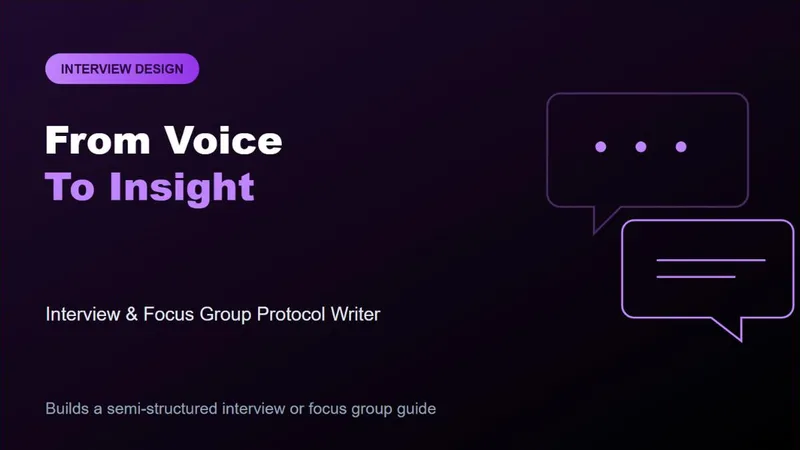
Interview & Focus Group Protocol Writer
Prepares a complete semi-structured interview guide or focus group protocol, from warm-up questions to closing, based on your research question and participant profile. Produces non-leading, open-ended questions and suggests an a priori code list for MAXQDA/NVivo. Who it's for: researchers and graduate students conducting qualitative or mixed-methods research.
Information
- Version
- v4
- Last updated
- Runtime credits
- Usage-based
- Models
- Auto