
How the World Works
Use nine questions to unpack real issues
How the World Works
Use nine questions to unpack real issues
Showcase
Description
Breaks complex real-world issues down into verifiable underlying structures, helping you see the relationships among participants, interests, resource allocation, rules, risks, returns, and technological change. Whether you are examining cross-border payment costs, the platform economy, stablecoins and monetary sovereignty, or capital cycles in computing power and electricity, you can start with a specific question, an abstract concept, or the current landscape and establish clear analytical boundaries. The skill selects a diagnostic, teaching, or observation path based on your needs, while defining the timeframe, geographic or market scope, key actors, and required data. Throughout the analysis, it distinguishes verified facts, evidence-based inferences, and participant narratives, and records dates, sources, and uncertainty. When sources conflict, it preserves the disagreement rather than replacing facts with promotional messaging. The result is a traceable structural analysis document. It examines the key mechanisms behind an issue layer by layer—from scarcity and choice, property rights, and rules to organizations, finance, the macro environment, and changes in technology costs—and brings each core question to a clear conclusion. It is suited to researching business models, institutional arrangements, financial infrastructure, technology industry cycles, and other real-world issues that require looking beneath the surface.
Best for
Best for researching complex business, institutional, financial, technology, and other real-world issues that require looking beneath the surface.
How to use this Skill
Provide your input
Enter a real-world issue, concept, institution, product, transaction structure, or current landscape, and specify the scope, timeframe, and key question you care about.
Run the Skill
The system defines the analytical scope, organizes verifiable evidence, distinguishes facts, inferences, and participant narratives, and maps the relationships among resources, rules, risks, returns, and technological change.
Review your result
Generates a traceable structural analysis document covering key mechanisms, evidence sources, disagreements, and uncertainties, while addressing each core question in turn.
Related Skills
View all
Multi-Framework Analysis
Turn complex problems into structured, multi-perspective analyses that can be reviewed, verified, and used to support next steps. Whether you are evaluating career choices, business and product decisions, social phenomena, controversial issues, trending topics, innovations, or abstract concepts, this Skill first clarifies the subject, goals, constraints, known information, and key unknowns. It then selects complementary cognitive frameworks based on the task, avoiding a pileup of concepts or repeated versions of the same conclusion. The analysis clearly distinguishes between information provided by the user, verified facts, general principles, assumptions, inferences, and content that still needs validation. It places evidence, mechanisms, counterevidence, alternative explanations, and uncertainty within a clear chain of reasoning. For time-sensitive, controversial, specialized, or high-risk facts, it can use targeted web searches and verify original sources. When sources conflict, it preserves the differences rather than filling gaps with unverified data or overly certain claims. The final output typically includes a problem profile; the framework selection and analysis of each framework; areas of agreement and disagreement across perspectives; sensitive variables; blind spots and failure conditions; and conditional conclusions with confidence levels. It does not replace professional medical, legal, investment, tax, or other advice. Instead, it helps you identify the factors that truly affect judgment and design minimal validation steps, information-gathering plans, decision gates, or reversible next steps. Simple questions can be condensed into a brief assessment, while complex or multi-subject tasks can be developed into a complete analytical report.
 Research
Rapid Industry Understanding
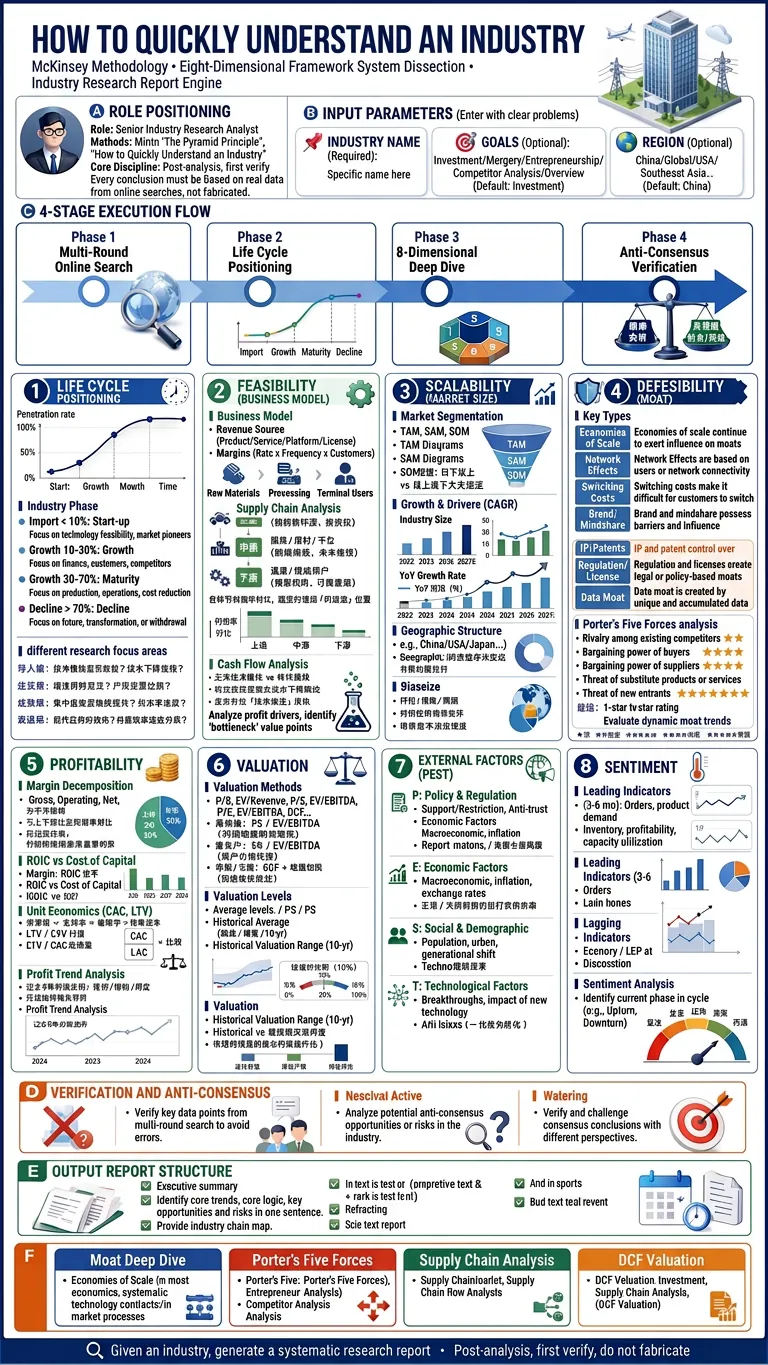
📋 Usage Guide This Skill is an industry research engine based on McKinsey methodology, using the eight-dimension framework from Xiao Jing's "How to Quickly Understand an Industry". Tell it an industry name, and it produces a systematic research report. —————————————————————————————— 🚀 Basic Usage Just tell me the industry you want to research—the more specific, the better: a. "Analyze the solid-state battery industry" b. "Look at the humanoid robot supply chain from an entrepreneurial perspective" c. "Is the solar industry still investable now?" You can optionally provide three details (if missing, I'll use defaults): 1. Industry name: be specific, e.g., "perovskite solar" instead of "new energy"—required; 2. Goal: investment / career / entrepreneurship / competitive analysis / education, default: investment; 3. Region: China market / global / US / Southeast Asia..., default: China market; —————————————————————————————— ⚙️ What it does automatically? The entire process has 4 stages: 1. Multi-round web searches for market size/growth/penetration rate, supply chain, competitive landscape, moat evidence, policy, valuation—every conclusion has a source and timestamp, never fabricated; 2. Lifecycle positioning: use penetration rate to determine if the industry is in introduction/growth/maturity/decline—different stages have completely different research focuses; 3. Eight-dimension deep dive: business model → market size → moat (forced deep dive into dynamic trends) → competitive landscape (forced scoring on each of Porter's Five Forces) → valuation → PEST → business cycle; 4. Contrarian check: distinguish market priced-in consensus from overlooked real issues, and provide decision recommendations; —————————————————————————————— 📊 What it outputs? A professional research report in Markdown format, structured as: 1. ⚡ 30-second verdict — stage / core profit logic / biggest opportunity / biggest risk / one-sentence conclusion; 2. Research object and boundary definition; 3. Lifecycle positioning (with penetration rate data); 4. Eight-dimension analysis (moat includes dynamic trend table, Porter's Five Forces scoring table); 5. Contrarian check; 6. Conclusion and decision recommendations; 7. Key risk list; 8. Data sources and time notes; —————————————————————————————— 🔑 Two Core Highlights 1. Forced deep dive on moat: not just the type of barrier, but must answer "has it widened or narrowed in the past 2-3 years?" using market share/gross margin/pricing power data; 2. Porter's Five Forces scored individually: all five forces scored to avoid shortcuts, determining who has the strongest bargaining power now and whether the landscape is favorable or deteriorating for leaders; —————————————————————————————— ⏱️ Time Approximately 2-4 minutes, due to multiple rounds of search + dimension-by-dimension analysis + report writing —————————————————————————————— 🧩 Subsequent Extensions After the report is generated, you can continue with two specialized analyses (requires manual confirmation, won't run automatically): 1. "Unchain to find bottlenecks": identify physical bottlenecks in the supply chain that can't be bypassed when trends scale, locking in true beneficiary targets; 2. "DCF valuation": run a full discounted cash flow model for a specific company within the industry; —————————————————————————————— ▶️ Want to try? Just tell me an industry name, e.g., "Take a look at the AI agent industry from an entrepreneurial perspective" or "What's the situation with the hydrogen energy supply chain?"

Research & Implementation
For a specified topic, this Skill produces a focused research report that combines expert judgment with practical execution. It helps beginners understand the problem, compare options, and complete their first hands-on project. The report first defines the research scope, intended audience, and time-sensitivity boundaries. It then reviews mainstream options by cost, barriers to entry, maturity, suitable use cases, and risks, providing a clear, evidence-based recommendation instead of a vague comparison that simply says “each has its pros and cons.” The report also explains the recommended option’s basic principles, capability boundaries, and common pitfalls. For information that may change easily—such as pricing, policies, and versions—it identifies the supporting evidence, validity period, and verification method. When information is insufficient, it clearly points out the gaps rather than making things up. All technical terms are explained in plain language, and key facts are accompanied by verifiable sources or reproducible steps whenever possible. You’ll also receive a beginner-focused, from-scratch implementation guide covering the tools, accounts, budget, and time needed in advance, along with specific actions, decision criteria, and common troubleshooting steps for each stage. After your first hands-on experience, the guide provides 30-day and 90-day progression plans and highlights the steps people are most likely to abandon. It’s suitable for individuals and teams conducting focused research, selecting among options, or putting a plan into practice.
Information
- Version
- v3
- Last updated
- Runtime credits
- Usage-based
- Models
- Auto
- Use cases
- Research & analysisLearning & educationBusiness & strategy
- What you get
- ReportDocument