Teacher Man · Science Q Check
Evaluate your scientific question from a reviewer's perspective
Teacher Man · Science Q Check
Evaluate your scientific question from a reviewer's perspective
Showcase
Description
Conduct a reviewer-perspective health check on the scientific questions condensed in your proposal. It first verifies the nature of the question (scientific vs. engineering, exploratory vs. goal-oriented), then diagnoses it item by item using a three-lens approach: origin, depth, and alignment. It verifies peer research levels online, outputs a three-lens scorecard, an overall judgment, a rewritten "one core + two keys" formulation, and saves it as a document.
Recommended by
Dancang
Why we love this skill
Uses a three-lens framework of origin, depth, and alignment to distinguish scientific questions from engineering goals, pinpoints true knowledge gaps with peer progress, and refines core statements and matching innovations for ready-to-use revisions.
Best for
Researchers looking to refine scientific questions for grant proposals, evaluate research entry points, and improve problem statements.
How to use this Skill
Provide your input
Provide a core scientific question along with your research field, technical bottlenecks or anomalous phenomena, preliminary work, proposed methods, and relevant text fragments.
Run the Skill
Evaluates the scientific merit, research track, question origin, depth, and methodological fit, while checking the question's level against recent peer research.
Review your result
Receive a three-lens scorecard, overall judgment, question revision suggestions, a "one core + two keys" formulation, and references.
Related Skills
View all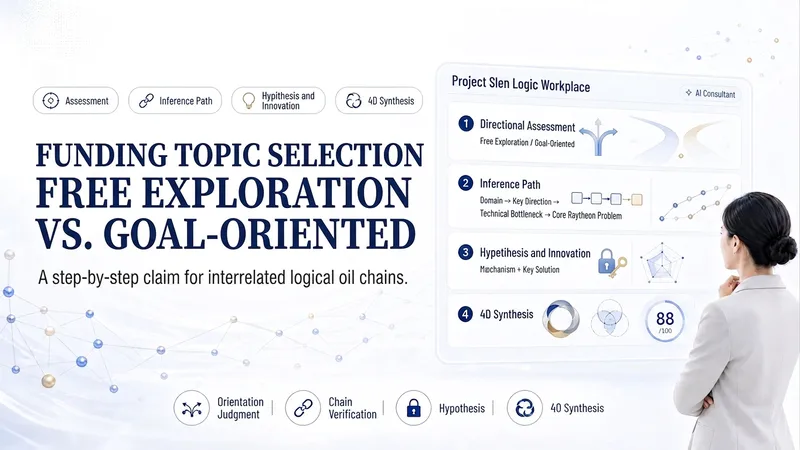
Teacher Man NSFC Topic Selection
"Teacher Man NSFC Topic Selection" consultant skill: first determines whether a project belongs to the open exploration or target-oriented track, then follows the corresponding chain (target-oriented: field -> characteristic direction -> technical bottleneck -> core scientific question; open exploration: anomalous phenomenon -> target setting -> deeper exploration -> core scientific question) for step-by-step deduction, conducting a "link-lock test" at each step. It then draws out the scientific hypothesis (lock cylinder diagram) and innovation (golden key), and finally performs a four-dimensional interlocking stress test on characteristic A, scientific question B, scientific hypothesis, and innovation C, producing an interlocking conception logic chain and closed-loop core statement that can be directly written into a proposal. Each step is accompanied by a hand-drawn marker graffiti-style (16:9, white background) illustration, turning each step's conclusion into a well-illustrated memory anchor. Suitable for researchers currently conceiving NSFC topics who need to clarify their logic chains.
NSFC Question Refiner
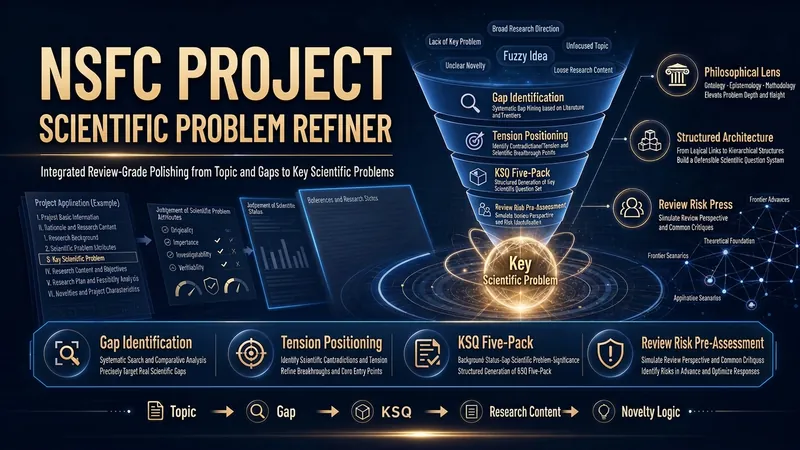
A deep tool focused on refining 'scientific questions' for NSFC projects. Starting from the researcher's topic, proposal rationale, or vague ideas, it applies the three-step refinement method (Gap → Tension → Question Sentence), the five-component structure for scientific questions, NSFC's four-category classification of scientific questions, anti-drift triangle verification, and pseudo-question blocking mechanisms to systematically distill research intentions into a group of scientific questions that meet NSFC review standards. It supports various project types including General Projects (3-4 scientific questions), Young Scientists Fund (2-3 scientific questions), Key Projects, and others, covering all disciplines such as management science, medicine, psychology, engineering, and information science. Output includes a structured refinement report with the complete five components, logical linkage diagram, KSQ-Gap Mapping Table, and review risk prediction.
 Research
Thesis Topic & Intro v3.2
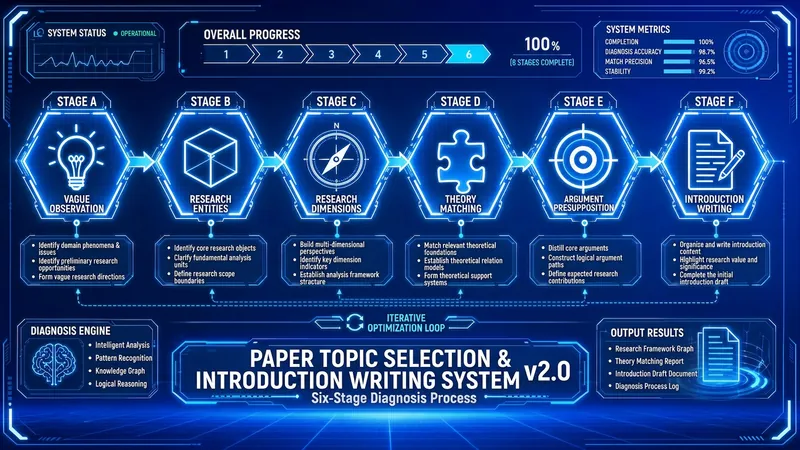
Read in 10 seconds: turn a vague observation into a defensible topic, then into an introduction that can pass review. Throughout, it uses only the real materials you provide — no fabricated references. Trigger words: thesis topic, topic selection, introduction, research gap, academic writing, thesis proposal, topic selection before literature review. Applies to: journal papers / dissertations / conference papers / course papers, across all disciplines — humanities and social sciences, STEM, agriculture, medicine, and life sciences. Up and running in 3 minutes: lock in your discipline and starting point → shape the topic layer by layer → strict evidence-chain gate → module-by-module introduction → ratchet finalization. [Division of labor with other skills] The health check comes first, writing comes after, and polishing comes last. This skill handles the middle stretch: topic shaping + introduction draft. It does not write the full paper (that's the Academic Paper Full-Process Writing System v4.x), and it does not polish language sentence by sentence (that's the Academic Paper Three-Track Polishing System v8.x). [Six gates] 1. Discipline placement: classify into one of four categories — 1A humanities/arts, 1B social sciences, 2A STEM, 2B agriculture/medicine/life sciences — and load the corresponding red-line norms; for category 2B, ethics review status is always checked. 2. Stage positioning: are you at a vague observation, have a unit but no angle, have an object but no theory, lack a method, lack a viewpoint, or only lack an introduction? Start from the corresponding gate instead of starting over from scratch. 3. Topic shaping: research unit → dimension compass → theoretical perspective → research method → research viewpoint, locked layer by layer; before locking each layer, first judge whether the previous layer holds. 4. Strict evidence-chain gate: before the introduction, your references are registered into an M1/M2… material library, each entry verified on four elements — author/year/title/locator; if fewer than 3 references are registered in the conversation, the system refuses to generate the research-gap statement — not a downgrade, a refusal. 5. Module-by-module generation: the introduction is produced in five inverted-pyramid modules, and each module must be annotated with citation numbers [Mn]; no source, no sentence. 6. Ratchet finalization: only versions that have passed receive credit; qualifying modules are locked and no longer changed; scores only go up, never down. [Deliverables] A '[Topic Keyword] · Topic & Introduction' document + a sentence-level traceable citation mapping table + a ⚠️ to-verify checklist + an AFP archive code. The archive code works across four systems — the proposal health-checker, the v4.x full-process system, and the three-track polishing system — so switching skills doesn't require re-stating your discipline, topic, journal, or material library. [Explicitly not done] It does not fabricate authors, years, volumes, issues, page numbers, or DOIs; any bibliographic records retrieved online are marked ⚠️ to-verify and can only be written into the reference list after you verify them; it makes no promises of acceptance or passing review. Authorship and responsibility are yours — please verify every citation and data point.
Information
- Version
- v5
- Last updated
- Runtime credits
- Usage-based
- Models
- Auto
- Use cases
- Writing & contentResearch & analysisLearning & education
- What you get
- ReportDocument
