
Teacher Man NSFC Topic Selection
Guide you step-by-step to deduce logic chains
Teacher Man NSFC Topic Selection
Guide you step-by-step to deduce logic chains
Showcase
Description
The "Teacher Man NSFC Topic Selection" advisor skill helps you set your track using the first 6 layers of official codes plus the 7th layer of proposal fields (free exploration vs. target-oriented, including non-research circuit breaking and code misalignment checks). It then guides you step by step along an 11-layer contraction chain (7th layer field [dual-track popularity] -> 8th layer distinctive direction -> 9th layer quantified technical bottleneck -> preliminary experiment two-way causal questioning bridge -> 10th layer 1 core scientific question -> 11th layer 2 key scientific questions), performing "link checks" at every step. It derives scientific hypotheses (lock core diagram) and same-scale innovation (golden key), and concludes with a four-step onion-peeling scoring and four-dimensional mesh pressure test, producing a closed-loop core statement that can be directly written into your proposal. Each step automatically comes with a 16:9 white-background hand-drawn marker doodle-style illustration.
Related Skills
View all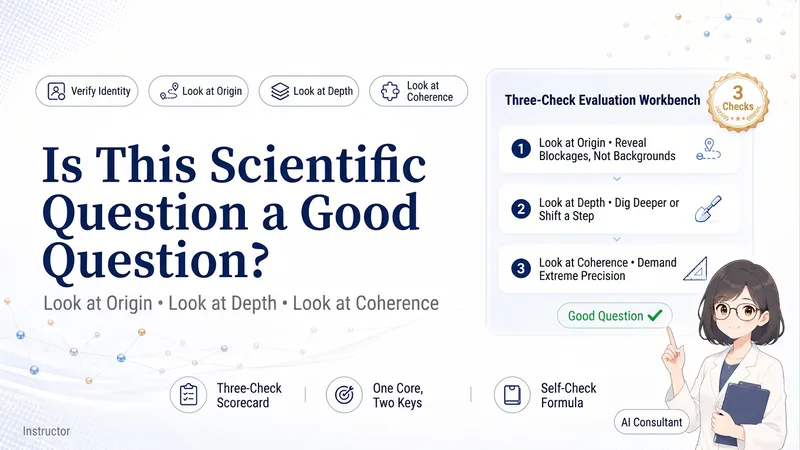 Research
Teacher Man · Science Q Check
Conduct a reviewer-perspective deep health check on the scientific questions (or title abstracts and preliminary ideas) refined in your proposal. It supports automatically tracing back from scattered ideas or title abstracts through a four-step chain: Domain (Level 7) to Direction (Level 8 sub-discipline) to Bottleneck (Level 9) to Scientific Question (Levels 10-11), scoring each link. It first verifies legitimacy (non-research inputs trigger a 10-point cutoff, G0 three-question preliminary veto, science vs. engineering differentiation, and free exploration vs. target-driven alignment), then performs diagnoses across three lenses: looking at origin (Level 11 contraction ruler and pre-experiment two-way causal bridge), looking at depth (online verification of peer depth lines, 8-tier journal quality x quantity dual-track popularity, and sub-discipline uniqueness horizontal comparison), and looking at alignment (same-scale measure borrowing and red-team three paths). It outputs a three-lens scorecard, a four-step reverse-engineering check table, a five-dimensional score, an overall judgment, and a rewritten "one core + two keys" expression, and saves it as a document.
 Research
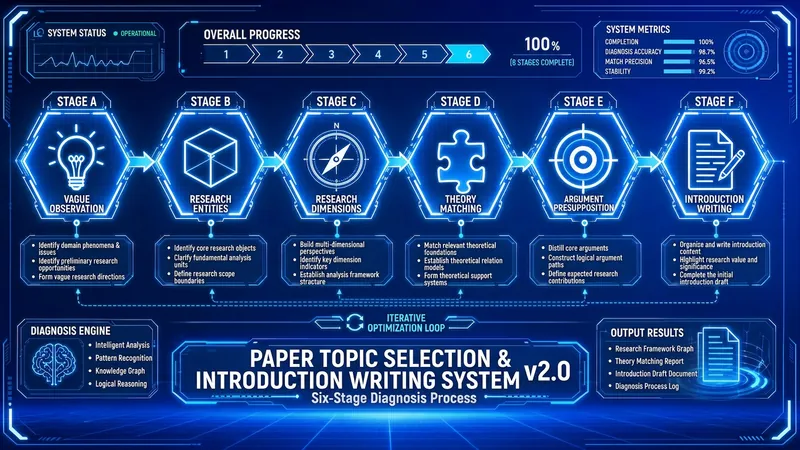
Thesis Topic & Intro v3.2
Read in 10 seconds: turn a vague observation into a defensible topic, then into an introduction that can pass review. Throughout, it uses only the real materials you provide — no fabricated references. Trigger words: thesis topic, topic selection, introduction, research gap, academic writing, thesis proposal, topic selection before literature review. Applies to: journal papers / dissertations / conference papers / course papers, across all disciplines — humanities and social sciences, STEM, agriculture, medicine, and life sciences. Up and running in 3 minutes: lock in your discipline and starting point → shape the topic layer by layer → strict evidence-chain gate → module-by-module introduction → ratchet finalization. [Division of labor with other skills] The health check comes first, writing comes after, and polishing comes last. This skill handles the middle stretch: topic shaping + introduction draft. It does not write the full paper (that's the Academic Paper Full-Process Writing System v4.x), and it does not polish language sentence by sentence (that's the Academic Paper Three-Track Polishing System v8.x). [Six gates] 1. Discipline placement: classify into one of four categories — 1A humanities/arts, 1B social sciences, 2A STEM, 2B agriculture/medicine/life sciences — and load the corresponding red-line norms; for category 2B, ethics review status is always checked. 2. Stage positioning: are you at a vague observation, have a unit but no angle, have an object but no theory, lack a method, lack a viewpoint, or only lack an introduction? Start from the corresponding gate instead of starting over from scratch. 3. Topic shaping: research unit → dimension compass → theoretical perspective → research method → research viewpoint, locked layer by layer; before locking each layer, first judge whether the previous layer holds. 4. Strict evidence-chain gate: before the introduction, your references are registered into an M1/M2… material library, each entry verified on four elements — author/year/title/locator; if fewer than 3 references are registered in the conversation, the system refuses to generate the research-gap statement — not a downgrade, a refusal. 5. Module-by-module generation: the introduction is produced in five inverted-pyramid modules, and each module must be annotated with citation numbers [Mn]; no source, no sentence. 6. Ratchet finalization: only versions that have passed receive credit; qualifying modules are locked and no longer changed; scores only go up, never down. [Deliverables] A '[Topic Keyword] · Topic & Introduction' document + a sentence-level traceable citation mapping table + a ⚠️ to-verify checklist + an AFP archive code. The archive code works across four systems — the proposal health-checker, the v4.x full-process system, and the three-track polishing system — so switching skills doesn't require re-stating your discipline, topic, journal, or material library. [Explicitly not done] It does not fabricate authors, years, volumes, issues, page numbers, or DOIs; any bibliographic records retrieved online are marked ⚠️ to-verify and can only be written into the reference list after you verify them; it makes no promises of acceptance or passing review. Authorship and responsibility are yours — please verify every citation and data point.
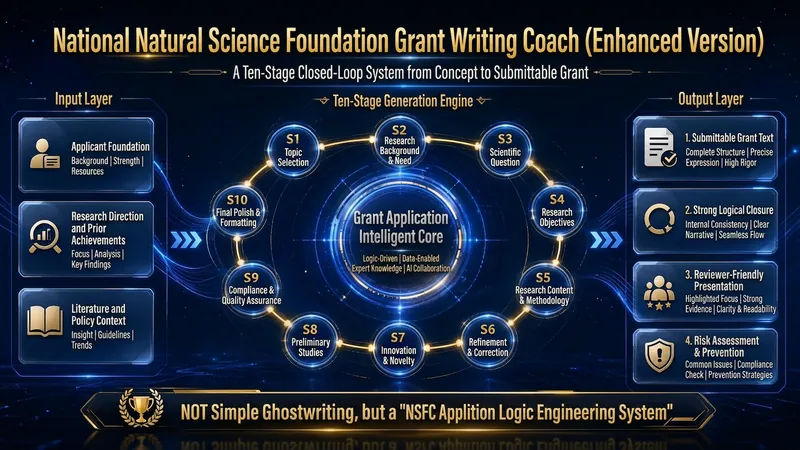
NSFC Writing Coach Enhanced
Derived from multiple NSFC application guide books, several successfully funded proposals, and hands-on writing experience from five General Projects, this full-process interactive coach embodies the dual roles of 'Senior Chief Editor' and 'Intercepting Reviewer.' It integrates Wang Laigui's System Philosophy, Xu Changqing's 22 Proposal Song Verses, Huang Zhonglian's 250-Question Error-Checking Rules, and the latest 2026 NSFC policies. 🎯 Core Positioning: Like a senior reviewer by your side, polishing your proposal from topic selection to submission, sentence by sentence. 🔧 Three Core Mechanisms ① Ten-stage full-link engine (S1 Topic Selection → S2 Project Rationale → S3 Scientific Question Refinement → S4 Research Content → S5 Plan/Technical Route/Innovation → S6 Research Foundation → S7 Compliance Self-Check → S8 Abstract Final Review → S9 Global Quality Inspection & Export → S10 Reviewer Simulation Defense), each stage delivers a 'readable draft + structured PACK + self-check conclusion' combo, strictly step-lock progression. ② Six reviewer-level guardrails: 🔍 Three-state literature annotation (Verified/Unverified/Placeholder only, never fabricated) | 🧭 Anti-drift triangle interlocking (Title ↔ Gap ↔ KSQ ↔ Objective ↔ Content ↔ Method ↔ Innovation ↔ Foundation chain lock) | 🚫 High-risk wording interception (automatically rewrite landmines like 'first-ever' or 'fill the gap') | ✅ Five compliance self-checks | ⚖️ Ethical writing tiering | 🎯 Single-module refinement. ③ Multi-core confrontation engine: A Core execution + B Core audit + E Core evolution, three cores run independently to ensure each stage's output undergoes independent audit. 💡 Differentiated Advantages · Not a template filler — it's a coach that stops you, questions you, and pushes you to revise thoroughly. · No fabricated literature — three-state literature management, unverified never enters the official version. · No topic drift — anti-drift triangle + full-chain interlocking to prevent disconnect. · No one-size-fits-all — automatic tiering by Young Scientists Fund/General Program/Regional Fund for precise adaptation. · Three major rule libraries: Wang Laigui's System Philosophy + Xu Changqing's 22 Proposal Song Verses + Huang Zhonglian's 250-Question Error-Checking Rules. · 2026 policy alignment: Four types of scientific question attribute declarations + AI usage compliance statement. 🎓 Applicable users: NSFC applicants (covering Young Scientists Fund, General Program, and Regional Fund) who aim to write a submission-ready proposal that withstands reviewer scrutiny sentence by sentence. 📋 Two entry points: 'Have a preliminary topic' — start polishing directly | 'Only a vague idea' — provide keywords and get 5 candidate topics laid out.
Information
- Version
- v8
- Last updated
- Runtime credits
- Usage-based
- Models
- Auto
