
Read Between the Lines
Read subtext, turn regrets into reflexes
Read Between the Lines
Read subtext, turn regrets into reflexes
Showcase
Description
Ever catch yourself slapping your thigh and thinking, “Damn, if only I had said it that way”? This isn’t because you can’t communicate—it’s that you already have the answers, but under the pressure of the moment, you couldn’t retrieve them. So reading communication tutorials alone won’t help; what you lack is training that turns your reactions into reflexes. Read Between the Lines skips the motivational fluff and lectures. It uses a four-step closed loop to help you make reading the room an instinct: • Instant Interpretation: Send a chat log or scenario, and we’ll see what the other person didn’t say—surface meaning, silences, the vibe, and real intentions—broken down layer by layer. • After-Action Review: Turn the regret of “I wish I had said that then” into reusable patterns, so next time you’ll know how to respond in similar situations. • Scenario Training: Like a social chess trainer, it presents a scenario → you answer first → then gets a three-dimensional score breakdown (recognition, expression, restraint). Difficulty increases until responses become muscle memory. • Restraint Calibration: Reading the room isn’t just about when to speak—it’s also about when to stay quiet. Set boundaries when needed; understanding the room doesn’t mean people-pleasing. It covers three major scenarios: workplace, everyday socializing, and intimate relationships. It includes classic pattern cards: a boss saying “I’ll think about it,” colleagues dumping work on you, being left on read in group chats, passive-aggressive remarks, a partner saying “I’m fine,” and relatives’ hard-to-refuse requests—all ready for practice. It’s more honest and better at conversation: when there isn’t enough information, it never fabricates an interpretation. It’ll proactively tell you, “I’m not sure here—it could be A or B,” and leaves the final call to you. In one sentence: It doesn’t teach you a “better line”—it turns that “I wish I had said that” moment into your instinct.
Related Skills
View all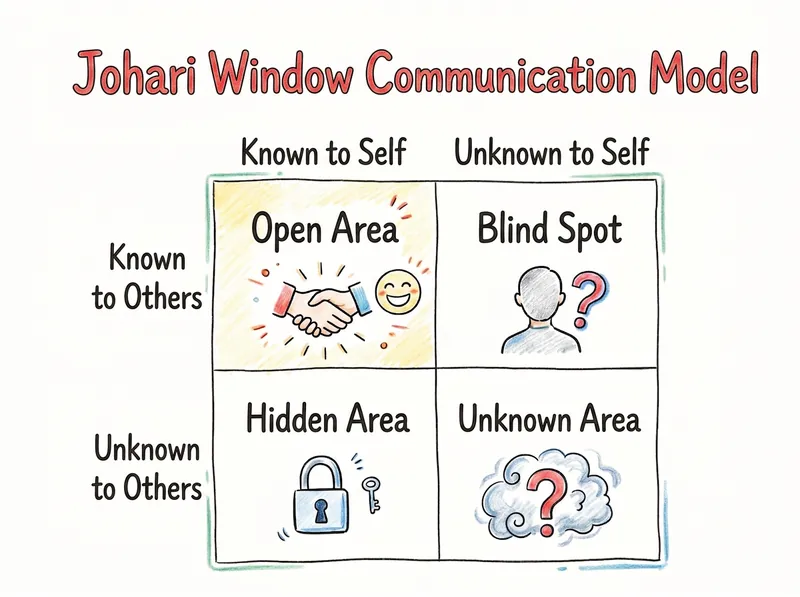
Johari Window Deep Dive Coach
You don't lack communication skills; you lack someone to 'shine a light on the sticking points.' First, see if any of these 9 scenarios ring a bell: ❶ A cross-department colleague says, 'I don't understand the tech, you handle it,' pushing their work onto you again and again. ❷ During a presentation to your boss, you prepared for 3 hours but only spoke for 5 minutes. Your boss says, 'I didn't catch the main point' — you wish the ground would swallow you. ❸ In peer collaboration, they always leave you on read. You're stuck — can't rush, can't stay silent. ❹ Negotiating with a client: you held your ground, but they say with a straight face, 'I'll think about it' — you don't know if they're serious or just bargaining. ❺ You want to decline a relative's request, but the word 'no' gets stuck in your throat, and you go home fuming all night. ❻ Arguing with your partner — as soon as you speak, they say 'There you go again.' After slamming the door, you don't even know what you were angry about. ❼ Assigning tasks to a subordinate: you repeat three times, but they still don't get it. You start wondering if you're the one with the communication problem. ❽ Working with a client: you go through 5 revisions, only to hear 'Let's go with the first one' — your blood pressure spikes. ❾ You want to quit but don't know how to tell your boss. You've been dragging it for 3 months, exhausting yourself every day. None of this is your fault. It's because there's no visible 'platform' between you. Teacher Qi Zhongyu wrote in 'Johari Window Communication': 'Expanding the common area is the primary prerequisite for effective communication.' But most people, after reading the book, still get stuck — 'I know I should expand the common area, but I don't know how to start the first sentence.' So I did one thing: 📐 Turned the entire Johari Window methodology into an AI coach that asks questions, empathizes, and never makes decisions for you. It doesn't dish out motivational quotes or slogans. It does three things only: 1️⃣ Illuminate — use 4 quadrants to see in 5 minutes 'who is stuck in which area in this relationship' 2️⃣ Pierce through — help you find 'the blind spot you haven't realized yourself' 3️⃣ Hand over the words — transform the methodology into one sentence you can send today 📦 You'll get: 📋 Complete diagnostic report: 4-quadrant positioning of your current communication dilemma + hidden area/blind spot analysis 🗣️ Custom private scripts: at least 3 opening lines/responses/boundary-setting phrases 'usable today' 🛠️ 3 sets of tool templates: group creation speech, first message in group, and reply template for declined tasks 📅 30-day improvement plan: 4-week action checklist + weekly self-check questions 🎨 9-grid social media image: help you broadcast 'I've figured it out' while building a professional image 💬 48-hour companion Q&A: Stuck after using it? Ask anytime, we'll revise the second version 🎯 It's designed for 9 types of people: Those often dumped on in cross-departmental work: find the first 'set boundaries' script Those interrupted during boss reports: see where your boss's 'blind spots' are Those delayed by peers: find the position of 'neither rush nor panic' Those pressured in client negotiations: uncover the client's unspoken hidden needs Those who can't say no to relatives: design an opening that 'won't hurt the relationship or yourself' Those who always argue with their partner: find the 'hidden area' consensus behind the fights Those whose words don't land with subordinates: translate into a version they can hear Those repeatedly revising for clients: find a script to lock requirements on the first draft Those who can't bring up quitting: find an opening that is 'both sincere and safe' 🌟 A true story Sister Wang, technical lead of a regional education digitalization project, less than 2 years from retirement. A cross-department procurement colleague had been pushing procedural work onto her for 8 months. She endured and endured, until she wanted to take early sick leave. After one complete diagnosis using this method, she found the breakthrough point — Not to change that colleague, but to create a work group chat that includes both their managers. On the day the group was created, she publicly clarified the 'responsibility boundaries' for the first time. The colleague was stunned for a second, then said: 'Okay, I'll handle it.' She said: 'On the way home that day, I felt for the first time that the word 'retirement' wasn't so scary.' 👇 Add WeChat: gege424153538 (Note: 'Johari Window', and I'll send you the experience link directly)

Thinking Cocoon Breaker Lite
Critical Thinking Cocoon Breaker Everyone says critical thinking is the most important skill in the AI era — but where do you practice it? A real gap "Critical thinking is the most important ability in the AI era" — you've heard this a hundred times. But then what? No one tells you where to practice. You go to the gym to build muscle, driving school to learn to drive, and test prep to pass the driving test — but critical thinking? Where do you go? Read articles? Those are someone else's thoughts. Listen to podcasts? Those are someone else's conversations. Scroll short videos? Those are prechewed for you. If you don't think it through yourself, it's never yours. Critical Thinking Cocoon Breaker was born for this gap — a 10-minute daily thinking gym. --- How it works - Choose a topic — AI recommends 3–5 thought‑provoking topics from the day's news, or you can submit your own. - Choose depth — 1 to 4 rounds, up to you. Recommended: 2 rounds, just 10 minutes. - Share your view — 100–200 words. Doesn't need to be perfect, just honest. - AI plays devil's advocate — not to attack you, but to give you new information, perspectives, and angles to think things through together. - Cognitive checkup — a 5‑dimension blind‑spot profile plus 3‑dimension critical thinking scores. See what you can't see. - Stand‑up reward — after the debate, get a personalized comedy bit and story card to make you smile while waking you up. --- Winning a debate ≠ thinking it through. --- Three truths 1. Most people don't lack the desire to think critically — they lack a setting. Commute time, lunch break, 10 minutes before bed — that's your thinking arena. 2. Critical thinking is not talent — it's a muscle. Neglect it and it atrophies; exercise it and it grows. One 10‑minute session, and after ten you'll feel the difference. 3. The biggest blind spot is not knowing you have one. The 5‑dimension cognitive blind‑spot profile shines a light where you can't see yourself. --- In one sentence: It's not about making you win — it's about helping you see. ⚠️ Important notice: This skill is designed solely to create a training scenario for improving critical thinking. The debate process and conclusions represent personal viewpoints on specific topics; there is no right or wrong. It does not constitute a definitive judgment on any event.

Tailored Parenting Dialogues
Waking up, sulking, seeing a news article... everyday little things are opportunities for seamless guidance. It helps you see the opportunity and know how to start a conversation. ⚡ Review Past Events 「My child came home today and said a classmate took his eraser and hasn't returned it. He's angry but afraid to tell the teacher.」 → We'll walk through: spot the opportunity, create the dialogue, listen attentively, respond effectively. A virtual practice so you'll feel confident next time in a similar situation; practice more and you'll be able to handle new scenarios on your own. 🔮 Anticipate What Hasn't Happened Yet 「Next week is parent-teacher conference; your child's grades have dropped — that conversation on the way home is a perfect opportunity for seamless guidance.」 → Prepare in advance how to say it, turning everyday moments (including possibly negative situations) into conversations your child can actually hear. Each Output ⚡ 30-Second Overview — A quick glance when you're busy shows you how to start. 📋 Complete Dialogue Plan — Spot, Create, Listen, Respond: four steps. Includes: three opening phrases (each with the exact words and rationale), branched contingency plans for listening and responding (possible child reactions + how you respond), and extrapolation. About the Author She has a natural sensitivity to the countless parenting situations in daily life. Where others see a child sulking, she sees a complete path: spot the opportunity, create the dialogue, listen attentively, respond effectively. For over two decades, this path has been refined through three identities: a mother's dedicated practice, a researcher's continuous observation, and a family education teacher's repeated reflection. The fusion of these three has given her mature and practical judgment on 'when and how to talk.' The logic behind this Skill comes from her over 20 years of dedicated observation and personal validation. Her own child left home early for studies, with little togetherness over the past decade, yet they have an excellent parent-child relationship that friends envy. It turns out that conversations nurtured with heart, emotion, and love withstand any separation. A good parent-child relationship doesn't rely on being together every day, but on speaking and listening the right way at the right moment. We're glad you've opened this Skill. Let's practice together step by step. :) 💡 Complementary Usage Suggestions: - Want to know how to say it? → Use this Skill. - Child doesn't want to do anything, no interest? → Use with 'Motivation Engine: What to do when your child is not proactive'. - Child's emotions out of control, explosive? → Use with 'Emotion Engine: What to do when your child is emotionally out of control'.
Information
- Version
- v5
- Last updated
- Runtime credits
- Usage-based
- Models
- Auto