
Surname Origins Chart
Enter a surname to map its origins
Surname Origins Chart
Enter a surname to map its origins
Showcase
Description
People often pause when they see their own surname. Surname Origins Chart turns the question “Where did this surname come from?” into a lineage chart that can be saved and shared in a family group. It covers the surname’s origin (which branch it came from and why it was adopted), ancestral regions and migration points, hall names, notable figures from different periods, and common accounts of generation names and family instructions. All you need to provide is a surname; you can also add an ancestral hometown and hall name. Strict rules: only include information supported by surname sources, label conflicting accounts as “Accounts vary,” and never fabricate migration dates, official positions, or genealogies of notable figures. The visual must not include real information about any living person.
Best for
For anyone who wants to explore a surname’s origins, organize family history materials, or create content to share in a family group.
How to use this Skill
Provide your input
Provide a single- or compound-character surname. You may also add an ancestral hometown, hall name, generation names, or layout preference.
Run the Skill
Using documented surname sources and commonly accepted local records, organize the surname’s origins, ancestral regions and hall names, migration history, and notable figures, marking disputed accounts.
Review your result
Receive a saveable, shareable 3:4 portrait surname lineage chart with six information sections and brief delivery notes.
Related Skills
View all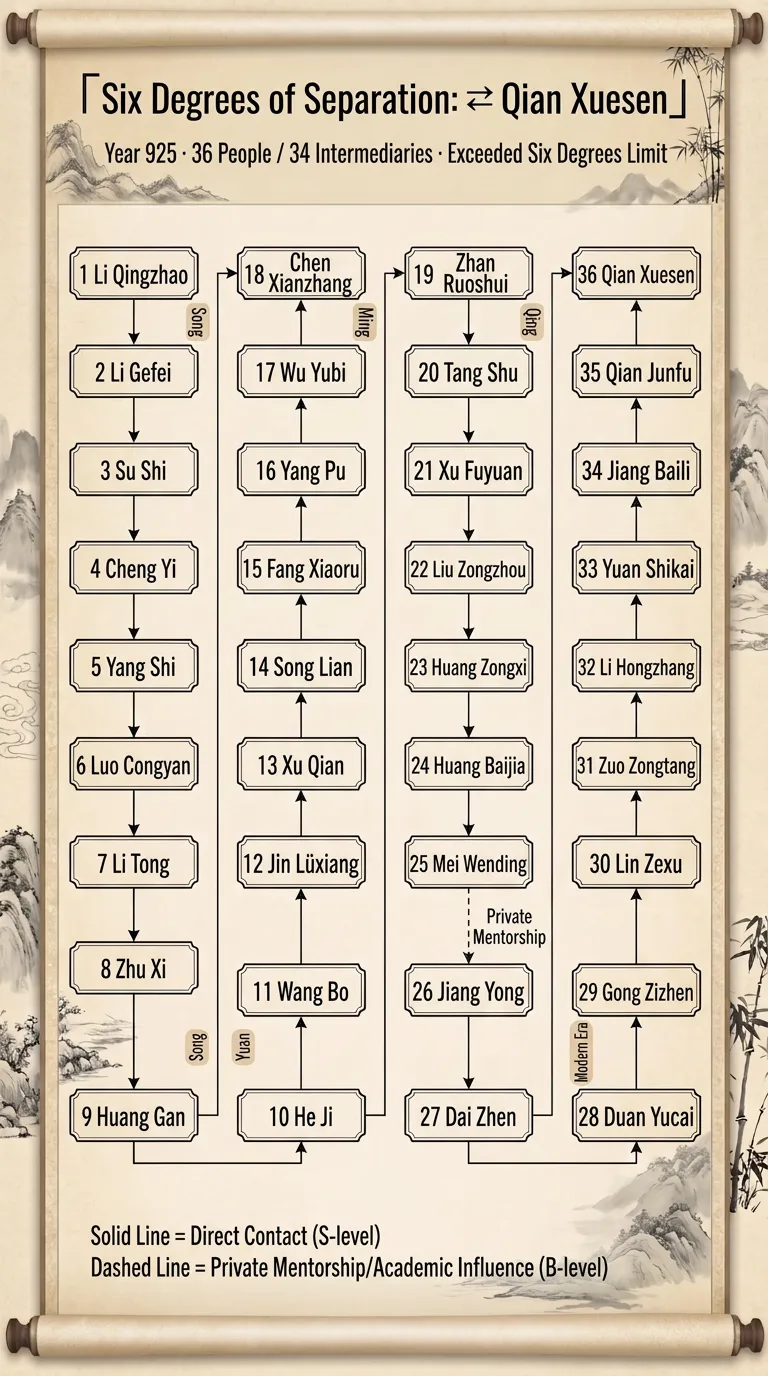 Research
Six Degrees of Connection
Enter the names of two real people. Using bidirectional research and timeline-overlap checks, the Skill finds the real interpersonal connection chain linking them through the fewest possible intermediaries. Each link includes a relationship-strength label (strong/medium/weak) and verifiable sources. It first provides copy for review; after you approve it, the Skill generates a vertical, shareable long image. If the chain cannot be completed within six degrees, it does not force a match—it honestly reports the fewest number of links found and explains that the six-degree limit was exceeded. If you enter a legendary, mythical, or fictional figure, such as He Xiangu or Sun Wukong, it does not run a connection search or create an image; instead, it produces an explanatory document labeled “Not a Six-Degrees Chain.” For cross-country pairings, three additional rules apply: first anchor each person to their original-language name to avoid transliteration differences being mistaken for two people; remove links based solely on written media; and exclude circulating anecdotes that appear only in commemorative articles. The image-generation stage follows version-control rules: for text-heavy images, it prioritizes a text-free background plus a separate text layer to avoid typos, and saves only the final proofread version to the canvas—not discarded drafts.

Baby BaZi Name Ideas
Based on the surname, gender, and birth date and time you provide, this Skill calculates the Four Pillars of Destiny (BaZi), analyzes the Five Elements, and creates a complete naming document. It includes a BaZi chart, Five Elements distribution, an illustration of how the elements support and counteract one another, several name options, and detailed reasoning for each. All recommendations are presented from the perspective of Chinese traditional culture, including BaZi and the Five Elements, the I Ching, and the Book of Songs and Songs of Chu. (For cultural reference only.)
Information
- Version
- v4
- Last updated
- Runtime credits
- Usage-based
- Models
- Auto
- Use cases
- Images & designResearch & analysisLearning & education
- What you get
- Image
- Visual styles
- MinimalistTraditional ChinesePaper art
