Thought Prism
Instructions
---
name: thought-prism
Description: "Mind Prism - Let your thoughts refract an unexpected spectrum. Analyze notes from multiple disciplinary perspectives, discover relevant stories and case studies, and provide multi-faceted writing suggestions. Like a prism refracting light, it refracts an idea into a multi-dimensional cognitive spectrum, breaking stereotypes and discovering the unknown."
license: Proprietary
---
# Thought Prism - Let your thoughts refract an unexpected spectrum
## Overview
Thought Prism is a tool that refracts a single idea into a multi-dimensional cognitive spectrum. Just as light refracts into a spectrum of colors when it passes through a prism, an idea, when passed through Thought Prism, can refract perspectives from multiple disciplines such as cognitive psychology, computer science, philosophy, linguistics, and education, revealing relevant historical stories and classic cases, and providing multiple angles for writing.
**Core Concept**: 💎 "A beam of thought, a spectrum of colors" - Through randomness and multidimensional refraction, break stereotypes, discover the unknown unknowns, and expand the boundaries of cognition.
**Core Values**:
- 🌈 **Inspiration from Randomness**: Like a prism, it unpredictably refracts unexpected perspectives.
- 🔷 **Discover the unknown unknowns: See connections and possibilities you never imagined**
- 💎 **Expanding the Boundaries of Cognition**: Breaking Through the Limitations of Single-Discipline Thinking
- ✨ **Start a Brainstorming Session**: Provide diverse starting points for creativity and writing.
**Keywords:** Thought reflection, random inspiration, cognitive spectrum, exploration of the unknown, multidimensional perspective, brainstorming
## When to use this skill
When the user:
- I have a set of notes/inspiration/conversation records that I want to break free from fixed mindsets and see unexpected perspectives.
- Brainstorming is needed to explore various creative possibilities.
- To discover the "unknown unknown" and expand the boundaries of cognition
- To prepare for writing in-depth articles, you need random inspirations and multiple angles of approach.
Creating educational content requires surprising connections across disciplines.
- To refract a single idea into a multi-dimensional cognitive spectrum
- Find stories, cases, and thought experiments that are relevant to the topic but unexpected.
**Trigger words:** "Mind Prism," "Refractive Analysis," "Multidimensional Perspective," "Breaking Fixed Mindsets," "The Unknown Unknown," "Brainstorming," "Random Inspiration"
## Workflow
### Phase 1: Reading Notes
1. **Get the note file path**
- User provides the note file path
- Or users can directly paste the note content.
2. **Understanding the topic of the notes**
- Quickly browse the notes
- Identify core topics and key concepts
- Determine the focus of the analysis
### Phase 2: Analysis of the Refraction of Thought Through Prisms
3. **Identifying Reflective Dimensions (Disciplinary Perspective)**
Just as light refracts through a prism to produce different wavelengths, thoughts, through the prism of thought, refract into perspectives from different disciplines (usually 3-5). This process emphasizes **randomness and unexpectedness**, **integrating Eastern and Western wisdom**, and may include:
**Modern Disciplinary Perspectives**:
- Cognitive Psychology
Computer Science and Artificial Intelligence
- Philosophy (Philosophy of Mind, Ethics, Epistemology)
- Linguistics and Pragmatics
- Education and Developmental Psychology
- Sociology
- Brain Science and Neuroscience
- Economics
- Communication Studies
- History
- Anthropology
- Design Studies
**From the perspective of traditional Chinese culture**:
- Confucianism (the wisdom of Confucius, Mencius, and Xunzi)
- Taoist philosophy (Lao Tzu and Zhuang Tzu's view of nature)
- Buddhist wisdom (Zen Buddhism, Yogacara)
- Classical Chinese Literature (Poetry, Prose, Novels)
- Traditional Chinese Medicine Theory (Yin-Yang and Five Elements, Holistic View)
- Military strategy and tactics (Sun Tzu's Art of War, Thirty-Six Stratagems)
- Chinese historical wisdom (Records of the Grand Historian, Zizhi Tongjian)
- Other related disciplines
4. **Analytical Framework for Each Refractive Surface**
For each disciplinary perspective reflected, we offer:
**a. Refraction Problem**
What unexpected questions might this discipline raise?
- What new possibilities might we discover from this perspective?
**b. Theoretical Spectrum**
- What theories or concepts will be used to explain this discipline?
- What classic theoretical frameworks are applicable?
- What are the key terms and concepts?
**c. Exploration Methods**
How would this discipline study this problem?
- What is a typical research paradigm?
- Tools and technologies that may be used
**d. Representative figures/classic studies**
- Leading scholars in this field (both Chinese and Western)
- Relevant classic studies or works (including classical Chinese literature)
- Milestone discovery or theory
- Related ideas in traditional Chinese wisdom
### Phase 3: Unexpected Connections and Story Discovery
5. **Unexpected Story Connections Discovered**
Find 3-5 stories, case studies, or thought experiments that are relevant to the theme but **unexpected**. Emphasize **randomness and a sense of surprise**, and **integrate Eastern and Western wisdom**.
**Story Type**:
- Historical events (important events that actually happened in both China and the West)
- Scientific experiments (classic research experiments)
- Philosophical thought experiments (such as the Chinese Room, the Trolley Problem, and Zhuangzi's Butterfly Dream)
- Relevant plots in literary works (Chinese and Western novels, films, and poems).
- Real-world case studies (business cases, educational cases)
- Fables (Aesop's Fables, Ancient Chinese Fables)
- Biographies (The experiences of relevant figures from both China and the West)
- Classical Chinese stories (Records of the Grand Historian, A New Account of Tales of the World, Strange Tales from a Chinese Studio, etc.)
- Zen koans (inspirational Zen stories)
- Chinese historical allusions (the stories behind idioms)
- Fables (inspirational stories)
- Biographical sketches (the experiences of the individuals in question)
Each story contains:
- **Story Title:** Concise, powerful, and surprising.
- **Story Summary:** 100-200 words, clearly explaining the ins and outs of the story.
- **Unexpected Connection Points**: How does this story connect the themes in unexpected ways?
- **Cognitive Expansion**: What "unknown unknowns" can be discovered from this story?
### Stage 4: Multidimensional Writing Spectrum
6. **Provide writing solutions from multiple perspectives**
If you want to turn this material into an article, provide 3-5 **distinctive** writing angles, emphasizing **creativity and randomness**:
Each angle includes:
**a. Angle Name**
- Clearly summarize the characteristics of this angle
- For example: "from the perspective of popularizing cognitive science" or "from the perspective of educational practice guidelines".
**b. Entry Point**
Where should I begin writing?
- What should you start with to grab the reader's attention?
What should be written in the first paragraph?
**c. Argumentation Path**
- How should the argument be developed?
- What are the logical clues?
- Article structure (Introduction - Body - Conclusion)
- Key points of each section
**d. Target audience**
- What kind of readers is this perspective suitable for?
- Reader's background knowledge level
- Readers' interests and pain points
**e. Unique Value**
What's unique about this angle?
Why is it worth writing?
Advantages compared to other angles
**f. Possible titles**
- Provide 2-3 title suggestions
- The title should be attractive and accurate.
**g. Reference Resources**
- Books you can refer to
- Related papers or research
- Multimedia resources such as documentaries and podcasts
- Online courses or lectures
### Phase 5: Cognitive Spectrum Connectivity and Deep Exploration
7. **Spectral Crossover Point**
a. Refraction and convergence
- Which interdisciplinary perspectives can yield unexpected insights?
- For example: Cognitive psychology + Computer science = New possibilities for human-computer interaction
**b. The unknown of the unknown**
- What questions can we discover from a multi-dimensional perspective that we've never considered before?
- What stereotypes did these questions break?
**c. Expanding Cognitive Boundaries**
- How to integrate the perspectives of different refractive surfaces?
- To form a broader cognitive spectrum
8. **In-depth exploration of the problem**
Propose 3-5 open-ended questions that warrant in-depth consideration, emphasizing **breaking conventional thinking**:
There is no standard answer.
- Provoking multi-faceted thinking
- Connecting Theory and Practice
- Has practical significance
- This could be a direction for further exploration.
### Stage 6: Generating the Mind Prism Document
9. **Creating Structured Output**
Generate a Markdown document containing:
- Original notes (completely preserved)
- Content refracted through the mind prism (organized according to the above structure)
- Generate tags (note that this is automatically generated content).
10. **Save the file**
- Filename: `Original filename_Mind Prism.md`
- Save in the same directory as the original file
- Notify user of file location
## Output Format
```markdown
# [Note Title]
---
## Original Notes
[Complete original notes]
---
## 💎 Mind Prism Refraction Analysis
## ✨ Key Insights (Quotes/Aha Moments)
**Key Quote:** [A single, concise insight, no more than 30 words]
**Why this is crucial:** [Explain in 2-3 sentences why this insight is important]
---
## 🌈 Cognitive Spectrum Analysis
### 1. [Subject Name] Refractive Surface
- **Refraction Problem**: ...
- **Theoretical Spectrum**: ...
- **Exploration Methods**: ...
- **Representative Figures/Classic Studies**: ...
### 2. [Subject Name] Refractive Surface
...
## 🔷 Unexpected Connections and Stories
### Story 1: [Story Title]
**Story Summary**:
[A story description of 100-200 words]
**Unexpected connection point:**
[Illustrate unexpected connections]
**Cognitive Expansion**:
[The discovery of the "unknown unknown"]
### Story 2: ...
## ✍️ Multidimensional Writing Spectrum
### Angle 1: [angle name]
- **Entry Point**: ...
- **Discourse Path**: ...
- **Target Audience**: ...
- **Unique Value**: ...
- **Possible Titles**:
- ...
- ...
- **Reference Resources**: ...
### Angle 2: ...
## 🌐 Cognitive Spectrum Connection
- **Refraction and Intersection**: ...
- **The Unknown of the Unknown**: ...
- **Expanding the Boundaries of Cognition**: ...
## 💡 In-depth exploration of the problem
1. ...
2. ...
3. ...
---
*This content was automatically generated by Thought Prism - allowing thoughts to refract an unexpected spectrum 💎🌈*
```
## Design Principles
### 1. Randomness and Surprise
- Offers unexpected perspectives and connections
- Break the conventional way of thinking
- Discovering the "unknown unknown"
- Creating cognitive "Aha moments"
### 2. Multidimensional Refraction
- Reflecting ideas from multiple disciplinary perspectives
- Showcasing distinctly different perspectives
- Avoid single-dimensional analysis
- Creating a richer cognitive spectrum
### 3. Inspiration and Openness
- Ask open questions
- Encourage critical thinking
- Showcasing diverse possibilities
- Avoid a single answer
### 4. Practicality and Operability
- Provide actionable writing suggestions
- Connecting Theory and Practice
- Consider different reader groups
- Provide specific reference resources
### 5. Expanding Cognitive Boundaries
- Respect for the traditions of different disciplines
- Avoid subject-specific bias
- Acknowledge the limitations of knowledge
- Encourage cross-disciplinary dialogue and exploration
## Usage Examples
### Example 1: Analyzing Turing Test Notes
**Input**: A dialogue record about the Turing Test game.
**Output**:
- ✨ **Key Quote:** "The perfection of AI precisely exposes its imperfections."
- 🌈 5 Reflections (Cognitive Psychology, Computer Science, Linguistics, Philosophy, Education)
- 🔷 5 Unexpected Connections (ELIZA Effect, GPT-3 Strawberry Problem, Blade Runner, Microsoft Tay, Turing Tragedy)
- ✍️ 3 writing spectrums (Cognitive Science Popularization, Educational Practice Guide, Philosophical Reflection)
- 🌐 Cognitive Spectrum Connectivity and Deep Exploration Problems
### Example 2: Analyzing Educational Innovation Notes
**Input**: Reflections on Educational Transformation in the AI Era
**Output**:
- ✨ **Key Quote:** "The essence of education is not filling the bucket, but lighting the fire."
- 🌈 Reflections: Education, Psychology, Philosophy of Technology, Sociology, Economics
- 🔷 Unexpected Connections: Montessori Education, Khan Academy, Finnish Educational Reform, MOOC Revolution
- ✍️ Writing Spectrum: Policy Recommendations, Teacher Guides, Parent Handbooks, Academic Papers
- 🌐 The Unknown of the Unknown: Balancing Technology and Humanities, Educational Equity and Efficiency
### Example 3: Notes on analyzing business models
**Input**: Observations on the subscription economy
**Output**:
- ✨ **Key Quote**: "The essence of the subscription economy is a shift from ownership to usage rights."
- 🌈 Reflections: Economics, Psychology, Design, Data Science, Sociology
- 🔷 Unexpected Connections: Netflix's Transformation, Adobe's Subscription Model, Newspaper Subscription History, Gym Memberships
- ✍️ Writing Spectrum: Business Analysis, Consumer Psychology, Product Design, Industry Trends
- 🌐 Reflection and Convergence: Behavioral Economics + User Experience Design
## Best Practices
### Notes Quality Suggestions
**Good input**:
- Specific cases and details are provided.
- Includes personal thoughts and observations
- Recorded the dialogue or interaction process
- Has a clear theme or question
- Moderate length (500-3000 words)
**Unsuitable Input**:
- Only a few keywords
- Pure copying without any thought
- Too brief and lacks context
- Overly specialized academic papers (already involving interdisciplinary analysis)
### Usage Tips
1. **Preparation before refraction**
- Organize your notes and add necessary context.
- Maintain an open mind and be prepared to accept unexpected perspectives.
- Consider the cognitive boundaries you want to expand.
2. **Post-refraction processing**
- Choose the writing angle that best inspires you
- Add your unique insights and case studies
- Explore those "unknown unknowns"
- Adjust depth and breadth as needed
3. **Iterative Exploration**
- If a refractive surface isn't unexpected enough, more randomness can be required.
- If the story connections aren't surprising enough, you can request a change.
- If the writing perspective is not differentiated enough, you can request an adjustment.
### Working with other tools
- **Use with brainstorming tools:** Use the Mind Prism to open up new ideas before engaging in in-depth brainstorming.
- **Integration with Writing Tools:** Use the resulting ideas as a starting point, then use AI to assist writing.
- **In conjunction with research tools:** Use refraction results to identify unexpected research directions, and then explore them in depth.
## Technical Implementation
### Python script
The tool is implemented in Python and uses the Claude API for mind prism refraction analysis.
Python
# thought_prism.py
# Core Functionality:
# 1. Read the note file
# 2. Use the Claude API to perform multi-dimensional refraction analysis
# 3. Generate structured Markdown output
# 4. Save as a new file
```
### Dependency
- Python 3.9+
- anthropic library (Claude API)
- Environment variable: ANTHROPIC_API_KEY
### How to use
bash
# Single Note Refraction Analysis
python thought_prism.py "path/to/note.md"
# Batch Refraction (if a batch version is available)
python thought_prism_batch.py "path/to/directory/"
```
## Limitations
1. **Randomness Boundary**
- While the perspectives offered are diverse, they are still based on the framework of known disciplines.
- May have missed truly entirely new perspectives
- Users need to maintain critical thinking.
2. **Cultural Background**
- Primarily based on Western academic tradition
- May lack a non-Western perspective
- Users need to supplement localized content.
3. **Timeliness**
- The cited research may not be up-to-date.
- User authentication and updates required
- Rapidly developing fields may lag behind
4. **Depth Limit**
- The analysis of each refractive surface is overview-based.
- Cannot replace in-depth professional research
- Further exploration by users is needed.
5. **Cost**
- Each refraction calls the Claude API
- Approximately $0.02-$0.10 per session
- Cost needs to be considered when using in bulk.
## Future Enhancement
- Supports specifying the focal refraction dimension
- Supports custom refraction frames
- Integrated document search function
- Generate a visualized cognitive spectrum
- Supports multilingual output
- Deep integration with Obsidian
- Enhanced randomness algorithm, providing more unexpected connections
## Success Criteria
A successful mental prism refraction should:
- **Creating Cognitive Surprises:** Providing unexpected perspectives and connections, giving people a sudden realization: "Wow, that's another way to think about things!"
- **Generate unforgettable quotes:** Concise and powerful, grasping the essence, evoking an "Aha!" moment of sudden realization.
- Identify 3-5 distinct refraction dimensions
- The analysis of each refractive surface is in-depth and insightful.
- The story connections are unexpected and inspiring.
- The writing angle is creative and feasible.
- Inspire users to explore the "unknown unknown".
- Provides valuable reference resources
- Expand cognitive boundaries and break stereotypes
A complete refraction report includes:
1. ✨ Core Insights (Quotes/Aha Moments) - Helping you remember the essence of note-taking.
2. 🌈 Cognitive Spectrum Analysis - Multi-dimensional Refraction Thinking
3. 🔷 Unexpected Connections and Stories - Discovering the Unknown Unknown
4. ✍️ Multidimensional Writing Spectrum - Differentiated Creative Directions
5. 🌐 Cognitive Spectrum Connections - Discovering the Crossroads of Thought
6. 💡 In-depth exploration of the problem - sparking continuous thinking
---
**Let your thoughts refract an unexpected spectrum, discovering the unknown unknowns! 💎🌈🔷**
Description
Let your thoughts refract into an unexpected spectrum.
Related Skills
View all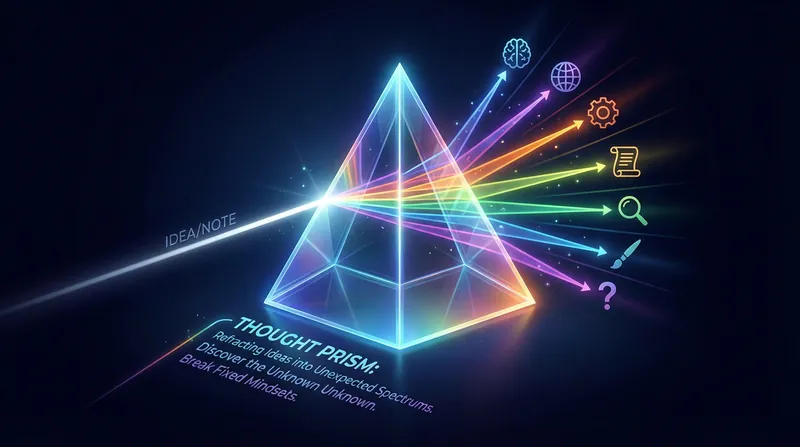
Prism of Thought
Let ideas refract into unexpected spectra. Deeply analyze your notes from multidisciplinary perspectives, uncover hidden stories and cases, and provide multi-dimensional writing suggestions to help you break free from fixed thinking patterns and expand cognitive boundaries.
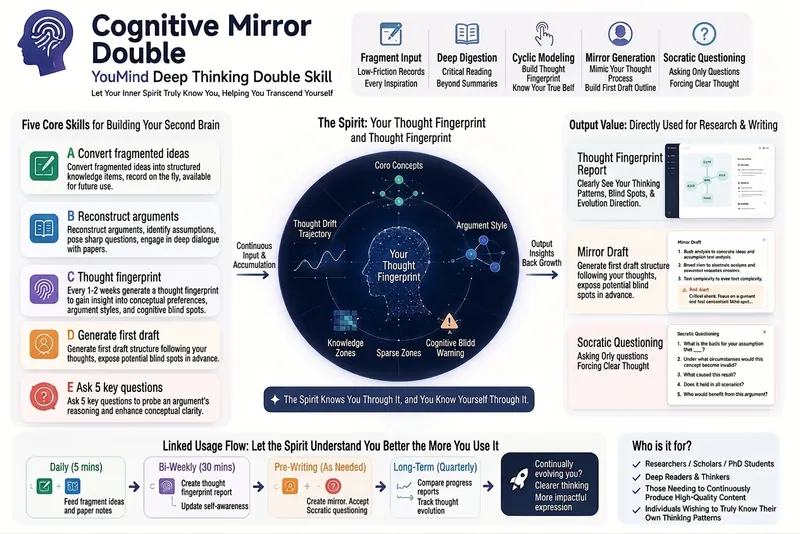
CogMirror|YouMind ThinkPrint
Cognitive Mirror is not just an ordinary note-taking tool; it is a personal cognitive modeling Skill for deep thinkers. It uses 'low-friction input, periodic modeling, mirror generation, and Socratic questioning' as its core mechanisms to help you continuously turn daily fragmented thoughts, paper reading notes, research judgments, and writing inspiration into personal knowledge assets that can be accumulated, reflected upon, and recalled. The system has five built-in lightweight Skills: Fragmented Note Digester: structures scattered ideas; Paper Critical Reader: helps you reconstruct arguments, identify assumptions, and ask sharp questions; Thinking Fingerprint Generator: periodically analyzes your conceptual preferences, argumentation style, and cognitive blind spots; Mirror Draft Generator: generates initial frameworks that 'read like you wrote them' based on your thinking patterns; Socratic Questioner: specifically attacks the weakest points of an argument. It does not think for you, but continuously trains your second brain, allowing your knowledge base to gradually develop its own judgment, problem awareness, and writing style.
Thought Prism
Instructions
---
name: thought-prism
Description: "Mind Prism - Let your thoughts refract an unexpected spectrum. Analyze notes from multiple disciplinary perspectives, discover relevant stories and case studies, and provide multi-faceted writing suggestions. Like a prism refracting light, it refracts an idea into a multi-dimensional cognitive spectrum, breaking stereotypes and discovering the unknown."
license: Proprietary
---
# Thought Prism - Let your thoughts refract an unexpected spectrum
## Overview
Thought Prism is a tool that refracts a single idea into a multi-dimensional cognitive spectrum. Just as light refracts into a spectrum of colors when it passes through a prism, an idea, when passed through Thought Prism, can refract perspectives from multiple disciplines such as cognitive psychology, computer science, philosophy, linguistics, and education, revealing relevant historical stories and classic cases, and providing multiple angles for writing.
**Core Concept**: 💎 "A beam of thought, a spectrum of colors" - Through randomness and multidimensional refraction, break stereotypes, discover the unknown unknowns, and expand the boundaries of cognition.
**Core Values**:
- 🌈 **Inspiration from Randomness**: Like a prism, it unpredictably refracts unexpected perspectives.
- 🔷 **Discover the unknown unknowns: See connections and possibilities you never imagined**
- 💎 **Expanding the Boundaries of Cognition**: Breaking Through the Limitations of Single-Discipline Thinking
- ✨ **Start a Brainstorming Session**: Provide diverse starting points for creativity and writing.
**Keywords:** Thought reflection, random inspiration, cognitive spectrum, exploration of the unknown, multidimensional perspective, brainstorming
## When to use this skill
When the user:
- I have a set of notes/inspiration/conversation records that I want to break free from fixed mindsets and see unexpected perspectives.
- Brainstorming is needed to explore various creative possibilities.
- To discover the "unknown unknown" and expand the boundaries of cognition
- To prepare for writing in-depth articles, you need random inspirations and multiple angles of approach.
Creating educational content requires surprising connections across disciplines.
- To refract a single idea into a multi-dimensional cognitive spectrum
- Find stories, cases, and thought experiments that are relevant to the topic but unexpected.
**Trigger words:** "Mind Prism," "Refractive Analysis," "Multidimensional Perspective," "Breaking Fixed Mindsets," "The Unknown Unknown," "Brainstorming," "Random Inspiration"
## Workflow
### Phase 1: Reading Notes
1. **Get the note file path**
- User provides the note file path
- Or users can directly paste the note content.
2. **Understanding the topic of the notes**
- Quickly browse the notes
- Identify core topics and key concepts
- Determine the focus of the analysis
### Phase 2: Analysis of the Refraction of Thought Through Prisms
3. **Identifying Reflective Dimensions (Disciplinary Perspective)**
Just as light refracts through a prism to produce different wavelengths, thoughts, through the prism of thought, refract into perspectives from different disciplines (usually 3-5). This process emphasizes **randomness and unexpectedness**, **integrating Eastern and Western wisdom**, and may include:
**Modern Disciplinary Perspectives**:
- Cognitive Psychology
Computer Science and Artificial Intelligence
- Philosophy (Philosophy of Mind, Ethics, Epistemology)
- Linguistics and Pragmatics
- Education and Developmental Psychology
- Sociology
- Brain Science and Neuroscience
- Economics
- Communication Studies
- History
- Anthropology
- Design Studies
**From the perspective of traditional Chinese culture**:
- Confucianism (the wisdom of Confucius, Mencius, and Xunzi)
- Taoist philosophy (Lao Tzu and Zhuang Tzu's view of nature)
- Buddhist wisdom (Zen Buddhism, Yogacara)
- Classical Chinese Literature (Poetry, Prose, Novels)
- Traditional Chinese Medicine Theory (Yin-Yang and Five Elements, Holistic View)
- Military strategy and tactics (Sun Tzu's Art of War, Thirty-Six Stratagems)
- Chinese historical wisdom (Records of the Grand Historian, Zizhi Tongjian)
- Other related disciplines
4. **Analytical Framework for Each Refractive Surface**
For each disciplinary perspective reflected, we offer:
**a. Refraction Problem**
What unexpected questions might this discipline raise?
- What new possibilities might we discover from this perspective?
**b. Theoretical Spectrum**
- What theories or concepts will be used to explain this discipline?
- What classic theoretical frameworks are applicable?
- What are the key terms and concepts?
**c. Exploration Methods**
How would this discipline study this problem?
- What is a typical research paradigm?
- Tools and technologies that may be used
**d. Representative figures/classic studies**
- Leading scholars in this field (both Chinese and Western)
- Relevant classic studies or works (including classical Chinese literature)
- Milestone discovery or theory
- Related ideas in traditional Chinese wisdom
### Phase 3: Unexpected Connections and Story Discovery
5. **Unexpected Story Connections Discovered**
Find 3-5 stories, case studies, or thought experiments that are relevant to the theme but **unexpected**. Emphasize **randomness and a sense of surprise**, and **integrate Eastern and Western wisdom**.
**Story Type**:
- Historical events (important events that actually happened in both China and the West)
- Scientific experiments (classic research experiments)
- Philosophical thought experiments (such as the Chinese Room, the Trolley Problem, and Zhuangzi's Butterfly Dream)
- Relevant plots in literary works (Chinese and Western novels, films, and poems).
- Real-world case studies (business cases, educational cases)
- Fables (Aesop's Fables, Ancient Chinese Fables)
- Biographies (The experiences of relevant figures from both China and the West)
- Classical Chinese stories (Records of the Grand Historian, A New Account of Tales of the World, Strange Tales from a Chinese Studio, etc.)
- Zen koans (inspirational Zen stories)
- Chinese historical allusions (the stories behind idioms)
- Fables (inspirational stories)
- Biographical sketches (the experiences of the individuals in question)
Each story contains:
- **Story Title:** Concise, powerful, and surprising.
- **Story Summary:** 100-200 words, clearly explaining the ins and outs of the story.
- **Unexpected Connection Points**: How does this story connect the themes in unexpected ways?
- **Cognitive Expansion**: What "unknown unknowns" can be discovered from this story?
### Stage 4: Multidimensional Writing Spectrum
6. **Provide writing solutions from multiple perspectives**
If you want to turn this material into an article, provide 3-5 **distinctive** writing angles, emphasizing **creativity and randomness**:
Each angle includes:
**a. Angle Name**
- Clearly summarize the characteristics of this angle
- For example: "from the perspective of popularizing cognitive science" or "from the perspective of educational practice guidelines".
**b. Entry Point**
Where should I begin writing?
- What should you start with to grab the reader's attention?
What should be written in the first paragraph?
**c. Argumentation Path**
- How should the argument be developed?
- What are the logical clues?
- Article structure (Introduction - Body - Conclusion)
- Key points of each section
**d. Target audience**
- What kind of readers is this perspective suitable for?
- Reader's background knowledge level
- Readers' interests and pain points
**e. Unique Value**
What's unique about this angle?
Why is it worth writing?
Advantages compared to other angles
**f. Possible titles**
- Provide 2-3 title suggestions
- The title should be attractive and accurate.
**g. Reference Resources**
- Books you can refer to
- Related papers or research
- Multimedia resources such as documentaries and podcasts
- Online courses or lectures
### Phase 5: Cognitive Spectrum Connectivity and Deep Exploration
7. **Spectral Crossover Point**
a. Refraction and convergence
- Which interdisciplinary perspectives can yield unexpected insights?
- For example: Cognitive psychology + Computer science = New possibilities for human-computer interaction
**b. The unknown of the unknown**
- What questions can we discover from a multi-dimensional perspective that we've never considered before?
- What stereotypes did these questions break?
**c. Expanding Cognitive Boundaries**
- How to integrate the perspectives of different refractive surfaces?
- To form a broader cognitive spectrum
8. **In-depth exploration of the problem**
Propose 3-5 open-ended questions that warrant in-depth consideration, emphasizing **breaking conventional thinking**:
There is no standard answer.
- Provoking multi-faceted thinking
- Connecting Theory and Practice
- Has practical significance
- This could be a direction for further exploration.
### Stage 6: Generating the Mind Prism Document
9. **Creating Structured Output**
Generate a Markdown document containing:
- Original notes (completely preserved)
- Content refracted through the mind prism (organized according to the above structure)
- Generate tags (note that this is automatically generated content).
10. **Save the file**
- Filename: `Original filename_Mind Prism.md`
- Save in the same directory as the original file
- Notify user of file location
## Output Format
```markdown
# [Note Title]
---
## Original Notes
[Complete original notes]
---
## 💎 Mind Prism Refraction Analysis
## ✨ Key Insights (Quotes/Aha Moments)
**Key Quote:** [A single, concise insight, no more than 30 words]
**Why this is crucial:** [Explain in 2-3 sentences why this insight is important]
---
## 🌈 Cognitive Spectrum Analysis
### 1. [Subject Name] Refractive Surface
- **Refraction Problem**: ...
- **Theoretical Spectrum**: ...
- **Exploration Methods**: ...
- **Representative Figures/Classic Studies**: ...
### 2. [Subject Name] Refractive Surface
...
## 🔷 Unexpected Connections and Stories
### Story 1: [Story Title]
**Story Summary**:
[A story description of 100-200 words]
**Unexpected connection point:**
[Illustrate unexpected connections]
**Cognitive Expansion**:
[The discovery of the "unknown unknown"]
### Story 2: ...
## ✍️ Multidimensional Writing Spectrum
### Angle 1: [angle name]
- **Entry Point**: ...
- **Discourse Path**: ...
- **Target Audience**: ...
- **Unique Value**: ...
- **Possible Titles**:
- ...
- ...
- **Reference Resources**: ...
### Angle 2: ...
## 🌐 Cognitive Spectrum Connection
- **Refraction and Intersection**: ...
- **The Unknown of the Unknown**: ...
- **Expanding the Boundaries of Cognition**: ...
## 💡 In-depth exploration of the problem
1. ...
2. ...
3. ...
---
*This content was automatically generated by Thought Prism - allowing thoughts to refract an unexpected spectrum 💎🌈*
```
## Design Principles
### 1. Randomness and Surprise
- Offers unexpected perspectives and connections
- Break the conventional way of thinking
- Discovering the "unknown unknown"
- Creating cognitive "Aha moments"
### 2. Multidimensional Refraction
- Reflecting ideas from multiple disciplinary perspectives
- Showcasing distinctly different perspectives
- Avoid single-dimensional analysis
- Creating a richer cognitive spectrum
### 3. Inspiration and Openness
- Ask open questions
- Encourage critical thinking
- Showcasing diverse possibilities
- Avoid a single answer
### 4. Practicality and Operability
- Provide actionable writing suggestions
- Connecting Theory and Practice
- Consider different reader groups
- Provide specific reference resources
### 5. Expanding Cognitive Boundaries
- Respect for the traditions of different disciplines
- Avoid subject-specific bias
- Acknowledge the limitations of knowledge
- Encourage cross-disciplinary dialogue and exploration
## Usage Examples
### Example 1: Analyzing Turing Test Notes
**Input**: A dialogue record about the Turing Test game.
**Output**:
- ✨ **Key Quote:** "The perfection of AI precisely exposes its imperfections."
- 🌈 5 Reflections (Cognitive Psychology, Computer Science, Linguistics, Philosophy, Education)
- 🔷 5 Unexpected Connections (ELIZA Effect, GPT-3 Strawberry Problem, Blade Runner, Microsoft Tay, Turing Tragedy)
- ✍️ 3 writing spectrums (Cognitive Science Popularization, Educational Practice Guide, Philosophical Reflection)
- 🌐 Cognitive Spectrum Connectivity and Deep Exploration Problems
### Example 2: Analyzing Educational Innovation Notes
**Input**: Reflections on Educational Transformation in the AI Era
**Output**:
- ✨ **Key Quote:** "The essence of education is not filling the bucket, but lighting the fire."
- 🌈 Reflections: Education, Psychology, Philosophy of Technology, Sociology, Economics
- 🔷 Unexpected Connections: Montessori Education, Khan Academy, Finnish Educational Reform, MOOC Revolution
- ✍️ Writing Spectrum: Policy Recommendations, Teacher Guides, Parent Handbooks, Academic Papers
- 🌐 The Unknown of the Unknown: Balancing Technology and Humanities, Educational Equity and Efficiency
### Example 3: Notes on analyzing business models
**Input**: Observations on the subscription economy
**Output**:
- ✨ **Key Quote**: "The essence of the subscription economy is a shift from ownership to usage rights."
- 🌈 Reflections: Economics, Psychology, Design, Data Science, Sociology
- 🔷 Unexpected Connections: Netflix's Transformation, Adobe's Subscription Model, Newspaper Subscription History, Gym Memberships
- ✍️ Writing Spectrum: Business Analysis, Consumer Psychology, Product Design, Industry Trends
- 🌐 Reflection and Convergence: Behavioral Economics + User Experience Design
## Best Practices
### Notes Quality Suggestions
**Good input**:
- Specific cases and details are provided.
- Includes personal thoughts and observations
- Recorded the dialogue or interaction process
- Has a clear theme or question
- Moderate length (500-3000 words)
**Unsuitable Input**:
- Only a few keywords
- Pure copying without any thought
- Too brief and lacks context
- Overly specialized academic papers (already involving interdisciplinary analysis)
### Usage Tips
1. **Preparation before refraction**
- Organize your notes and add necessary context.
- Maintain an open mind and be prepared to accept unexpected perspectives.
- Consider the cognitive boundaries you want to expand.
2. **Post-refraction processing**
- Choose the writing angle that best inspires you
- Add your unique insights and case studies
- Explore those "unknown unknowns"
- Adjust depth and breadth as needed
3. **Iterative Exploration**
- If a refractive surface isn't unexpected enough, more randomness can be required.
- If the story connections aren't surprising enough, you can request a change.
- If the writing perspective is not differentiated enough, you can request an adjustment.
### Working with other tools
- **Use with brainstorming tools:** Use the Mind Prism to open up new ideas before engaging in in-depth brainstorming.
- **Integration with Writing Tools:** Use the resulting ideas as a starting point, then use AI to assist writing.
- **In conjunction with research tools:** Use refraction results to identify unexpected research directions, and then explore them in depth.
## Technical Implementation
### Python script
The tool is implemented in Python and uses the Claude API for mind prism refraction analysis.
Python
# thought_prism.py
# Core Functionality:
# 1. Read the note file
# 2. Use the Claude API to perform multi-dimensional refraction analysis
# 3. Generate structured Markdown output
# 4. Save as a new file
```
### Dependency
- Python 3.9+
- anthropic library (Claude API)
- Environment variable: ANTHROPIC_API_KEY
### How to use
bash
# Single Note Refraction Analysis
python thought_prism.py "path/to/note.md"
# Batch Refraction (if a batch version is available)
python thought_prism_batch.py "path/to/directory/"
```
## Limitations
1. **Randomness Boundary**
- While the perspectives offered are diverse, they are still based on the framework of known disciplines.
- May have missed truly entirely new perspectives
- Users need to maintain critical thinking.
2. **Cultural Background**
- Primarily based on Western academic tradition
- May lack a non-Western perspective
- Users need to supplement localized content.
3. **Timeliness**
- The cited research may not be up-to-date.
- User authentication and updates required
- Rapidly developing fields may lag behind
4. **Depth Limit**
- The analysis of each refractive surface is overview-based.
- Cannot replace in-depth professional research
- Further exploration by users is needed.
5. **Cost**
- Each refraction calls the Claude API
- Approximately $0.02-$0.10 per session
- Cost needs to be considered when using in bulk.
## Future Enhancement
- Supports specifying the focal refraction dimension
- Supports custom refraction frames
- Integrated document search function
- Generate a visualized cognitive spectrum
- Supports multilingual output
- Deep integration with Obsidian
- Enhanced randomness algorithm, providing more unexpected connections
## Success Criteria
A successful mental prism refraction should:
- **Creating Cognitive Surprises:** Providing unexpected perspectives and connections, giving people a sudden realization: "Wow, that's another way to think about things!"
- **Generate unforgettable quotes:** Concise and powerful, grasping the essence, evoking an "Aha!" moment of sudden realization.
- Identify 3-5 distinct refraction dimensions
- The analysis of each refractive surface is in-depth and insightful.
- The story connections are unexpected and inspiring.
- The writing angle is creative and feasible.
- Inspire users to explore the "unknown unknown".
- Provides valuable reference resources
- Expand cognitive boundaries and break stereotypes
A complete refraction report includes:
1. ✨ Core Insights (Quotes/Aha Moments) - Helping you remember the essence of note-taking.
2. 🌈 Cognitive Spectrum Analysis - Multi-dimensional Refraction Thinking
3. 🔷 Unexpected Connections and Stories - Discovering the Unknown Unknown
4. ✍️ Multidimensional Writing Spectrum - Differentiated Creative Directions
5. 🌐 Cognitive Spectrum Connections - Discovering the Crossroads of Thought
6. 💡 In-depth exploration of the problem - sparking continuous thinking
---
**Let your thoughts refract an unexpected spectrum, discovering the unknown unknowns! 💎🌈🔷**
Description
Let your thoughts refract into an unexpected spectrum.
Related Skills
View allPrism of Thought
Let ideas refract into unexpected spectra. Deeply analyze your notes from multidisciplinary perspectives, uncover hidden stories and cases, and provide multi-dimensional writing suggestions to help you break free from fixed thinking patterns and expand cognitive boundaries.
CogMirror|YouMind ThinkPrint
Cognitive Mirror is not just an ordinary note-taking tool; it is a personal cognitive modeling Skill for deep thinkers. It uses 'low-friction input, periodic modeling, mirror generation, and Socratic questioning' as its core mechanisms to help you continuously turn daily fragmented thoughts, paper reading notes, research judgments, and writing inspiration into personal knowledge assets that can be accumulated, reflected upon, and recalled. The system has five built-in lightweight Skills: Fragmented Note Digester: structures scattered ideas; Paper Critical Reader: helps you reconstruct arguments, identify assumptions, and ask sharp questions; Thinking Fingerprint Generator: periodically analyzes your conceptual preferences, argumentation style, and cognitive blind spots; Mirror Draft Generator: generates initial frameworks that 'read like you wrote them' based on your thinking patterns; Socratic Questioner: specifically attacks the weakest points of an argument. It does not think for you, but continuously trains your second brain, allowing your knowledge base to gradually develop its own judgment, problem awareness, and writing style.
Find your next favorite skill
Explore more curated AI skills for research, creation, and everyday work.