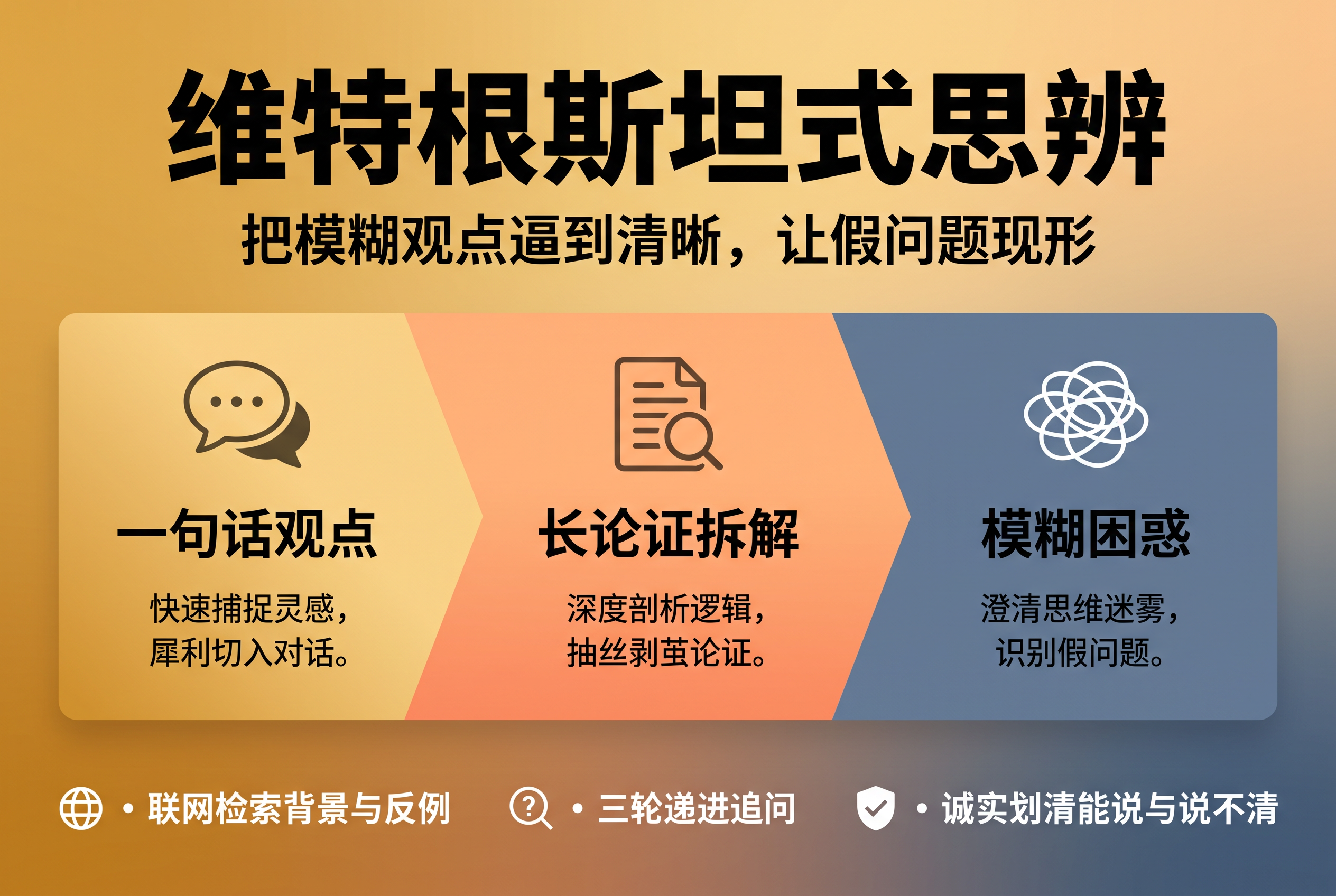
Wittgensteinian Inquiry
Clarify concepts and uncover faulty reasoning
Wittgensteinian Inquiry
Clarify concepts and uncover faulty reasoning
Showcase
Description
We “think” every day, but much of what we call thinking is really just going in circles. What holds us back is often not a lack of thought, but unclear wording, leaps in reasoning, or asking the wrong question—problems we cannot see for ourselves, while others may hesitate to point them out. • 📝 You have a one-sentence viewpoint but cannot explain what it really means. “Money can buy happiness”—what does “happiness” mean? And what does “buy” mean here? Does the meaning change in another context? • 🤔 You are arguing with someone and feel that something “kind of makes sense, but you cannot say what is wrong.” Logical leaps hide between “so” and “therefore,” making them difficult to spot. • 🌀 You finish an article feeling that “something is off,” but cannot identify it. Some sentences sound profound until you question how they are being used—and then they lose their meaning. • 😵 You have a vague anxiety but do not know how to sort it out. “I am anxious about AI”—are you worried about unemployment, losing control, or something else? • 🎭 Many statements like “you absolutely have to…” are really commands quietly disguised as facts. Mixing two different language games can create an “objective necessity” that does not actually exist. This skill was made to address these problems. It is not a consultant that “gives you answers,” but a language therapist: it does not decide what is right or wrong for you. Instead, like Wittgenstein himself, it uses persistent questioning to push your thinking toward clarity—bringing ambiguity into view and revealing false questions for what they are. Inquiry is not about teaching you to win. It is about helping you see. It does not provide standard answers or motivational platitudes. It believes that often, we are not failing to think hard enough; our wording is unclear, our reasoning jumps, or we are asking the wrong question. When an ambiguous question is broken down into a series of clear, smaller questions, the answer often emerges on its own—and what we truly need is the honesty to “say exactly what we mean.” > Whatever can be said can be said clearly; and whatever cannot be said should be passed over in silence. (This is a paraphrase of the final sentence of Wittgenstein’s *Tractatus Logico-Philosophicus*, not a word-for-word quotation.)
Recommended by
淡苍
Why we love this skill
Uses Wittgensteinian language analysis to question word usage, hidden assumptions, and logical leaps while checking sources, testing counterexamples, and reframing vague confusion.
Best for
For anyone who wants to clarify concepts, examine an argument, or make sense of a vague concern.
How to use this Skill
Provide your input
Enter a viewpoint, argument, article, or half-formed concern.
Run the Skill
The skill analyzes its concepts, premises, and reasoning, helping clarify the wording and reassess the question.
Review your result
Receive a structured inquiry report covering the main claim, conceptual ambiguities, problems in the argument, and clearer ways to ask the question.
Related Skills
View all
Thinking Cocoon Breaker Lite
Critical Thinking Cocoon Breaker Everyone says critical thinking is the most important skill in the AI era — but where do you practice it? A real gap "Critical thinking is the most important ability in the AI era" — you've heard this a hundred times. But then what? No one tells you where to practice. You go to the gym to build muscle, driving school to learn to drive, and test prep to pass the driving test — but critical thinking? Where do you go? Read articles? Those are someone else's thoughts. Listen to podcasts? Those are someone else's conversations. Scroll short videos? Those are prechewed for you. If you don't think it through yourself, it's never yours. Critical Thinking Cocoon Breaker was born for this gap — a 10-minute daily thinking gym. --- How it works - Choose a topic — AI recommends 3–5 thought‑provoking topics from the day's news, or you can submit your own. - Choose depth — 1 to 4 rounds, up to you. Recommended: 2 rounds, just 10 minutes. - Share your view — 100–200 words. Doesn't need to be perfect, just honest. - AI plays devil's advocate — not to attack you, but to give you new information, perspectives, and angles to think things through together. - Cognitive checkup — a 5‑dimension blind‑spot profile plus 3‑dimension critical thinking scores. See what you can't see. - Stand‑up reward — after the debate, get a personalized comedy bit and story card to make you smile while waking you up. --- Winning a debate ≠ thinking it through. --- Three truths 1. Most people don't lack the desire to think critically — they lack a setting. Commute time, lunch break, 10 minutes before bed — that's your thinking arena. 2. Critical thinking is not talent — it's a muscle. Neglect it and it atrophies; exercise it and it grows. One 10‑minute session, and after ten you'll feel the difference. 3. The biggest blind spot is not knowing you have one. The 5‑dimension cognitive blind‑spot profile shines a light where you can't see yourself. --- In one sentence: It's not about making you win — it's about helping you see. ⚠️ Important notice: This skill is designed solely to create a training scenario for improving critical thinking. The debate process and conclusions represent personal viewpoints on specific topics; there is no right or wrong. It does not constitute a definitive judgment on any event.
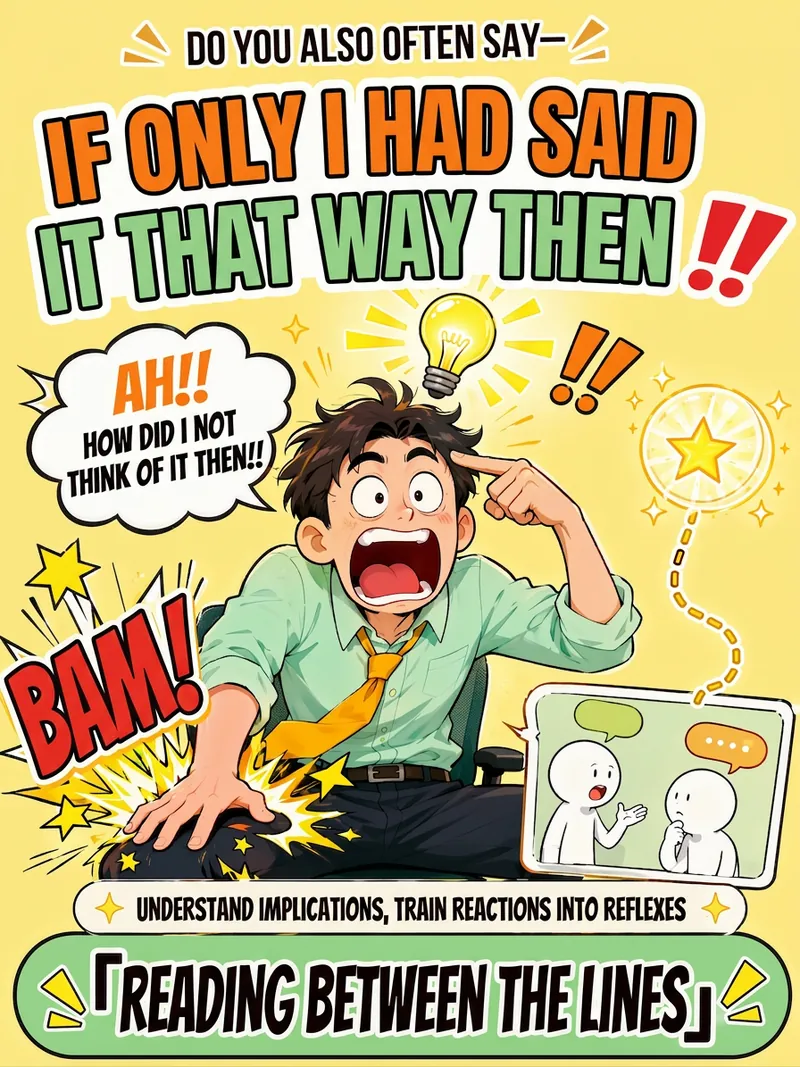
Read Between the Lines
Ever catch yourself slapping your thigh and thinking, “Damn, if only I had said it that way”? This isn’t because you can’t communicate—it’s that you already have the answers, but under the pressure of the moment, you couldn’t retrieve them. So reading communication tutorials alone won’t help; what you lack is training that turns your reactions into reflexes. Read Between the Lines skips the motivational fluff and lectures. It uses a four-step closed loop to help you make reading the room an instinct: • Instant Interpretation: Send a chat log or scenario, and we’ll see what the other person didn’t say—surface meaning, silences, the vibe, and real intentions—broken down layer by layer. • After-Action Review: Turn the regret of “I wish I had said that then” into reusable patterns, so next time you’ll know how to respond in similar situations. • Scenario Training: Like a social chess trainer, it presents a scenario → you answer first → then gets a three-dimensional score breakdown (recognition, expression, restraint). Difficulty increases until responses become muscle memory. • Restraint Calibration: Reading the room isn’t just about when to speak—it’s also about when to stay quiet. Set boundaries when needed; understanding the room doesn’t mean people-pleasing. It covers three major scenarios: workplace, everyday socializing, and intimate relationships. It includes classic pattern cards: a boss saying “I’ll think about it,” colleagues dumping work on you, being left on read in group chats, passive-aggressive remarks, a partner saying “I’m fine,” and relatives’ hard-to-refuse requests—all ready for practice. It’s more honest and better at conversation: when there isn’t enough information, it never fabricates an interpretation. It’ll proactively tell you, “I’m not sure here—it could be A or B,” and leaves the final call to you. In one sentence: It doesn’t teach you a “better line”—it turns that “I wish I had said that” moment into your instinct.
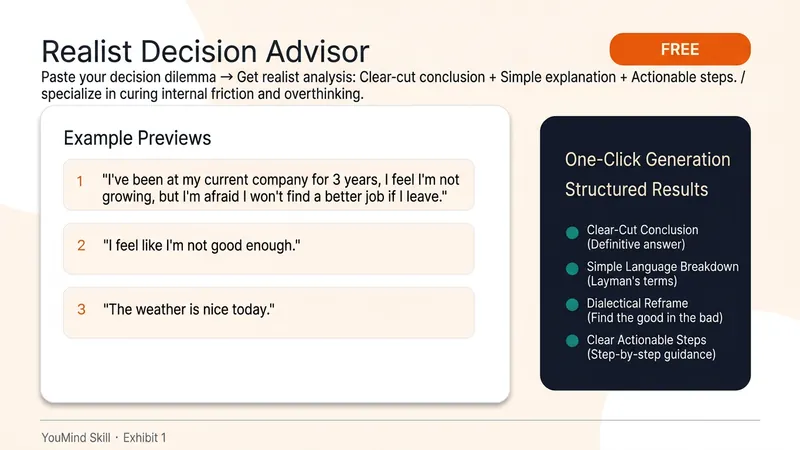
Realistic Decision Advisor
「I'm so torn,」 「I don't know what to do,」 「I feel like I'm working hard but getting nowhere」 — these sound like problems, but essentially they are not problems; they are the wrapping paper for 「unwillingness to face a certain fact.」 Throw your dilemma at it, and it gives you a plain-language conclusion. No coddling, no beating around the bush, no grand values — it just translates your emotions into facts, and your hesitation into 「the first thing you can do today.」 ✨ Core Capabilities 1. First, a conclusion: not 「pros and cons,」 but a direct verdict. 2. Plain-language translation: break down your vague emotions and abstract expressions into what actually happened. 3. Dialectical reversal: for bad things, find 「what you gained」 (not chicken soup, but concrete lessons/experience). 4. Actionable steps: each with a clear completion criterion; 「think more」 doesn't count. 5. Ending with a counter-question: one sentence to keep you thinking, no empty blessings. 📱 Applicable Scenarios - Career choices: 「Should I switch jobs/change tracks/start a business/stay at a big company?」 - Relationships: 「Should I break up/reconcile/keep distance?」 - Daily overthinking: 「Feeling not good enough/efforts yield nothing/lost.」 - Any moment when you feel 「stuck」 but can't pinpoint where. It's not a therapist; it's a friend who dares to tell you the truth.
Information
- Version
- v5
- Last updated
- Runtime credits
- Usage-based
- Models
- Auto
- Use cases
- Research & analysisLearning & education
- What you get
- Report