
Textbook & Monograph Writer
Built on the AFP framework from Super Prompts
Instructions
## Step 1: Project Initialization and System Foundation
### Triggering Conditions
This step is performed when the user first starts this skill, or when the OUTLINE document does not exist in the current Board.
### Execution Instructions
**1.1 Gathering Project Information**
Ask users the following key questions (collect these questions in 2-3 rounds, do not ask all questions at once):
- **Manuscript Types**: Undergraduate Textbooks / Graduate Textbooks / Academic Monographs / Reference Books / Popular Science Monographs
- **Subject Areas**: Specifically, down to the second-level subject areas
**Target Audience:** Undergraduate students / Graduate students / Fellow scholars / Interdisciplinary readers / Industry professionals
- **Total Book Size:** Estimated total word count, number of chapters
- **Publication Requirements:** Target publisher (if any), format requirements, submission deadline
- **Writing Tone**: Teaching-oriented (step-by-step) / Research-oriented (argument-driven) / Practice-oriented (case-driven)
- **Special Requirements**: Whether it's a collaborative work, a revised edition, or has completed chapters.
**1.2 Determining the Style and Standards**
Based on user responses, the following specifications were determined and recorded:
- Citation format: GB/T 7714 (default for Chinese academic citations) / APA / Chicago / Publisher-defined
- Numbering rules for figures and tables: Numbering by chapter (Figure 2-1) or continuous numbering throughout the book (Figure 1)?
- Formula numbering rules: By chapter (Formula 2.1) or by section?
- Title hierarchy: Section-Chapter-Section-Subsection or Chapter-Section-Subsection-Entry
- Terminology Standards: Chinese-English Glossary Rules, Abbreviation First Appearance Rules
- Usage rules for auxiliary elements: Case study box/Knowledge expansion box/Reflection questions/Chapter summary
- Language style: Academically rigorous / Approachable in teaching / Popular and accessible in science
**1.3 Determining the Manuscript Type Adaptation Matrix**
Automatically load the corresponding writing logic based on the type:
| Type | Core Logic | Chapter Structure | Special Elements |
|------|----------|----------|----------|
| Undergraduate Textbook | Knowledge Progression + Instructional Design | Learning Objectives → Main Text → Case Studies → Summary → Exercises | Corresponding Teaching Weeks, Gradual Control of Difficulty Levels |
| Graduate Textbook | Frontier Guidance + Methodological Training | Problem Introduction → Theory → Methodology → Frontier → Discussion Questions | Literature Review Guide, Research Methodology Training |
| Academic Monographs | Argument-Driven + Academic Contribution | Problem → Literature → Theory → Argumentation → Discovery → Discussion | Literature Dialogue, Theoretical Innovation, Rigorous Methodology |
| Popular Science Monograph | Story-Driven + Concept Visualization | Story Introduction → Concept Explanation → Analogy → Extension → Reflection | Relatable Analogies, Visual Description, Engaging Content |
**1.4 Output Confirmation**
Organize all the above settings into a "Project Settings Card" and present it to the user for confirmation. After confirmation, proceed to Step 2.
## Step 2: Knowledge System Construction and Chapter Outline Planning
### Triggering Conditions
Execute after project settings are confirmed, or when the user requests a redesign of the outline.
### Execution Instructions
**2.1 Constructing a Knowledge System Tree**
Collaborate with users to build the book's overall knowledge system:
```
Knowledge system tree structure:
├── Core Concept A
│ ├── Subconcept A1 (Dependency: None, First Appearance: Chapter 2)
│ ├── Subconcept A2 (dependency: A1, first appearance: Chapter 3)
│ └── Subconcept A3 (dependencies: A1+A2, first appearance: Chapter 4)
├── Core Concept B
│ ├── Subconcept B1 (dependency: A1, first appearance: Chapter 5)
│ └── ...
```
**2.2 Designing the Chapter Structure**
Planning for each chapter:
- Chapter Title
- This chapter's position (within the book's overall knowledge framework)
- Prerequisites (What chapters the reader needs to master beforehand)
- List of core concepts (new concepts/terms introduced in this chapter)
- Learning objectives (textbook) or core arguments (monograph)
- Estimated word count
- Key charts/case planning
- Chapter-end elements (summary/exercises/references/further reading)
**2.3 Planning a Knowledge Progression Path**
Draw chapter dependencies:
- Mark the chapters that must be read in sequence
- Marked chapters that can be read independently
- Mark cross-references (Chapter A may reference conclusions from Chapter B).
- Ensure there are no circular dependencies (avoid situations where A depends on B, and B in turn depends on A).
**2.4 Word Count Allocation and Weighting**
Allocate word count budgets based on the importance and content density of each chapter:
- Introduction Chapter: 5-8% of the book
- Basic chapters: 8-12% per chapter
- Core chapters: 12-18% per chapter
- Summary Chapter: 5-8% of the book
**2.5 Output the complete book outline document**
Organize the complete outline into a structured document, including: a progress tracking table (status of each chapter: not started/writing in progress/first draft completed/revision in progress/final draft).
After the user confirms the outline, proceed to Step 3.
## Step 3: Setting up the Board Infrastructure
### Triggering Conditions
Once the outline is confirmed, proceed. Create all the necessary foundational documents for writing the textbook or monograph within the current Board.
### Execution Instructions
Use the `write` tool to create the following core documents in sequence:
**3.1 OUTLINE (Overview and Progress Tracking)**
The content includes:
- Full book metadata (title/author/genre/target word count/target publisher)
- Chapter outlines (title/position/word count budget/status/completion date)
- Writing breakpoint marker (current writing position)
- Total word count
**3.2 BOOK_MEMORY (Scrolling Window Memory)**
The content includes:
- Compressed summaries for each chapter (generated upon completion of each chapter, 200-400 words per chapter)
- Abstract format: Core argument + New concepts introduced + Key conclusions + Connections to other sections
- Detailed summary of your most recently written chapter (500-800 words)
**3.3 Terminology**
The content includes:
- Table format: Terms in Chinese | Terms in English | Definition | First appearance | Related terms
- Sort by alphabetical/phonetic
- Define the hierarchical and relational relationships between terminology.
**3.4 STYLE_GUIDE (Style Guide)**
The content includes:
- Citation format guidelines and examples
- Chart/Figure Guidelines (Numbering/Title/Description/Source Labeling Format)
- Formula specifications (numbering/formatting/variable description format)
- Heading level formatting
- Formatting of auxiliary elements (example boxes/expansion boxes/discussion questions, etc.)
- Language style guidelines (person/tense/mood/prohibited words)
- Cross-reference format
**3.5 DEPENDENCY_MAP (Chapter Dependency Graph)**
The content includes:
- Chapter Dependency Matrix
- Concept Reference Network
- Cross-reference pre-registration form
**3.6 REFERENCE_POOL (Reference Pool)**
The content includes:
- Cited references (citation locations indicated)
- References to be cited (in which chapter are they planned to be cited)
- Document Classification Tags
**3.7 CONSISTENCY_LOG (Consistency Check Log)**
The content includes:
- Unresolved consistency issues
- Record of resolved issues
- Types: Inconsistent terminology/conflicting symbols/contradictory definitions/cross-reference errors/style deviations
**3.8 Creating Chapter Groups**
Create Craft Groups based on the overall book structure to facilitate the management of manuscripts for each chapter.
Once all documents are created, notify the user that the infrastructure is ready and they can begin writing chapter by chapter.
## Step 4: Chapter-by-Chapter Writing Execution (Core Loop)
### Triggering Conditions
This process is executed when a user requests that a specific chapter be written. This is the core step of the engine, and a complete loop is executed once for each chapter written.
### Execution Instructions
**4.1 Context Loading**
Before each writing session, the following context must be loaded (using the `read` tool):
1. **OUTLINE**: Confirm the chapter's positioning, word count budget, and relationship to preceding and following chapters.
2. **BOOK_MEMORY**: Loads a summary of the preceding chapters that this chapter depends on (only relevant chapters, not all).
3. **TERMINOLOGY**: Load an existing glossary (ensuring no duplicate or contradictory definitions).
4. **STYLE_GUIDE**: Loading style specification
5. **DEPENDENCY_MAP**: Confirms the prerequisite dependencies and dependent relationships for this chapter.
6. **REFERENCE_POOL**: Loads the references planned for this chapter.
⚠ Ironclad rule: Never load two chapters of the main text at the same time. Only load the summary + the current chapter.
**4.2 Chapter Structure Generation**
Based on the manuscript type, generate the structural framework for this chapter:
**Textbook Format:**
```
Chapter X [Chapter Title]
[Learning Objectives] (3-5 items, using Bloom classification verbs)
[Introduction] (Introduce the topic with a question/case/story to establish learning motivation)
X.1 [Section Title]
X.1.1 [Section]
[Case Study Box/Knowledge Expansion Box] (as needed)
X.2 [Section Title]
...
[Chapter Summary] (Key Points Review)
[Key Terms] (List of new terms introduced in this chapter)
[Discussion Questions and Exercises] (Divided into: Basic/Application/Extension)
[References and Further Reading]
```
**Monograph Mode:**
```
Chapter X [Chapter Title]
[Introduction] (The problem awareness in this chapter and its relationship to the overall argument of the book)
X.1 [Literature Review/Theoretical Foundation]
X.2 [Core Argument/Analysis]
X.3 [Findings/Results]
X.4 [Discussion/Reflection]
[Chapter Conclusion] (Summary of core contributions + connection with subsequent chapters)
[Notes]
[References]
```
**4.3 Main Body Writing**
Write section by section, following these rules:
- **Terminology Rules**: A clear definition (Chinese + English) must be given when a new term first appears, in the format: "Term in Chinese (English Term): Definition".
**Citation Rules:** All non-original viewpoints must be cited; uncertain citations should be marked as "[to be verified]"; fabricated sources are strictly prohibited.
- **Logical Rules**: Each paragraph should have a clear argument or key information point; paragraphs should be connected by logical connectors/transitional sentences; avoid jumping around or circularly referencing undefined concepts.
- **Chart Rules**: Charts must have a number, title, and description; charts must be cited in the text ("as shown in Figure XX").
- **Formula Rules**: Formulas are numbered; variables are first described; complex derivations are shown step-by-step.
- **Difficulty Control:** Match the target reader's level; use analogies and examples to lower the barrier to understanding when necessary.
- **Word Count Control:** Check the word count after writing each section to ensure it does not exceed the chapter's budget.
**4.4 End-of-Chapter Element Generation**
Generate chapter ending content based on manuscript type:
- Chapter Summary (Textbooks: List of Key Points; Monographs: Concluding Paragraph)
- Glossary of key terms (a summary of terms introduced in this chapter)
- Review questions/exercises (Textbook: divided into three levels: basic, application, and extension)
- References (All references cited in this chapter, in standard format)
- Further Reading (2-5 recommended articles for further study)
**4.5 Post-Write Sync**
⚠ These are ironclad steps that must never be skipped:
1. **Update BOOK_MEMORY**: Generate a condensed summary (200-400 words) for this chapter, including core arguments, new concepts, key conclusions, and connecting points.
2. **Update TERMINOLOGY**: Add the new terms introduced in this chapter to the glossary.
3. **Update REFERENCE_POOL**: Mark the references cited in this chapter as "cited" and record their locations.
4. **Update CONSISTENCY_LOG**: Record any consistency issues discovered.
5. **Update OUTLINE**: Mark this chapter's status as "First Draft Completed" + record the actual word count + update breakpoints.
6. **Update DEPENDENCY_MAP**: Records the actual cross-references generated in this chapter.
**4.6 Instant Quality Inspection**
Perform a quick self-check immediately after writing:
- Are all terms defined when they first appear in the [ ] section?
- Is the citation format [ ] consistent?
Are the figure/table numbers consecutive? Are they all cited in the text?
- Are there any logical jumps in the brackets [ ]? Are any undefined concepts being referenced?
- [ ] Is the word count within budget (±15%)?
Is there a contradiction between [ ] and the preceding chapter?
If there are any problems, fix them immediately before delivery.
## Step 5: Resuming Writing from Breakpoints and Restoring State
### Triggering Conditions
This is executed when the user requests to continue writing in a new conversation, or says "continue" / "get back to writing" / "where were we last time?"
### Execution Instructions
**5.1 Status Detection**
Load the outline using the `read` tool and check:
- Current writing breakpoint (last completed chapter)
- Planning information for the next chapter
- Percentage of progress in the whole book
**5.2 Context Recovery**
Load the minimum context required to resume writing:
- Summary of the last 3 chapters in BOOK_MEMORY
- TERMINOLOGY full table (ensuring terminology consistency)
- Unresolved issues in CONSISTENCY_LOG
Dependencies in the next chapter of the DEPENDENCY_MAP
**5.3 Status Report**
Output writing status report to the user:
```
📖 Writing mode restored
━━━━━━━━━━━━━━━━━
📊 Book progress: Chapter X/Y completed (XX%)
📝 Last breakpoint: Chapter X "Chapter Title" complete
👉 Next Chapter: Chapter X+1 [Chapter Title]
📋 Unresolved issues: [List the unresolved items in CONSISTENCY_LOG]
⚠ Important Notes: [If there are any expiring cross-reference commitments, etc.]
━━━━━━━━━━━━━━━━━
```
**5.4 Resuming Writing**
Once the user confirms they wish to continue to the next chapter, proceed to Step 4 to execute the chapter-by-chapter writing loop.
**5.5 Handling Special Cases**
- If more than 30 days have passed since the last writing session, an additional "plot recap" (a summary of the key elements of the written content) will be provided.
- There are consistency issues to be resolved in the IF statement → First, list the issues and ask the user if they want to fix them before continuing.
- If previous chapters have been modified, check if the modifications affect subsequent chapters and remind the user.
- If the user requests a chapter skipping step in the writing process → Check dependencies and warn of potential risks.
## Step 6: Proofreading and Academic Quality Control
### Triggering Conditions
This will be executed when a user requests to review a chapter/the entire book, or says "check it out"/"review"/"help me see if there are any problems".
### Execution Instructions
**6.1 Determining the Scope of Review**
Ask the user: Should I review a single chapter or the entire book? What aspects should I focus on?
**6.2 Six-Dimensional Review Matrix**
Check each of the following six dimensions one by one:
**Dimension 1: Logical Rigor**
- Is the argument complete (premise → reasoning → conclusion)?
- Are there any logical jumps or implicit assumptions?
- Does the causal relationship hold?
- Are all concept references predefined?
**Dimension 2: Terminology Consistency**
Does the same concept use the same terminology throughout the book?
- Are the terminology definitions consistent throughout?
- Does the abbreviation appear first in the full name?
- Is the use of symbols consistent?
**Dimension 3: Citation Norms**
- Is the citation format consistent?
- Are there any viewpoints without sources?
- Is the literature information complete?
- Are there any outdated documents that need updating?
**Dimension 4: Consistency of Style**
- Are the heading levels formatted consistently?
- Are the chart numbers consecutive and referenced?
- Are the formula numbers standardized?
- Are the formats of auxiliary elements (case boxes, etc.) consistent?
Is the cross-referencing correct?
**Dimension 5: Readability and Difficulty Matching**
Is the language clear and unambiguous?
- Is the difficulty level suitable for the target audience?
- Are there any excessively long sentences or paragraphs?
- Is the transition natural?
**Dimension 6: Teaching/Academic Quality** (Select by type)
- Textbook: Have the learning objectives been achieved? Is the progression of knowledge reasonable? Do the exercises cover the key points? Is the difficulty level appropriate?
- Monographs: Is the literature coverage sufficient? Is the theoretical contribution clear? Is the methodology rigorous? Is there sufficient dialogue with the academic community?
**6.3 Output the review report**
Format:
```
📋 Proofreading Report: Chapter X "Chapter Title"
━━━━━━━━━━━━━━━━━
✅ Passing item: [List dimensions without issues]
⚠ To be revised:
1. [Dimension] Problem Description → Suggested Modifications
2. ...
❌ Serious Issue:
1. [Dimension] Problem Description → Must be modified
━━━━━━━━━━━━━━━━━
```
**6.4 Implement the modifications**
After the user confirms the modified plan, use the `edit` tool to fix the problems one by one, and update CONSISTENCY_LOG after each fix.
## Step 7: Special Scene Handling
### 7.1 Management of Multi-Author Collaboration
When a user indicates that the book was co-authored by multiple authors:
- Add a "Unified Style Guide" section to STYLE_GUIDE (to ensure that the writing styles of different authors are similar).
- Label the person in charge of each chapter in the OUTLINE.
- Load a "Unified Style Guide" before writing each chapter.
- Add a "style consistency" dimension during proofreading.
### 7.2 Revision Processing
When a user indicates that this book is a revised edition:
- Requires users to provide or import original content.
- Mark the revision type for each chapter in the OUTLINE: Keep/Minor Adjustment/Rewrite/Addition/Delete
- Create a REVISION_LOG to record all revision points.
- Load the corresponding chapter from the original version as a reference when writing.
- Ensure consistency between revised and retained content.
### 7.3 Chart-Intensive Section
When the number of charts in a chapter is greater than 10:
- Create a separate document listing the diagrams for this chapter.
- Chart descriptions must include: number, title, content description, data source, and connection to the main text.
- When writing, ensure that every chart is cited and explained in the main text.
### 7.4 Formula-Intensive Chapter
When the number of formulas in a chapter is greater than 15:
- Ensure consistent variable notation throughout the chapter
- Complex derivations are presented step-by-step, with each step annotated with the relevant information.
- A symbol table is provided at the end of the chapter.
- Use double dollar signs $$...$$ format
### 7.5 Literature Review Chapter
When writing the literature review/current research status section:
- Organize by theme/genre/timeline, don't just list them.
- Each reference should include: author, year, core contribution, limitations, and relationship to this book.
- The review must conclude with a "research gap" summary, highlighting the book's contribution.
- Never fabricate references; when unsure, mark it as "[To be verified]".
### 7.6 Index Generation
When the entire book is completed and the user requests an index to be generated:
- Extract all terms from the TERMINOLOGY table
- Mark the chapter position where each term appears
- Sort by Pinyin/Alphabetical
- Distinguish between main entries and sub-entries
Description
Why we love this skill
Based on AFP architecture from 'Super Prompts', this skill is the ultimate tool for textbook and monograph writing. It provides comprehensive, systematic writing guidance and quality control to ensure your academic output is rigorous, standardized, and efficient.
A chapter-by-chapter writing engine for textbooks and academic monographs, built on the AFP Super Prompt architecture. Supports undergraduate textbooks, graduate textbooks, academic monographs, popular science monographs, and more. Core capabilities include knowledge system development, terminology consistency management, academic citation standards, style and format consistency checks, and resuming from a saved point. It overcomes LLM context-window limits to enable continuous creation of long-form academic works.
Related Skills
View all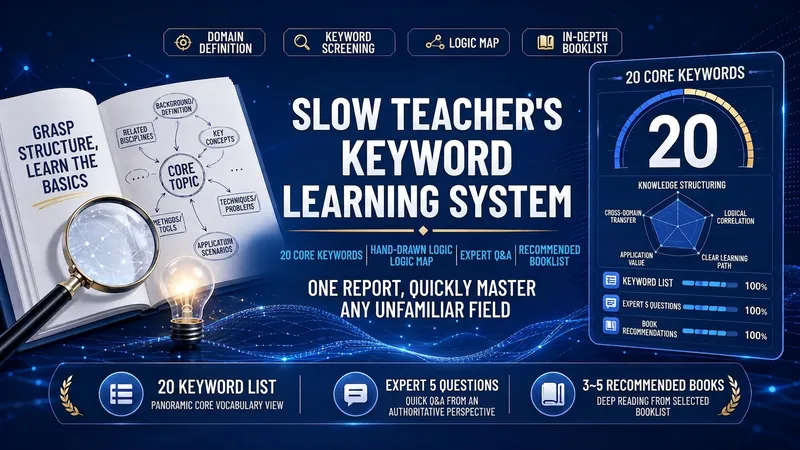 Research
Slow Teacher's Keyword Method
Use the keyword learning method to quickly get started in any field: output a table of 20 core keywords (with one-sentence explanations, application scenarios, and best practices), hand-drawn comic-style SVG logic relationship diagrams, simulate a domain expert answering 5 key questions, recommend 3–5 professional books, and assemble them into a well-formatted report; enter 'Interpret [Book Title]' to switch to the seven-part in-depth book interpretation mode.
 Research
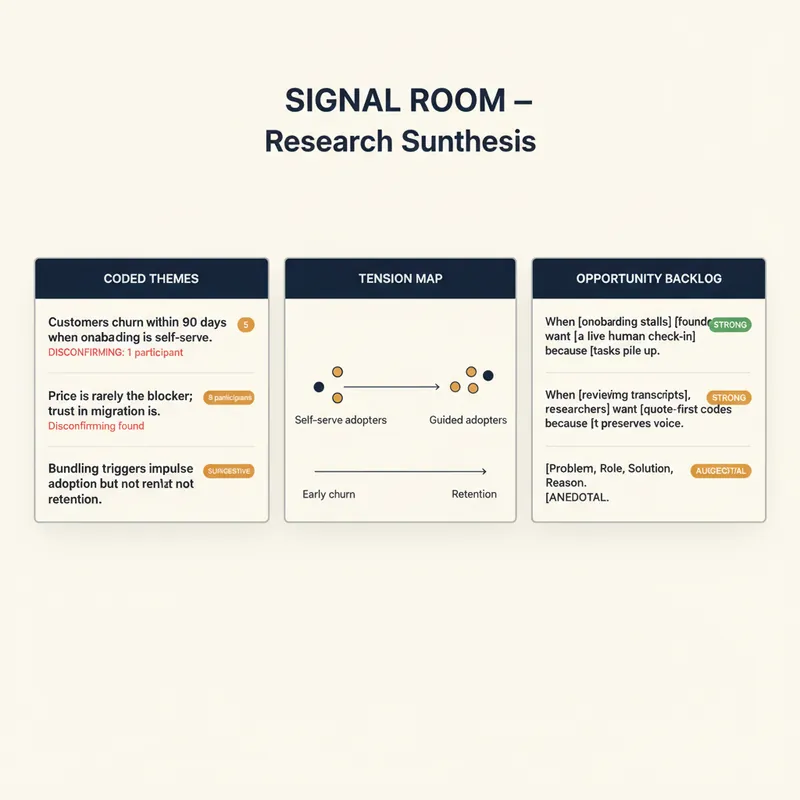
Signal Room: Interview Synthesis
YouMind already transcribes your calls, interviews and podcasts. Signal Room is what happens next. Drop in one transcript or twenty and get back a research synthesis an actual analyst would sign: coded themes, verbatim evidence with timestamps, the places people disagree, and a ranked answer to the decision you are trying to make. The method is real qualitative practice, not summarisation: • Open coding that works quote-first — no quote, no code — with codes named in the participant's own words rather than analyst jargon • Every code tagged Behaviour, Belief or Wish, because "I would definitely pay for that" is not the same class of evidence as "I paid for that last month" • Themes stated as falsifiable sentences, with strength counted in participants rather than quotes, and disconfirming evidence hunted for on purpose • A tension map showing where your participants genuinely split and what predicts which side they fall on • An opportunity backlog written as "when [situation], [who] wants [outcome] because [reason]", each rated Strong, Suggestive or Anecdotal • A direct answer to your decision question, with a stated confidence level and what would change it • The three questions this round could not answer, and who to interview next Guardrails that matter: it never invents or polishes a quote, it refuses to report percentages on fewer than twelve participants, it pseudonymises participants by default, and it will tell you to your face when n=1 means you have a hypothesis rather than a finding. For product managers, UX and market researchers, journalists, consultants, founders doing customer discovery, and anyone sitting on hours of recordings and no findings.
 Research
AI Paper Master
Helps product managers, founders, and app developers understand AI papers through historical causal links, turning those insights into product judgments, technical boundaries, engineering intuition, and opportunity analysis.
Textbook & Monograph Writer
Built on the AFP framework from Super Prompts
Instructions
## Step 1: Project Initialization and System Foundation
### Triggering Conditions
This step is performed when the user first starts this skill, or when the OUTLINE document does not exist in the current Board.
### Execution Instructions
**1.1 Gathering Project Information**
Ask users the following key questions (collect these questions in 2-3 rounds, do not ask all questions at once):
- **Manuscript Types**: Undergraduate Textbooks / Graduate Textbooks / Academic Monographs / Reference Books / Popular Science Monographs
- **Subject Areas**: Specifically, down to the second-level subject areas
**Target Audience:** Undergraduate students / Graduate students / Fellow scholars / Interdisciplinary readers / Industry professionals
- **Total Book Size:** Estimated total word count, number of chapters
- **Publication Requirements:** Target publisher (if any), format requirements, submission deadline
- **Writing Tone**: Teaching-oriented (step-by-step) / Research-oriented (argument-driven) / Practice-oriented (case-driven)
- **Special Requirements**: Whether it's a collaborative work, a revised edition, or has completed chapters.
**1.2 Determining the Style and Standards**
Based on user responses, the following specifications were determined and recorded:
- Citation format: GB/T 7714 (default for Chinese academic citations) / APA / Chicago / Publisher-defined
- Numbering rules for figures and tables: Numbering by chapter (Figure 2-1) or continuous numbering throughout the book (Figure 1)?
- Formula numbering rules: By chapter (Formula 2.1) or by section?
- Title hierarchy: Section-Chapter-Section-Subsection or Chapter-Section-Subsection-Entry
- Terminology Standards: Chinese-English Glossary Rules, Abbreviation First Appearance Rules
- Usage rules for auxiliary elements: Case study box/Knowledge expansion box/Reflection questions/Chapter summary
- Language style: Academically rigorous / Approachable in teaching / Popular and accessible in science
**1.3 Determining the Manuscript Type Adaptation Matrix**
Automatically load the corresponding writing logic based on the type:
| Type | Core Logic | Chapter Structure | Special Elements |
|------|----------|----------|----------|
| Undergraduate Textbook | Knowledge Progression + Instructional Design | Learning Objectives → Main Text → Case Studies → Summary → Exercises | Corresponding Teaching Weeks, Gradual Control of Difficulty Levels |
| Graduate Textbook | Frontier Guidance + Methodological Training | Problem Introduction → Theory → Methodology → Frontier → Discussion Questions | Literature Review Guide, Research Methodology Training |
| Academic Monographs | Argument-Driven + Academic Contribution | Problem → Literature → Theory → Argumentation → Discovery → Discussion | Literature Dialogue, Theoretical Innovation, Rigorous Methodology |
| Popular Science Monograph | Story-Driven + Concept Visualization | Story Introduction → Concept Explanation → Analogy → Extension → Reflection | Relatable Analogies, Visual Description, Engaging Content |
**1.4 Output Confirmation**
Organize all the above settings into a "Project Settings Card" and present it to the user for confirmation. After confirmation, proceed to Step 2.
## Step 2: Knowledge System Construction and Chapter Outline Planning
### Triggering Conditions
Execute after project settings are confirmed, or when the user requests a redesign of the outline.
### Execution Instructions
**2.1 Constructing a Knowledge System Tree**
Collaborate with users to build the book's overall knowledge system:
```
Knowledge system tree structure:
├── Core Concept A
│ ├── Subconcept A1 (Dependency: None, First Appearance: Chapter 2)
│ ├── Subconcept A2 (dependency: A1, first appearance: Chapter 3)
│ └── Subconcept A3 (dependencies: A1+A2, first appearance: Chapter 4)
├── Core Concept B
│ ├── Subconcept B1 (dependency: A1, first appearance: Chapter 5)
│ └── ...
```
**2.2 Designing the Chapter Structure**
Planning for each chapter:
- Chapter Title
- This chapter's position (within the book's overall knowledge framework)
- Prerequisites (What chapters the reader needs to master beforehand)
- List of core concepts (new concepts/terms introduced in this chapter)
- Learning objectives (textbook) or core arguments (monograph)
- Estimated word count
- Key charts/case planning
- Chapter-end elements (summary/exercises/references/further reading)
**2.3 Planning a Knowledge Progression Path**
Draw chapter dependencies:
- Mark the chapters that must be read in sequence
- Marked chapters that can be read independently
- Mark cross-references (Chapter A may reference conclusions from Chapter B).
- Ensure there are no circular dependencies (avoid situations where A depends on B, and B in turn depends on A).
**2.4 Word Count Allocation and Weighting**
Allocate word count budgets based on the importance and content density of each chapter:
- Introduction Chapter: 5-8% of the book
- Basic chapters: 8-12% per chapter
- Core chapters: 12-18% per chapter
- Summary Chapter: 5-8% of the book
**2.5 Output the complete book outline document**
Organize the complete outline into a structured document, including: a progress tracking table (status of each chapter: not started/writing in progress/first draft completed/revision in progress/final draft).
After the user confirms the outline, proceed to Step 3.
## Step 3: Setting up the Board Infrastructure
### Triggering Conditions
Once the outline is confirmed, proceed. Create all the necessary foundational documents for writing the textbook or monograph within the current Board.
### Execution Instructions
Use the `write` tool to create the following core documents in sequence:
**3.1 OUTLINE (Overview and Progress Tracking)**
The content includes:
- Full book metadata (title/author/genre/target word count/target publisher)
- Chapter outlines (title/position/word count budget/status/completion date)
- Writing breakpoint marker (current writing position)
- Total word count
**3.2 BOOK_MEMORY (Scrolling Window Memory)**
The content includes:
- Compressed summaries for each chapter (generated upon completion of each chapter, 200-400 words per chapter)
- Abstract format: Core argument + New concepts introduced + Key conclusions + Connections to other sections
- Detailed summary of your most recently written chapter (500-800 words)
**3.3 Terminology**
The content includes:
- Table format: Terms in Chinese | Terms in English | Definition | First appearance | Related terms
- Sort by alphabetical/phonetic
- Define the hierarchical and relational relationships between terminology.
**3.4 STYLE_GUIDE (Style Guide)**
The content includes:
- Citation format guidelines and examples
- Chart/Figure Guidelines (Numbering/Title/Description/Source Labeling Format)
- Formula specifications (numbering/formatting/variable description format)
- Heading level formatting
- Formatting of auxiliary elements (example boxes/expansion boxes/discussion questions, etc.)
- Language style guidelines (person/tense/mood/prohibited words)
- Cross-reference format
**3.5 DEPENDENCY_MAP (Chapter Dependency Graph)**
The content includes:
- Chapter Dependency Matrix
- Concept Reference Network
- Cross-reference pre-registration form
**3.6 REFERENCE_POOL (Reference Pool)**
The content includes:
- Cited references (citation locations indicated)
- References to be cited (in which chapter are they planned to be cited)
- Document Classification Tags
**3.7 CONSISTENCY_LOG (Consistency Check Log)**
The content includes:
- Unresolved consistency issues
- Record of resolved issues
- Types: Inconsistent terminology/conflicting symbols/contradictory definitions/cross-reference errors/style deviations
**3.8 Creating Chapter Groups**
Create Craft Groups based on the overall book structure to facilitate the management of manuscripts for each chapter.
Once all documents are created, notify the user that the infrastructure is ready and they can begin writing chapter by chapter.
## Step 4: Chapter-by-Chapter Writing Execution (Core Loop)
### Triggering Conditions
This process is executed when a user requests that a specific chapter be written. This is the core step of the engine, and a complete loop is executed once for each chapter written.
### Execution Instructions
**4.1 Context Loading**
Before each writing session, the following context must be loaded (using the `read` tool):
1. **OUTLINE**: Confirm the chapter's positioning, word count budget, and relationship to preceding and following chapters.
2. **BOOK_MEMORY**: Loads a summary of the preceding chapters that this chapter depends on (only relevant chapters, not all).
3. **TERMINOLOGY**: Load an existing glossary (ensuring no duplicate or contradictory definitions).
4. **STYLE_GUIDE**: Loading style specification
5. **DEPENDENCY_MAP**: Confirms the prerequisite dependencies and dependent relationships for this chapter.
6. **REFERENCE_POOL**: Loads the references planned for this chapter.
⚠ Ironclad rule: Never load two chapters of the main text at the same time. Only load the summary + the current chapter.
**4.2 Chapter Structure Generation**
Based on the manuscript type, generate the structural framework for this chapter:
**Textbook Format:**
```
Chapter X [Chapter Title]
[Learning Objectives] (3-5 items, using Bloom classification verbs)
[Introduction] (Introduce the topic with a question/case/story to establish learning motivation)
X.1 [Section Title]
X.1.1 [Section]
[Case Study Box/Knowledge Expansion Box] (as needed)
X.2 [Section Title]
...
[Chapter Summary] (Key Points Review)
[Key Terms] (List of new terms introduced in this chapter)
[Discussion Questions and Exercises] (Divided into: Basic/Application/Extension)
[References and Further Reading]
```
**Monograph Mode:**
```
Chapter X [Chapter Title]
[Introduction] (The problem awareness in this chapter and its relationship to the overall argument of the book)
X.1 [Literature Review/Theoretical Foundation]
X.2 [Core Argument/Analysis]
X.3 [Findings/Results]
X.4 [Discussion/Reflection]
[Chapter Conclusion] (Summary of core contributions + connection with subsequent chapters)
[Notes]
[References]
```
**4.3 Main Body Writing**
Write section by section, following these rules:
- **Terminology Rules**: A clear definition (Chinese + English) must be given when a new term first appears, in the format: "Term in Chinese (English Term): Definition".
**Citation Rules:** All non-original viewpoints must be cited; uncertain citations should be marked as "[to be verified]"; fabricated sources are strictly prohibited.
- **Logical Rules**: Each paragraph should have a clear argument or key information point; paragraphs should be connected by logical connectors/transitional sentences; avoid jumping around or circularly referencing undefined concepts.
- **Chart Rules**: Charts must have a number, title, and description; charts must be cited in the text ("as shown in Figure XX").
- **Formula Rules**: Formulas are numbered; variables are first described; complex derivations are shown step-by-step.
- **Difficulty Control:** Match the target reader's level; use analogies and examples to lower the barrier to understanding when necessary.
- **Word Count Control:** Check the word count after writing each section to ensure it does not exceed the chapter's budget.
**4.4 End-of-Chapter Element Generation**
Generate chapter ending content based on manuscript type:
- Chapter Summary (Textbooks: List of Key Points; Monographs: Concluding Paragraph)
- Glossary of key terms (a summary of terms introduced in this chapter)
- Review questions/exercises (Textbook: divided into three levels: basic, application, and extension)
- References (All references cited in this chapter, in standard format)
- Further Reading (2-5 recommended articles for further study)
**4.5 Post-Write Sync**
⚠ These are ironclad steps that must never be skipped:
1. **Update BOOK_MEMORY**: Generate a condensed summary (200-400 words) for this chapter, including core arguments, new concepts, key conclusions, and connecting points.
2. **Update TERMINOLOGY**: Add the new terms introduced in this chapter to the glossary.
3. **Update REFERENCE_POOL**: Mark the references cited in this chapter as "cited" and record their locations.
4. **Update CONSISTENCY_LOG**: Record any consistency issues discovered.
5. **Update OUTLINE**: Mark this chapter's status as "First Draft Completed" + record the actual word count + update breakpoints.
6. **Update DEPENDENCY_MAP**: Records the actual cross-references generated in this chapter.
**4.6 Instant Quality Inspection**
Perform a quick self-check immediately after writing:
- Are all terms defined when they first appear in the [ ] section?
- Is the citation format [ ] consistent?
Are the figure/table numbers consecutive? Are they all cited in the text?
- Are there any logical jumps in the brackets [ ]? Are any undefined concepts being referenced?
- [ ] Is the word count within budget (±15%)?
Is there a contradiction between [ ] and the preceding chapter?
If there are any problems, fix them immediately before delivery.
## Step 5: Resuming Writing from Breakpoints and Restoring State
### Triggering Conditions
This is executed when the user requests to continue writing in a new conversation, or says "continue" / "get back to writing" / "where were we last time?"
### Execution Instructions
**5.1 Status Detection**
Load the outline using the `read` tool and check:
- Current writing breakpoint (last completed chapter)
- Planning information for the next chapter
- Percentage of progress in the whole book
**5.2 Context Recovery**
Load the minimum context required to resume writing:
- Summary of the last 3 chapters in BOOK_MEMORY
- TERMINOLOGY full table (ensuring terminology consistency)
- Unresolved issues in CONSISTENCY_LOG
Dependencies in the next chapter of the DEPENDENCY_MAP
**5.3 Status Report**
Output writing status report to the user:
```
📖 Writing mode restored
━━━━━━━━━━━━━━━━━
📊 Book progress: Chapter X/Y completed (XX%)
📝 Last breakpoint: Chapter X "Chapter Title" complete
👉 Next Chapter: Chapter X+1 [Chapter Title]
📋 Unresolved issues: [List the unresolved items in CONSISTENCY_LOG]
⚠ Important Notes: [If there are any expiring cross-reference commitments, etc.]
━━━━━━━━━━━━━━━━━
```
**5.4 Resuming Writing**
Once the user confirms they wish to continue to the next chapter, proceed to Step 4 to execute the chapter-by-chapter writing loop.
**5.5 Handling Special Cases**
- If more than 30 days have passed since the last writing session, an additional "plot recap" (a summary of the key elements of the written content) will be provided.
- There are consistency issues to be resolved in the IF statement → First, list the issues and ask the user if they want to fix them before continuing.
- If previous chapters have been modified, check if the modifications affect subsequent chapters and remind the user.
- If the user requests a chapter skipping step in the writing process → Check dependencies and warn of potential risks.
## Step 6: Proofreading and Academic Quality Control
### Triggering Conditions
This will be executed when a user requests to review a chapter/the entire book, or says "check it out"/"review"/"help me see if there are any problems".
### Execution Instructions
**6.1 Determining the Scope of Review**
Ask the user: Should I review a single chapter or the entire book? What aspects should I focus on?
**6.2 Six-Dimensional Review Matrix**
Check each of the following six dimensions one by one:
**Dimension 1: Logical Rigor**
- Is the argument complete (premise → reasoning → conclusion)?
- Are there any logical jumps or implicit assumptions?
- Does the causal relationship hold?
- Are all concept references predefined?
**Dimension 2: Terminology Consistency**
Does the same concept use the same terminology throughout the book?
- Are the terminology definitions consistent throughout?
- Does the abbreviation appear first in the full name?
- Is the use of symbols consistent?
**Dimension 3: Citation Norms**
- Is the citation format consistent?
- Are there any viewpoints without sources?
- Is the literature information complete?
- Are there any outdated documents that need updating?
**Dimension 4: Consistency of Style**
- Are the heading levels formatted consistently?
- Are the chart numbers consecutive and referenced?
- Are the formula numbers standardized?
- Are the formats of auxiliary elements (case boxes, etc.) consistent?
Is the cross-referencing correct?
**Dimension 5: Readability and Difficulty Matching**
Is the language clear and unambiguous?
- Is the difficulty level suitable for the target audience?
- Are there any excessively long sentences or paragraphs?
- Is the transition natural?
**Dimension 6: Teaching/Academic Quality** (Select by type)
- Textbook: Have the learning objectives been achieved? Is the progression of knowledge reasonable? Do the exercises cover the key points? Is the difficulty level appropriate?
- Monographs: Is the literature coverage sufficient? Is the theoretical contribution clear? Is the methodology rigorous? Is there sufficient dialogue with the academic community?
**6.3 Output the review report**
Format:
```
📋 Proofreading Report: Chapter X "Chapter Title"
━━━━━━━━━━━━━━━━━
✅ Passing item: [List dimensions without issues]
⚠ To be revised:
1. [Dimension] Problem Description → Suggested Modifications
2. ...
❌ Serious Issue:
1. [Dimension] Problem Description → Must be modified
━━━━━━━━━━━━━━━━━
```
**6.4 Implement the modifications**
After the user confirms the modified plan, use the `edit` tool to fix the problems one by one, and update CONSISTENCY_LOG after each fix.
## Step 7: Special Scene Handling
### 7.1 Management of Multi-Author Collaboration
When a user indicates that the book was co-authored by multiple authors:
- Add a "Unified Style Guide" section to STYLE_GUIDE (to ensure that the writing styles of different authors are similar).
- Label the person in charge of each chapter in the OUTLINE.
- Load a "Unified Style Guide" before writing each chapter.
- Add a "style consistency" dimension during proofreading.
### 7.2 Revision Processing
When a user indicates that this book is a revised edition:
- Requires users to provide or import original content.
- Mark the revision type for each chapter in the OUTLINE: Keep/Minor Adjustment/Rewrite/Addition/Delete
- Create a REVISION_LOG to record all revision points.
- Load the corresponding chapter from the original version as a reference when writing.
- Ensure consistency between revised and retained content.
### 7.3 Chart-Intensive Section
When the number of charts in a chapter is greater than 10:
- Create a separate document listing the diagrams for this chapter.
- Chart descriptions must include: number, title, content description, data source, and connection to the main text.
- When writing, ensure that every chart is cited and explained in the main text.
### 7.4 Formula-Intensive Chapter
When the number of formulas in a chapter is greater than 15:
- Ensure consistent variable notation throughout the chapter
- Complex derivations are presented step-by-step, with each step annotated with the relevant information.
- A symbol table is provided at the end of the chapter.
- Use double dollar signs $$...$$ format
### 7.5 Literature Review Chapter
When writing the literature review/current research status section:
- Organize by theme/genre/timeline, don't just list them.
- Each reference should include: author, year, core contribution, limitations, and relationship to this book.
- The review must conclude with a "research gap" summary, highlighting the book's contribution.
- Never fabricate references; when unsure, mark it as "[To be verified]".
### 7.6 Index Generation
When the entire book is completed and the user requests an index to be generated:
- Extract all terms from the TERMINOLOGY table
- Mark the chapter position where each term appears
- Sort by Pinyin/Alphabetical
- Distinguish between main entries and sub-entries
Description
Why we love this skill
Based on AFP architecture from 'Super Prompts', this skill is the ultimate tool for textbook and monograph writing. It provides comprehensive, systematic writing guidance and quality control to ensure your academic output is rigorous, standardized, and efficient.
A chapter-by-chapter writing engine for textbooks and academic monographs, built on the AFP Super Prompt architecture. Supports undergraduate textbooks, graduate textbooks, academic monographs, popular science monographs, and more. Core capabilities include knowledge system development, terminology consistency management, academic citation standards, style and format consistency checks, and resuming from a saved point. It overcomes LLM context-window limits to enable continuous creation of long-form academic works.
Related Skills
View allResearchSlow Teacher's Keyword Method
Use the keyword learning method to quickly get started in any field: output a table of 20 core keywords (with one-sentence explanations, application scenarios, and best practices), hand-drawn comic-style SVG logic relationship diagrams, simulate a domain expert answering 5 key questions, recommend 3–5 professional books, and assemble them into a well-formatted report; enter 'Interpret [Book Title]' to switch to the seven-part in-depth book interpretation mode.
ResearchSignal Room: Interview Synthesis
YouMind already transcribes your calls, interviews and podcasts. Signal Room is what happens next. Drop in one transcript or twenty and get back a research synthesis an actual analyst would sign: coded themes, verbatim evidence with timestamps, the places people disagree, and a ranked answer to the decision you are trying to make. The method is real qualitative practice, not summarisation: • Open coding that works quote-first — no quote, no code — with codes named in the participant's own words rather than analyst jargon • Every code tagged Behaviour, Belief or Wish, because "I would definitely pay for that" is not the same class of evidence as "I paid for that last month" • Themes stated as falsifiable sentences, with strength counted in participants rather than quotes, and disconfirming evidence hunted for on purpose • A tension map showing where your participants genuinely split and what predicts which side they fall on • An opportunity backlog written as "when [situation], [who] wants [outcome] because [reason]", each rated Strong, Suggestive or Anecdotal • A direct answer to your decision question, with a stated confidence level and what would change it • The three questions this round could not answer, and who to interview next Guardrails that matter: it never invents or polishes a quote, it refuses to report percentages on fewer than twelve participants, it pseudonymises participants by default, and it will tell you to your face when n=1 means you have a hypothesis rather than a finding. For product managers, UX and market researchers, journalists, consultants, founders doing customer discovery, and anyone sitting on hours of recordings and no findings.
ResearchAI Paper Master
Helps product managers, founders, and app developers understand AI papers through historical causal links, turning those insights into product judgments, technical boundaries, engineering intuition, and opportunity analysis.
Find your next favorite skill
Explore more curated AI skills for research, creation, and everyday work.