
Academic Poster Generator
Convert an academic paper into a conference poster
Description
Why we love this skill
This skill transforms academic papers into stunning, print-ready conference posters. It intelligently extracts key information and visually highlights the paper's most distinctive features for maximum impact.
Transform an academic research paper PDF into a single portrait academic poster image end-to-end. AI adaptively determines visual style, information density, and color scheme, identifies the paper's "distinctive anchors" and presents them prominently, redraws diagrams, preserves original data charts, recreates evidence visuals (UI screenshots/chat screenshots) as high-fidelity mockups when extraction fails, filters out informal publication markers like preprint pagination, and generates a print-ready high-quality poster.
Related Skills
View all Research
Sprout Signal Translator
In a major industry news story, the company mentioned in the news is often not the one most worth researching. A surge in NVIDIA demand could reshape the server, power, and cooling industries; rapid growth at a private AI company could actually generate revenue for cloud providers, chip designers, and networking suppliers; and a highly publicized CEO speech may not have changed any economic facts. Sprout Signal Translator first verifies the event, then traces the value chain: What happened → What assumption changed → Where is the money flowing → What is the next bottleneck → Who already has the capability to solve it → Has the market already been revalued. It looks for both direct beneficiaries and potential losers, Picks & Shovels, and Emerging Sprout Candidates whose “mature core business provides a safety net while a new industry provides growth options.” When it cannot find a reliable economic transmission path, it allows the output NONE. It does not provide BUY / SELL recommendations, price targets, or return promises. Its goal is not to predict the next skyrocketing stock, but to translate industry changes into research leads worth validating further.
 Research
Slow Teacher's Keyword Method
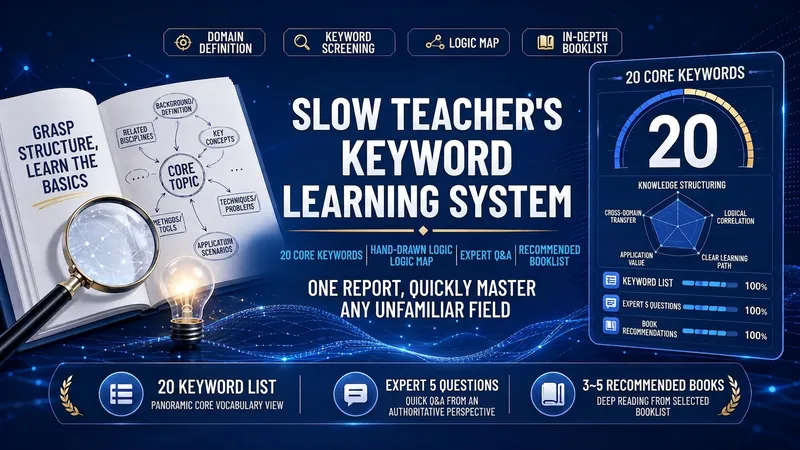
Use the keyword learning method to quickly get started in any field: output a table of 20 core keywords (with one-sentence explanations, application scenarios, and best practices), hand-drawn comic-style SVG logic relationship diagrams, simulate a domain expert answering 5 key questions, recommend 3–5 professional books, and assemble them into a well-formatted report; enter 'Interpret [Book Title]' to switch to the seven-part in-depth book interpretation mode.
 Research
Signal Room: Interview Synthesis
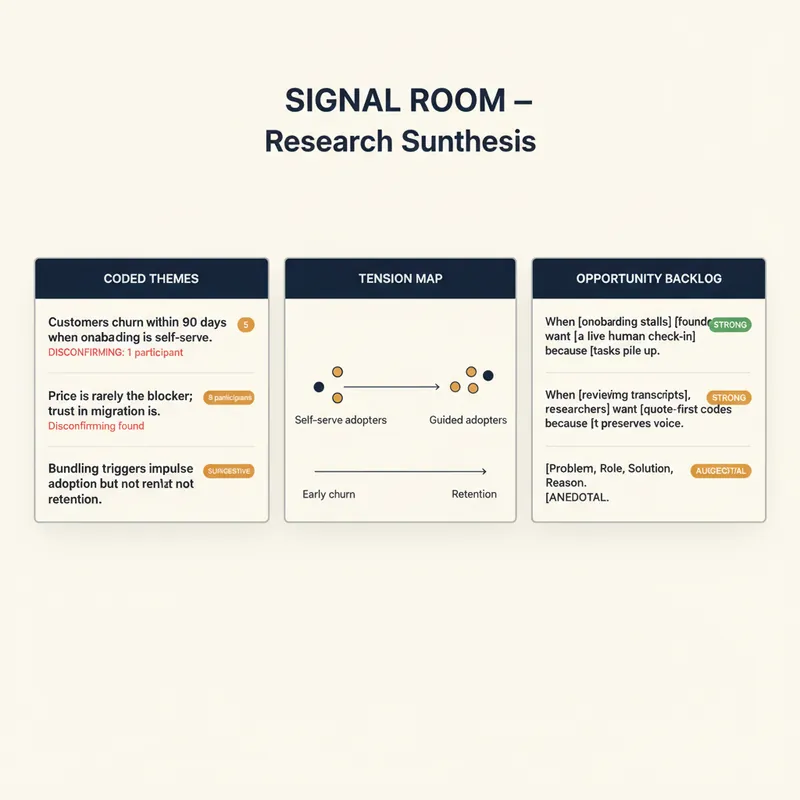
YouMind already transcribes your calls, interviews and podcasts. Signal Room is what happens next. Drop in one transcript or twenty and get back a research synthesis an actual analyst would sign: coded themes, verbatim evidence with timestamps, the places people disagree, and a ranked answer to the decision you are trying to make. The method is real qualitative practice, not summarisation: • Open coding that works quote-first — no quote, no code — with codes named in the participant's own words rather than analyst jargon • Every code tagged Behaviour, Belief or Wish, because "I would definitely pay for that" is not the same class of evidence as "I paid for that last month" • Themes stated as falsifiable sentences, with strength counted in participants rather than quotes, and disconfirming evidence hunted for on purpose • A tension map showing where your participants genuinely split and what predicts which side they fall on • An opportunity backlog written as "when [situation], [who] wants [outcome] because [reason]", each rated Strong, Suggestive or Anecdotal • A direct answer to your decision question, with a stated confidence level and what would change it • The three questions this round could not answer, and who to interview next Guardrails that matter: it never invents or polishes a quote, it refuses to report percentages on fewer than twelve participants, it pseudonymises participants by default, and it will tell you to your face when n=1 means you have a hypothesis rather than a finding. For product managers, UX and market researchers, journalists, consultants, founders doing customer discovery, and anyone sitting on hours of recordings and no findings.
Academic Poster Generator
Convert an academic paper into a conference poster
Description
Why we love this skill
This skill transforms academic papers into stunning, print-ready conference posters. It intelligently extracts key information and visually highlights the paper's most distinctive features for maximum impact.
Transform an academic research paper PDF into a single portrait academic poster image end-to-end. AI adaptively determines visual style, information density, and color scheme, identifies the paper's "distinctive anchors" and presents them prominently, redraws diagrams, preserves original data charts, recreates evidence visuals (UI screenshots/chat screenshots) as high-fidelity mockups when extraction fails, filters out informal publication markers like preprint pagination, and generates a print-ready high-quality poster.
Related Skills
View allResearchSprout Signal Translator
In a major industry news story, the company mentioned in the news is often not the one most worth researching. A surge in NVIDIA demand could reshape the server, power, and cooling industries; rapid growth at a private AI company could actually generate revenue for cloud providers, chip designers, and networking suppliers; and a highly publicized CEO speech may not have changed any economic facts. Sprout Signal Translator first verifies the event, then traces the value chain: What happened → What assumption changed → Where is the money flowing → What is the next bottleneck → Who already has the capability to solve it → Has the market already been revalued. It looks for both direct beneficiaries and potential losers, Picks & Shovels, and Emerging Sprout Candidates whose “mature core business provides a safety net while a new industry provides growth options.” When it cannot find a reliable economic transmission path, it allows the output NONE. It does not provide BUY / SELL recommendations, price targets, or return promises. Its goal is not to predict the next skyrocketing stock, but to translate industry changes into research leads worth validating further.
ResearchSlow Teacher's Keyword Method
Use the keyword learning method to quickly get started in any field: output a table of 20 core keywords (with one-sentence explanations, application scenarios, and best practices), hand-drawn comic-style SVG logic relationship diagrams, simulate a domain expert answering 5 key questions, recommend 3–5 professional books, and assemble them into a well-formatted report; enter 'Interpret [Book Title]' to switch to the seven-part in-depth book interpretation mode.
ResearchSignal Room: Interview Synthesis
YouMind already transcribes your calls, interviews and podcasts. Signal Room is what happens next. Drop in one transcript or twenty and get back a research synthesis an actual analyst would sign: coded themes, verbatim evidence with timestamps, the places people disagree, and a ranked answer to the decision you are trying to make. The method is real qualitative practice, not summarisation: • Open coding that works quote-first — no quote, no code — with codes named in the participant's own words rather than analyst jargon • Every code tagged Behaviour, Belief or Wish, because "I would definitely pay for that" is not the same class of evidence as "I paid for that last month" • Themes stated as falsifiable sentences, with strength counted in participants rather than quotes, and disconfirming evidence hunted for on purpose • A tension map showing where your participants genuinely split and what predicts which side they fall on • An opportunity backlog written as "when [situation], [who] wants [outcome] because [reason]", each rated Strong, Suggestive or Anecdotal • A direct answer to your decision question, with a stated confidence level and what would change it • The three questions this round could not answer, and who to interview next Guardrails that matter: it never invents or polishes a quote, it refuses to report percentages on fewer than twelve participants, it pseudonymises participants by default, and it will tell you to your face when n=1 means you have a hypothesis rather than a finding. For product managers, UX and market researchers, journalists, consultants, founders doing customer discovery, and anyone sitting on hours of recordings and no findings.
Find your next favorite skill
Explore more curated AI skills for research, creation, and everyday work.