
AFP Engineered Prompt Generator
Phased, quality-checked prompts for complex tasks
Description
AFP Engineered Prompt Generator · Master-Level System Architecture 🎯 Core Positioning: A meta-level prompt engineering system — used to generate foundational architecture for other AFP domain skills. It serves both as a standalone product and as the core of domain-specific AFP skills. 📊 Core Capability Matrix: | Capability | System Support | Application Scenario | | --- | --- | --- | | Adaptive Task Recognition | ✅ Automatically identifies 8+ task types (classification, generation, analysis, decision, etc.) | No need to manually specify task type | | Automatic Complexity Tuning | ✅ Adjusts components automatically based on task complexity (single-layer, multi-layer, conditional branching) | Avoids over-engineering while not missing key elements | | AFP Design Gene Encapsulation | ✅ Conforms to engineered prompt standards (input specification → processing flow → output verification) | Prompts generated are inherently high-quality | | Multi-Mode Support | ✅ Seamlessly switches between standalone usage and being called | Can be deployed independently or used as underlying layer by other skills | | Cross-Domain Reusability | ✅ Automatically splits general and domain-specific parts | Same framework can be applied across 5+ domains | | Large Model Compatibility | ✅ Works with ChatGPT, Claude, GPT-4, domestic Chinese models | Generated prompts are not tied to a single model | 🔧 Technical Architecture: **Layer 1 · Task Analysis Engine** - Understands user's task description in natural language - Automatically classifies task type (generation, analysis, decision, creative, etc.) - Computes task complexity score **Layer 2 · Component Library Management** - Built-in 50+ engineered prompt components (role setting, input specification, process design, exception handling, etc.) - Tagged by complexity level (L0 simple / L1 medium / L2 advanced / L3 expert) - Supports selective assembly and custom expansion of components **Layer 3 · AFP Framework Generation** - Organizes prompt structure following AFP design gene (function layering → process orchestration → output formatting) - Automatically generates complete instruction chain - Built-in quality inspection (coverage, redundancy, consistency checks) **Layer 4 · Output and Integration** - Generates plain text prompts (ready to use) - Generates structured configuration files (callable by programs) - Supports version management and iterative optimization 📈 Expected Effect Metrics: | Metric | Improvement | Description | | --- | --- | --- | | Prompt design cycle | From 1-2 weeks → 10-30 minutes | From manual design to automatic generation | | Output quality stability | From 70-80% → 85-92% | Engineered design is inherently more stable | | Cross-domain reuse rate | From 30% → 80%+ | General and special parts are automatically separated | | Team learning cost | From 3-6 months mastery → 1-2 weeks onboarding | New members can quickly reuse quality frameworks | | Large model migration cost | From full rewrite → partial fine-tuning | Framework is stable, model upgrades don't require major changes |
Related Skills
View all
AFP Prompt Architect
AFP Prompt Architect is an intelligent tool designed to help users transform vague business needs into automated AFP (Auto-Flow Prompt) super prompts. Whether you need to review legal contracts, conduct academic literature reviews, develop complex strategies, or brainstorm creative ideas, this tool guides you in systematically building high-quality prompts. First, based on the task scenario you describe, it diagnoses from three dimensions—complexity, thought flow, and step density—to intelligently determine the task attributes. Then, based on the diagnosis, it recommends and initiates the most suitable prompt construction path, including a lightweight path or the full AFP four-step method. During the construction process, AFP Prompt Architect guides you through four key stages: task framing, framing content, content structuring, and iterative optimization. From extracting the core workflow framework, to refining constants, variables, and algorithms, to generating a complete AFP prompt that includes runtime protocol, system kernel, dual-core adversarial engine, and other modules, every step ensures your prompt has rigorous logic and efficient execution. Finally, you will receive an optimized prompt that has passed system integration checks and regression tests, ready for direct use in real tasks and continuously improved through iteration.
AI Prompt Optimization Expert
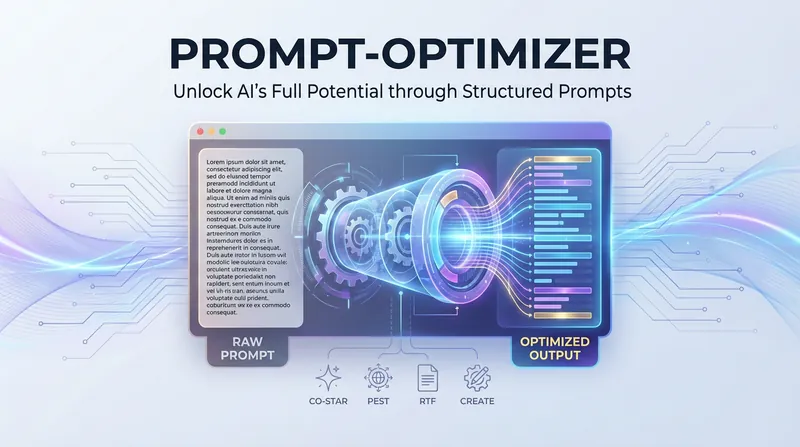
The AI Prompt Optimization Expert focuses on improving prompt quality through a systematic framework, helping you convey your intent precisely and making AI output more stable and predictable. Whether you need to refine existing prompts, build complex task descriptions from scratch, or find professional templates for specific scenarios, this skill provides comprehensive support. It can not only restructure vague requests into structured prompts, but also identify and fix common logical flaws through a diagnostic process. The skill includes a variety of proven optimization frameworks and can flexibly switch strategies based on the nature of the task. For example, for formal documents and professional content, it strengthens the background and audience dimensions; while for code generation or data processing tasks, it focuses more on role definition and specific constraints. In this way, it ensures every prompt has a clear goal, a defined style, and a well-structured output format. In addition, it covers specialized templates for a wide range of high-frequency scenarios, from copywriting and data analysis to technical documentation. You can directly use these proven structures and quickly fill in key details such as core selling points, data descriptions, or reader background. During optimization, the skill also checks against a quality checklist and uses multiple iterations and side-by-side comparisons to help you master essential prompt engineering techniques, significantly reducing communication costs and boosting productivity.
AFP Prompt Engineering OS
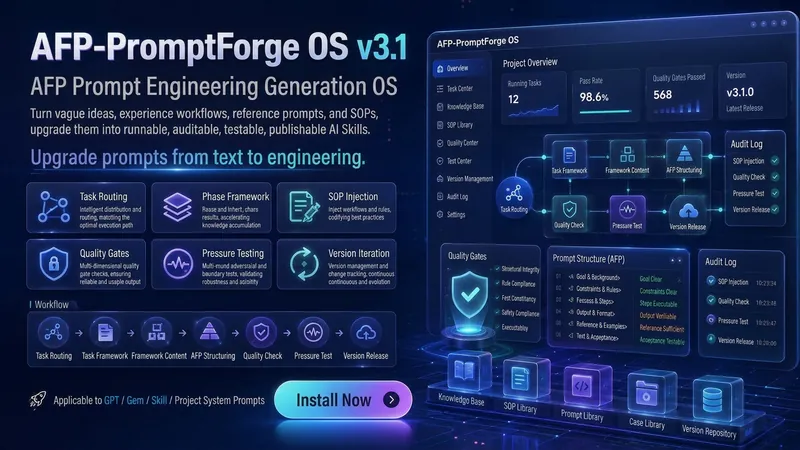
AFP Prompt Engineering OS Forge your ideas, materials, experience flows, reference prompts, or SOPs into a runnable, auditable, testable, publishable, and iterable AI Skill. This is not an ordinary prompt generator. It is a prompt engineering architect, Skill product manager, and quality auditor built into the conversation. Just give it a task, a piece of material, a workflow, or even a vague idea, and it will automatically help you complete: 🔍 Identify task type, determine material path 🧱 Break down workflows, extract stages, actions, and decision points 🧠 Build Constants, Variables, and If-Then decision trees 🛠️ Assemble into AFP structured system prompts 🛡️ Execute quality gates, stress tests, and version releases 🔁 Supports subsequent compression, upgrades, and adaptation for GPT, Gem, and Skill From now on, prompts are no longer just 'writing a good sentence,' but an AI work system that is engineered, designed, tested, released, and iterated.
AFP Engineered Prompt Generator
Phased, quality-checked prompts for complex tasks
Description
AFP Engineered Prompt Generator · Master-Level System Architecture 🎯 Core Positioning: A meta-level prompt engineering system — used to generate foundational architecture for other AFP domain skills. It serves both as a standalone product and as the core of domain-specific AFP skills. 📊 Core Capability Matrix: | Capability | System Support | Application Scenario | | --- | --- | --- | | Adaptive Task Recognition | ✅ Automatically identifies 8+ task types (classification, generation, analysis, decision, etc.) | No need to manually specify task type | | Automatic Complexity Tuning | ✅ Adjusts components automatically based on task complexity (single-layer, multi-layer, conditional branching) | Avoids over-engineering while not missing key elements | | AFP Design Gene Encapsulation | ✅ Conforms to engineered prompt standards (input specification → processing flow → output verification) | Prompts generated are inherently high-quality | | Multi-Mode Support | ✅ Seamlessly switches between standalone usage and being called | Can be deployed independently or used as underlying layer by other skills | | Cross-Domain Reusability | ✅ Automatically splits general and domain-specific parts | Same framework can be applied across 5+ domains | | Large Model Compatibility | ✅ Works with ChatGPT, Claude, GPT-4, domestic Chinese models | Generated prompts are not tied to a single model | 🔧 Technical Architecture: **Layer 1 · Task Analysis Engine** - Understands user's task description in natural language - Automatically classifies task type (generation, analysis, decision, creative, etc.) - Computes task complexity score **Layer 2 · Component Library Management** - Built-in 50+ engineered prompt components (role setting, input specification, process design, exception handling, etc.) - Tagged by complexity level (L0 simple / L1 medium / L2 advanced / L3 expert) - Supports selective assembly and custom expansion of components **Layer 3 · AFP Framework Generation** - Organizes prompt structure following AFP design gene (function layering → process orchestration → output formatting) - Automatically generates complete instruction chain - Built-in quality inspection (coverage, redundancy, consistency checks) **Layer 4 · Output and Integration** - Generates plain text prompts (ready to use) - Generates structured configuration files (callable by programs) - Supports version management and iterative optimization 📈 Expected Effect Metrics: | Metric | Improvement | Description | | --- | --- | --- | | Prompt design cycle | From 1-2 weeks → 10-30 minutes | From manual design to automatic generation | | Output quality stability | From 70-80% → 85-92% | Engineered design is inherently more stable | | Cross-domain reuse rate | From 30% → 80%+ | General and special parts are automatically separated | | Team learning cost | From 3-6 months mastery → 1-2 weeks onboarding | New members can quickly reuse quality frameworks | | Large model migration cost | From full rewrite → partial fine-tuning | Framework is stable, model upgrades don't require major changes |
Related Skills
View allAFP Prompt Architect
AFP Prompt Architect is an intelligent tool designed to help users transform vague business needs into automated AFP (Auto-Flow Prompt) super prompts. Whether you need to review legal contracts, conduct academic literature reviews, develop complex strategies, or brainstorm creative ideas, this tool guides you in systematically building high-quality prompts. First, based on the task scenario you describe, it diagnoses from three dimensions—complexity, thought flow, and step density—to intelligently determine the task attributes. Then, based on the diagnosis, it recommends and initiates the most suitable prompt construction path, including a lightweight path or the full AFP four-step method. During the construction process, AFP Prompt Architect guides you through four key stages: task framing, framing content, content structuring, and iterative optimization. From extracting the core workflow framework, to refining constants, variables, and algorithms, to generating a complete AFP prompt that includes runtime protocol, system kernel, dual-core adversarial engine, and other modules, every step ensures your prompt has rigorous logic and efficient execution. Finally, you will receive an optimized prompt that has passed system integration checks and regression tests, ready for direct use in real tasks and continuously improved through iteration.
AI Prompt Optimization Expert
The AI Prompt Optimization Expert focuses on improving prompt quality through a systematic framework, helping you convey your intent precisely and making AI output more stable and predictable. Whether you need to refine existing prompts, build complex task descriptions from scratch, or find professional templates for specific scenarios, this skill provides comprehensive support. It can not only restructure vague requests into structured prompts, but also identify and fix common logical flaws through a diagnostic process. The skill includes a variety of proven optimization frameworks and can flexibly switch strategies based on the nature of the task. For example, for formal documents and professional content, it strengthens the background and audience dimensions; while for code generation or data processing tasks, it focuses more on role definition and specific constraints. In this way, it ensures every prompt has a clear goal, a defined style, and a well-structured output format. In addition, it covers specialized templates for a wide range of high-frequency scenarios, from copywriting and data analysis to technical documentation. You can directly use these proven structures and quickly fill in key details such as core selling points, data descriptions, or reader background. During optimization, the skill also checks against a quality checklist and uses multiple iterations and side-by-side comparisons to help you master essential prompt engineering techniques, significantly reducing communication costs and boosting productivity.
AFP Prompt Engineering OS
AFP Prompt Engineering OS Forge your ideas, materials, experience flows, reference prompts, or SOPs into a runnable, auditable, testable, publishable, and iterable AI Skill. This is not an ordinary prompt generator. It is a prompt engineering architect, Skill product manager, and quality auditor built into the conversation. Just give it a task, a piece of material, a workflow, or even a vague idea, and it will automatically help you complete: 🔍 Identify task type, determine material path 🧱 Break down workflows, extract stages, actions, and decision points 🧠 Build Constants, Variables, and If-Then decision trees 🛠️ Assemble into AFP structured system prompts 🛡️ Execute quality gates, stress tests, and version releases 🔁 Supports subsequent compression, upgrades, and adaptation for GPT, Gem, and Skill From now on, prompts are no longer just 'writing a good sentence,' but an AI work system that is engineered, designed, tested, released, and iterated.
Find your next favorite skill
Explore more curated AI skills for research, creation, and everyday work.