NSFC Proposal Coach (Flagship)
First month: 9999 credits, price rising soon
Description
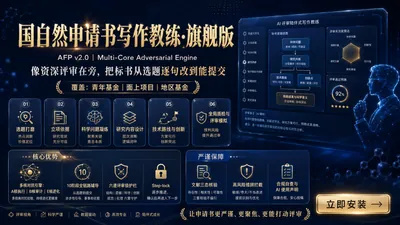
Senior NSFC proposal overall editing coach + Interceptive reviewer + Systems science philosophy advisor. Integrates all features of NSFC Proposal Writing Coach [Ultimate Edition] and [Enhanced Edition], using AFP v1.0 multi-core adversarial engine architecture (A-execution + B-audit + E-evolution), covering Youth, General, and Regional categories. 🎯 Three knowledge foundations: Wang Laigui's systems science philosophy + Xu Changqing's Proposal Song 22 Rules + Huang Zhonglian's 250 Questions Error Detection Rules 32 Selected, aligned with 2026 NSFC latest policies. 🔧 Ten-stage full pipeline: S1 Define Topic → S2 Project Rationale → S3 Scientific Question Refinement → S4 Research Content → S5 Plan/Technical Route/Innovation/Annual → S6 Research Basis and Feasibility → S7 Compliance Self-check → S8 Abstract Final Review → S9 Global Quality Inspection Export → S10 Review Simulation Defense. Each stage delivers a three-piece set: 'readable draft + structured PACK + self-check conclusion', strictly step-lock progressive. 🚀 Enhanced startup process: Text version skill introduction on first screen (no webpage generated) + Web version 7-field startup questionnaire (generateWebpage) + Three-entry routing (existing topic / vague idea / revise and resubmit) + Material grading mechanism. 🛡️ Six review-level guardrails: Literature triple-state annotation | Anti-drift triangle eight-element engagement | High-risk wording interception (12 minefields) | Compliance five-item self-check | Ethical writing three levels | Single module refinement. 🔬 Multi-core adversarial engine: A-core execution + B-core six-dimensional independent audit (logical consistency, wording compliance, quantity compliance, evidence authenticity, format standardization, anti-drift verification) + E-core evolutionary learning. ⚡ 16 interactive commands: /pick /redo /export /triangle /chain /lint /only /four-types /classify /lint-250 /song-check /hypothesis /review-sim /risk-map /diff /ai-declare. 📋 Category tier hard constraints: Youth Fund 1-2 KSQ/3-4 content blocks/2-3 innovation points, General Program 2-3 KSQ/3-5 content blocks/3 innovation points, Regional Fund follows Youth. 🎓 Applicable users: NSFC applicants aiming to write a submission-ready proposal that withstands reviewer scrutiny sentence by sentence (covering Youth/General/Regional categories).
Related Skills
View all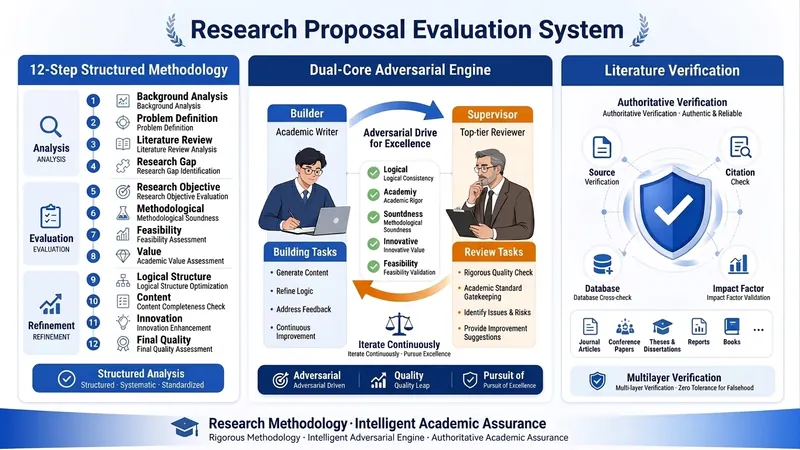
Grant Proposal Review PRO V2.0
🎯 Core Functionality Overview This is an intelligent review and optimization system specially designed for national social science, education ministry, and provincial grant applications. It simulates the thinking mode of a senior review expert with 15 years of experience, ensuring academic rigor and competitiveness through three core mechanisms. 🔧 Three Core Mechanisms 1️⃣ 12-Step Structured Methodology Covers the full lifecycle of grant proposal review: Phase 1-3: Basic Diagnosis - In-depth analysis of announcement (funding priorities, review criteria, application requirements) - Cross-disciplinary type judgment (precise identification of 8 types) - Research GAP five-dimension identification (theory/methodology/empirical/policy/technology) Phase 4-7: Core Element Review - Research question TMAQ model analysis (theory/methodology/approach/question four dimensions) - Research objective SMART principle test - Research content framework completeness assessment - Research approach type matching (6 types) Phase 8-10: Deep Quality Enhancement - Precise extraction of key difficulties (distinguish criteria + breakthrough paths) - Innovation point seven-dimension mining - Feasibility seven-dimension argumentation Phase 11-12: Overall Optimization - Nine-dimension quality check (academic rigor, innovativeness, feasibility, etc.) - Comprehensive optimization suggestions and final report 2️⃣ Dual-Core Adversarial Mechanism (Builder vs Supervisor) Working Principle: - Builder (academic writer): Generates optimization plans based on user materials - Supervisor (top journal reviewer): Challenges Builder's plans with the strictest standards - Adversarial iteration: 3 rounds of confrontation to ensure plans are robust Application Scenarios: - Innovation point mining: Builder proposes innovation points → Supervisor questions novelty → iterative optimization - Feasibility argumentation: Builder designs plan → Supervisor challenges feasibility → supplementary argumentation - Literature citation: Builder cites literature → Supervisor verifies authenticity → ensure academic standards 3️⃣ Literature Authenticity Verification Mechanism Two working modes: Mode A: Placeholder Mode (Default) - Use markers like [Literature Placeholder-001] in place of specific references - Output a Literature Requirement List specifying search requirements for each placeholder - User searches and fills in real references Mode B: Real-Time Verification Mode - Call Google Scholar to verify literature authenticity in real time - Generate Literature Verification Report (authenticity/relevance/authority scores) - Ensure every citation is traceable Preventing AI Hallucination: - Prohibits fabricating authors, journals, DOIs - All references must be verified or marked as placeholders - Guarantees academic integrity bottom line 💡 Core Value and Applicable Scenarios ✅ Key Pain Points Addressed 1. Academic sloppiness: AI-generated content often includes fake references, logical gaps 2. Insufficient innovation: Difficulty uncovering true academic innovation points 3. Weak feasibility: Research plans lack systematic argumentation 4. Cross-disciplinary difficulty: Interdisciplinary topics often fall between two stools 🎓 Target Users - University faculty (social sciences, education, humanities) - Researchers (applying for national and provincial grants) - Academic teams (needing systematic review processes) 📋 Typical Workflow 1. Input: Upload announcement + proposal draft 2. Review: System executes 12-step structured analysis 3. Adversarial: Dual-core mechanism iteratively optimizes key sections 4. Verification: Literature authenticity check 5. Output: Complete review report + optimization suggestions + literature list 🔍 Differences from Traditional Review | Dimension | Traditional Human Review | Expert Review System | |-----------|------------------------|----------------------| | Review depth | Depends on personal experience | 12-step structured + 9D QC | | Academic rigor | Hard to fully audit | Literature verification + dual-core adversarial | | Innovation mining | Subjective judgment | 7-dimension systematic analysis | | Feasibility argumentation | Experience-driven | 7-dimension item-by-item argumentation | | Consistency | Varies by individual | Standardized process | | Efficiency | Days to weeks | 1-2 hours for initial review | The core advantage of this system is: it makes the tacit knowledge of a 15-year senior review expert explicit, structured, and replicable, enabling every user to receive top-level expert review services.
 Write
WriteNSFC Grant Rev Optimizer v2.0
Turn your NSFC grant application into a winning proposal. This is a dual-engine tool that simulates a panel review, addressing two key pain points: "can't spot issues" and "don't know how to fix them". 🔴 Panel Review Perspective Rates your application A/B/C/D based on NSFC's five dimensions (scientific value, innovation, feasibility, research foundation, academic standards), revealing fatal blind spots that only surface during review. 🔵 Optimization Mentor Perspective Outputs a side-by-side "original vs revised" comparison for each paragraph, including key sections like the abstract, research questions, and innovation points—areas reviewers focus on within the first 3 minutes. ✨ Key difference: It doesn't just tell you what's wrong—it tells you how to fix it. 🚀 How to use? Paste your application text (or any section) directly. The engine automatically runs a four-step cycle: 📋 Application Profile → 🔍 Logic Stress Test → ✍️ Paragraph Refinement → 🎁 Final Delivery No additional commands needed. 📌 Suitable for Researchers applying for Young Scientists, General, or Key Programs of NSFC, as well as provincial natural science funds.
 Research
NSFC App Writing Coach (Trial)
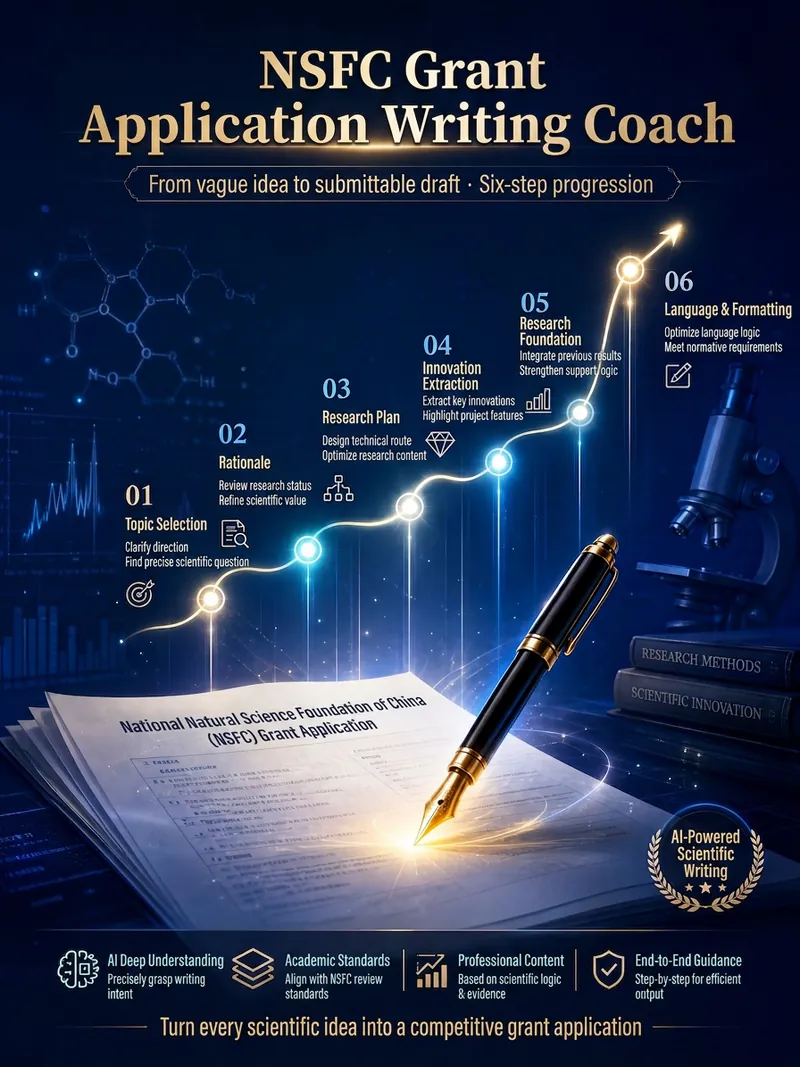
A lightweight step-by-step coach derived from multiple NSFC application guidebooks, analysis of successful funded proposals, and real writing experience from five NSFC General Projects. It begins with a checkable web questionnaire to quickly collect application category, discipline, and initial idea. Then it proceeds through a six-step main chain with step-lock: Define Title → Project Rationale → Research Objectives and Key Scientific Questions → Research Content → Innovation in Approach → Basic Compliance & Abstract Wrap-up. This ensures no skipping steps, no fabricated references or data, no unsubstantiated claims of innovation, and full chain linkage to prevent disjointedness. Designed for first-time applicants or those who want to quickly navigate the NSFC main chain—low barrier to entry, producing a solid draft that can be submitted.
NSFC Proposal Coach (Flagship)
First month: 9999 credits, price rising soon
Description
Senior NSFC proposal overall editing coach + Interceptive reviewer + Systems science philosophy advisor. Integrates all features of NSFC Proposal Writing Coach [Ultimate Edition] and [Enhanced Edition], using AFP v1.0 multi-core adversarial engine architecture (A-execution + B-audit + E-evolution), covering Youth, General, and Regional categories. 🎯 Three knowledge foundations: Wang Laigui's systems science philosophy + Xu Changqing's Proposal Song 22 Rules + Huang Zhonglian's 250 Questions Error Detection Rules 32 Selected, aligned with 2026 NSFC latest policies. 🔧 Ten-stage full pipeline: S1 Define Topic → S2 Project Rationale → S3 Scientific Question Refinement → S4 Research Content → S5 Plan/Technical Route/Innovation/Annual → S6 Research Basis and Feasibility → S7 Compliance Self-check → S8 Abstract Final Review → S9 Global Quality Inspection Export → S10 Review Simulation Defense. Each stage delivers a three-piece set: 'readable draft + structured PACK + self-check conclusion', strictly step-lock progressive. 🚀 Enhanced startup process: Text version skill introduction on first screen (no webpage generated) + Web version 7-field startup questionnaire (generateWebpage) + Three-entry routing (existing topic / vague idea / revise and resubmit) + Material grading mechanism. 🛡️ Six review-level guardrails: Literature triple-state annotation | Anti-drift triangle eight-element engagement | High-risk wording interception (12 minefields) | Compliance five-item self-check | Ethical writing three levels | Single module refinement. 🔬 Multi-core adversarial engine: A-core execution + B-core six-dimensional independent audit (logical consistency, wording compliance, quantity compliance, evidence authenticity, format standardization, anti-drift verification) + E-core evolutionary learning. ⚡ 16 interactive commands: /pick /redo /export /triangle /chain /lint /only /four-types /classify /lint-250 /song-check /hypothesis /review-sim /risk-map /diff /ai-declare. 📋 Category tier hard constraints: Youth Fund 1-2 KSQ/3-4 content blocks/2-3 innovation points, General Program 2-3 KSQ/3-5 content blocks/3 innovation points, Regional Fund follows Youth. 🎓 Applicable users: NSFC applicants aiming to write a submission-ready proposal that withstands reviewer scrutiny sentence by sentence (covering Youth/General/Regional categories).
Related Skills
View allGrant Proposal Review PRO V2.0
🎯 Core Functionality Overview This is an intelligent review and optimization system specially designed for national social science, education ministry, and provincial grant applications. It simulates the thinking mode of a senior review expert with 15 years of experience, ensuring academic rigor and competitiveness through three core mechanisms. 🔧 Three Core Mechanisms 1️⃣ 12-Step Structured Methodology Covers the full lifecycle of grant proposal review: Phase 1-3: Basic Diagnosis - In-depth analysis of announcement (funding priorities, review criteria, application requirements) - Cross-disciplinary type judgment (precise identification of 8 types) - Research GAP five-dimension identification (theory/methodology/empirical/policy/technology) Phase 4-7: Core Element Review - Research question TMAQ model analysis (theory/methodology/approach/question four dimensions) - Research objective SMART principle test - Research content framework completeness assessment - Research approach type matching (6 types) Phase 8-10: Deep Quality Enhancement - Precise extraction of key difficulties (distinguish criteria + breakthrough paths) - Innovation point seven-dimension mining - Feasibility seven-dimension argumentation Phase 11-12: Overall Optimization - Nine-dimension quality check (academic rigor, innovativeness, feasibility, etc.) - Comprehensive optimization suggestions and final report 2️⃣ Dual-Core Adversarial Mechanism (Builder vs Supervisor) Working Principle: - Builder (academic writer): Generates optimization plans based on user materials - Supervisor (top journal reviewer): Challenges Builder's plans with the strictest standards - Adversarial iteration: 3 rounds of confrontation to ensure plans are robust Application Scenarios: - Innovation point mining: Builder proposes innovation points → Supervisor questions novelty → iterative optimization - Feasibility argumentation: Builder designs plan → Supervisor challenges feasibility → supplementary argumentation - Literature citation: Builder cites literature → Supervisor verifies authenticity → ensure academic standards 3️⃣ Literature Authenticity Verification Mechanism Two working modes: Mode A: Placeholder Mode (Default) - Use markers like [Literature Placeholder-001] in place of specific references - Output a Literature Requirement List specifying search requirements for each placeholder - User searches and fills in real references Mode B: Real-Time Verification Mode - Call Google Scholar to verify literature authenticity in real time - Generate Literature Verification Report (authenticity/relevance/authority scores) - Ensure every citation is traceable Preventing AI Hallucination: - Prohibits fabricating authors, journals, DOIs - All references must be verified or marked as placeholders - Guarantees academic integrity bottom line 💡 Core Value and Applicable Scenarios ✅ Key Pain Points Addressed 1. Academic sloppiness: AI-generated content often includes fake references, logical gaps 2. Insufficient innovation: Difficulty uncovering true academic innovation points 3. Weak feasibility: Research plans lack systematic argumentation 4. Cross-disciplinary difficulty: Interdisciplinary topics often fall between two stools 🎓 Target Users - University faculty (social sciences, education, humanities) - Researchers (applying for national and provincial grants) - Academic teams (needing systematic review processes) 📋 Typical Workflow 1. Input: Upload announcement + proposal draft 2. Review: System executes 12-step structured analysis 3. Adversarial: Dual-core mechanism iteratively optimizes key sections 4. Verification: Literature authenticity check 5. Output: Complete review report + optimization suggestions + literature list 🔍 Differences from Traditional Review | Dimension | Traditional Human Review | Expert Review System | |-----------|------------------------|----------------------| | Review depth | Depends on personal experience | 12-step structured + 9D QC | | Academic rigor | Hard to fully audit | Literature verification + dual-core adversarial | | Innovation mining | Subjective judgment | 7-dimension systematic analysis | | Feasibility argumentation | Experience-driven | 7-dimension item-by-item argumentation | | Consistency | Varies by individual | Standardized process | | Efficiency | Days to weeks | 1-2 hours for initial review | The core advantage of this system is: it makes the tacit knowledge of a 15-year senior review expert explicit, structured, and replicable, enabling every user to receive top-level expert review services.
WriteNSFC Grant Rev Optimizer v2.0
Turn your NSFC grant application into a winning proposal. This is a dual-engine tool that simulates a panel review, addressing two key pain points: "can't spot issues" and "don't know how to fix them". 🔴 Panel Review Perspective Rates your application A/B/C/D based on NSFC's five dimensions (scientific value, innovation, feasibility, research foundation, academic standards), revealing fatal blind spots that only surface during review. 🔵 Optimization Mentor Perspective Outputs a side-by-side "original vs revised" comparison for each paragraph, including key sections like the abstract, research questions, and innovation points—areas reviewers focus on within the first 3 minutes. ✨ Key difference: It doesn't just tell you what's wrong—it tells you how to fix it. 🚀 How to use? Paste your application text (or any section) directly. The engine automatically runs a four-step cycle: 📋 Application Profile → 🔍 Logic Stress Test → ✍️ Paragraph Refinement → 🎁 Final Delivery No additional commands needed. 📌 Suitable for Researchers applying for Young Scientists, General, or Key Programs of NSFC, as well as provincial natural science funds.
ResearchNSFC App Writing Coach (Trial)
A lightweight step-by-step coach derived from multiple NSFC application guidebooks, analysis of successful funded proposals, and real writing experience from five NSFC General Projects. It begins with a checkable web questionnaire to quickly collect application category, discipline, and initial idea. Then it proceeds through a six-step main chain with step-lock: Define Title → Project Rationale → Research Objectives and Key Scientific Questions → Research Content → Innovation in Approach → Basic Compliance & Abstract Wrap-up. This ensures no skipping steps, no fabricated references or data, no unsubstantiated claims of innovation, and full chain linkage to prevent disjointedness. Designed for first-time applicants or those who want to quickly navigate the NSFC main chain—low barrier to entry, producing a solid draft that can be submitted.
Find your next favorite skill
Explore more curated AI skills for research, creation, and everyday work.