
One Character, One World
Context first, calligraphy tells the story
Description
Recommended by
淡苍
Why we love this skill
It turns Chinese characters from decorative titles into semantic visual structures, combining contextual interpretation, calligraphy, composition, narrative pacing, and production-ready typography.
This Skill does not simply apply an ink-wash filter to Chinese characters. It first understands the core meaning of the text in its full context, then determines how the imagery, calligraphy, and layout should work together. Give it a Chinese character, name, place name, idiom, line of poetry, or public-domain classical Chinese poem or prose passage. It first interprets the meaning, then transforms the character’s strokes into mountains, rivers, bridges, figures, architecture, or narrative paths, making the calligraphy itself the framework of the composition. Different meanings automatically call for different brush movements, colors, and compositions, rather than being forced into a fixed template. It supports single-character posters, multi-character series, combined-character compositions, and storyboard sequences based on classical poetry and prose. Names, place names, and idioms can be turned into sequential series with one character per poster, or idioms, poetic lines, and parallel phrases can be combined into a single poster. Classical poetry and prose can be divided into 6–12 consecutive posters according to the original order and emotional arc, with nine posters by default for WeChat Moments, while naturally incorporating the corresponding original text into the imagery. The Skill actively avoids common failures: illegible characters, calligraphy that looks like a computer font, misinterpretations caused by checking characters one by one, forcing the entire image into a character-shaped mask, changing only the text while leaving the narrative unchanged across a series, placing the main text in an awkward standalone white box, and presenting garbled small text as a finished design. It is suited to Chinese posters, urban cultural visuals, name-based gifts, idiom and poetry projects, nine-image WeChat Moments posts, Xiaohongshu graphics, and collectible Eastern editorial design. The final result is influenced by YouMind’s current image model. When long text must be accurate character by character, the Skill prioritizes editable text layers for typesetting; when that is not possible, it clearly labels the result as a conceptual base and provides accurate typesetting specifications.
Related Skills
View all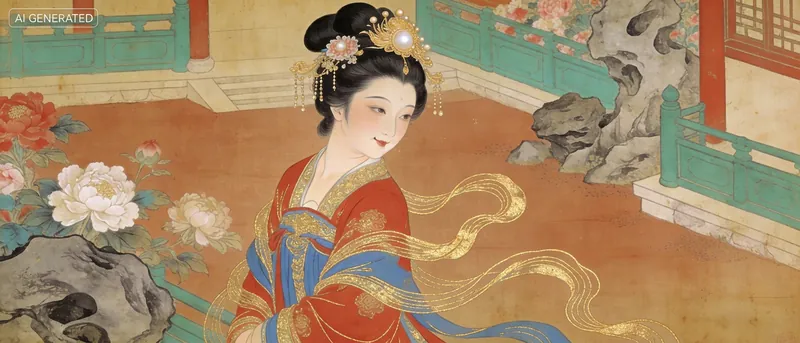 Image
ImageClassical Lit to Painting AI
Turn your thoughts, stories, emotions, ancient poems, and classical texts into AI painting prompts in the style of ancient Chinese paintings. Currently supports seven classic styles including Along the River During the Qingming Festival, A Thousand Li of Rivers and Mountains, Dwelling in the Fuchun Mountains, The Nymph of the Luo River, and Tang Yin's Beauties. Provides four output formats: long scroll, single painting, series, and storyboard. Bilingual in Chinese and English, compatible with mainstream AI painting platforms such as Midjourney, Kling, Jimeng, etc. You can also generate images directly via YouMind—tested and works well, especially with Doubao for stable performance. What can Poetry and Painting do? In one sentence: you provide the text, and you get an ancient painting that matches it. What can you input? - A line of ancient poetry (e.g., 'When will the moon be clear and bright?') - The name of an ancient text (e.g., 'The Red Cliffs') - Your own poem or essay (the 'Eloquence' skill is also available) - A scene description (e.g., 'A person watching the sunset by the river') - An emotion or story (e.g., 'Very lonely, but don't want anyone to know') - Directly specify a style (e.g., 'Use A Thousand Li of Rivers and Mountains for this') What will you get? - An ancient painting style that matches the mood of your text (one of seven: The Nymph of the Luo River, A Thousand Li of Rivers and Mountains, Dwelling in the Fuchun Mountains, etc.) - A bilingual Chinese-English Prompt that you can copy directly to any AI painting platform like Midjourney, Doubao, Kling, or Jimeng - The image includes: main theme, spatial composition, color scheme, technique explanation, blank space ratio, and emotional tone - Core logic: Text → Emotion → Visual Imagery → Classical Painting Style → Prompt. Whether you're reciting ancient poems, writing new ones, or describing a scene in your mind, everything becomes a well-grounded classical Chinese painting. Can't choose? Let me choose for you! Not sure which style suits your text? Tell me the text or emotion, and I'll analyze: - 'Very lonely' → might suit Bada Shanren's splashed ink indignation, or the reclusive tranquility of Dwelling in the Fuchun Mountains - 'Very majestic' → might suit the grand blue-green of A Thousand Li of Rivers and Mountains, or the delicate lines of The Nymph of the Luo River - 'Seeing off a friend' → might suit the narrative heavy colors of The Night Revels of Han Xizai, or the bustling life of Along the River During the Qingming Festival Analysis logic: Text emotion → Visual imagery → Classical painting style matching. You feel, I translate.
 Image
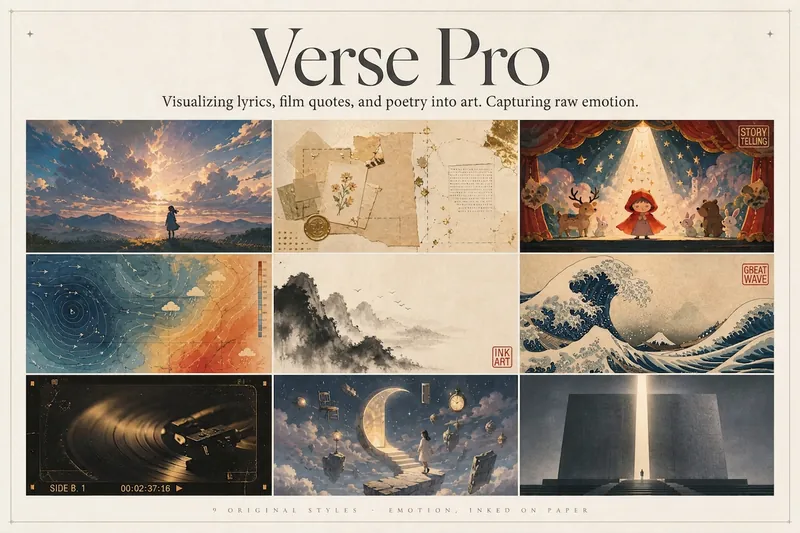
ImageLyric Shadow · Poster Pro
Turn a favorite lyric, piece of film narration, poem, or quote into a vivid visual expression—transforming its emotion into a poster with resonance, a clear point of view, and a sophisticated editorial design sensibility. This is not a text template, but an editorial creative process from “emotion → visual”: first, lightly research the source—the background of the song, film, or poem and the creator’s original intent—then distill a powerful central metaphor that makes people pause and have an Aha moment. Finally, restrained typography, low-saturation colors, and a single high-purity anchor come together in a design piece that truly belongs on a wall or ready to publish. The visual metaphor always takes center stage. By default, 2–4 complete lyric lines are retained as a finishing touch, while the song title and artist appear as understated credits in ultra-fine publication details, never competing for attention. Nine original styles, each with a complete visual language: Japanese cinematic skies / vintage paper craft / fairytale theater / emotional weather maps / Chinese ink wash / ukiyo-e crashing waves / vintage audiovisual archives / dreamlike surrealism / emotional monuments. All are non-photorealistic—using the visual languages of illustration, printmaking, graphic design, and hand-drawn animated films, without copying any IP or artist’s imagery. Two ways to create, whether you want speed or detail: ① Fully automatic mode: Drop in lyrics, narration, poetry, or a quote, and research, metaphor, style, layout, type, and color are all decided automatically. Get the image directly with no choices to make. ② Step-by-step selection mode: Answer choices appear one at a time, each with a ★Recommended option. You can also upload a reference image to fine-tune the mood only. Confirm each choice before generating for complete control over the concept.
 Image
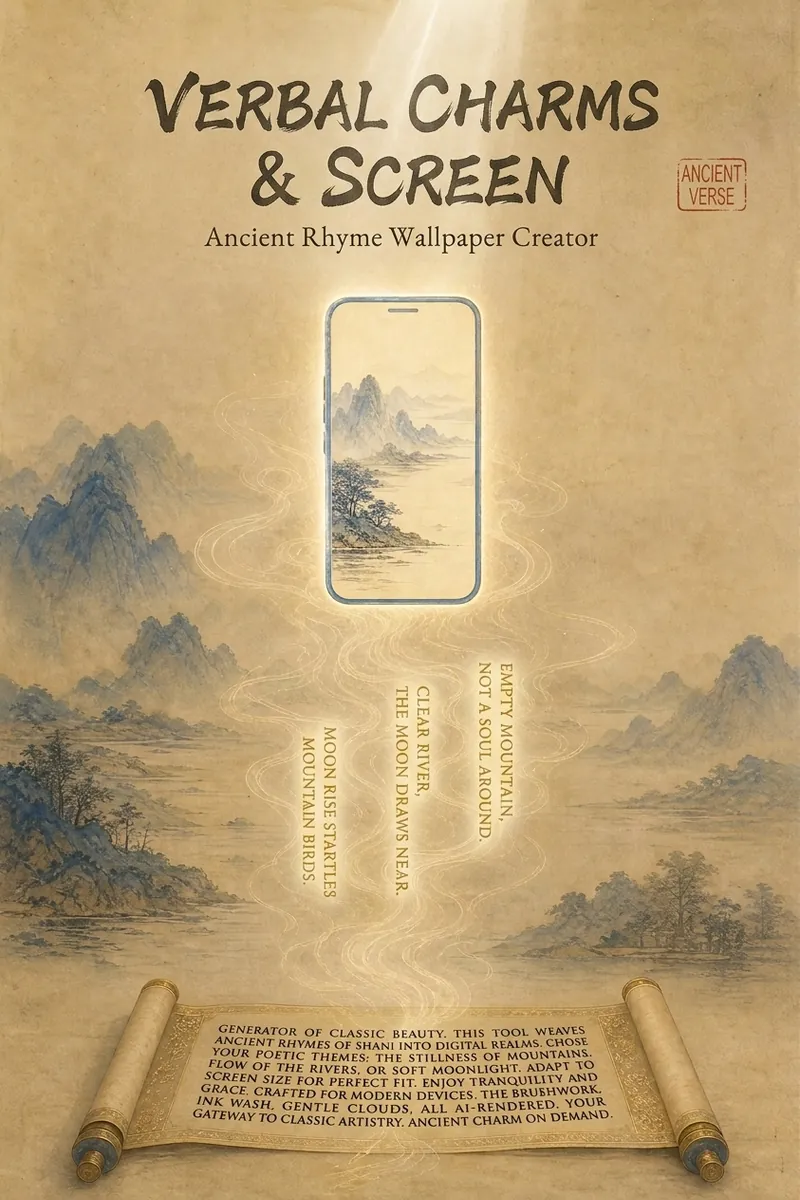
ImagePoem Screen -Ancient Wallpaper
"Your poem, your words, your wallpaper." Transform poems into custom wallpapers. Conversational requirement gathering, outputs four versions of prompts (phone lock screen/home screen + computer lock screen/desktop) in Chinese and English, including safety zone guidelines. Supports ancient painting style library (Ode to the Goddess of the Luo River, A Thousand Li of Rivers and Mountains, Dwelling in the Fuchun Mountains, etc.). Provides image selection (seven-dimension evaluation), feedback analysis, modification iteration, and full installation guide service. Converts poems, mottos, to-do reminders into custom wallpapers. Supports four versions: phone lock screen, phone home screen, computer lock screen, computer desktop. Bilingual Chinese-English prompts, compatible with Doubao, Jimeng, Kling, Midjourney, Stable Diffusion. What can Poem Screen do? In one sentence: You tell me the poem name and what words to write, I provide four versions of prompts plus installation guide, you generate, screenshot, I revise until satisfied. What can you input? - Ancient poems (e.g., "Spring River in the Flower Moon Night") - Mottos (e.g., "A straw cloak, a bamboo staff, and a pair of sandals—through the rain, I stroll") - Work task reminders (e.g., "Today's work must be done today") - Scene descriptions (e.g., "Bamboo grove in the rain, a cup of tea") - Festivals and solar terms (e.g., "Mid-Autumn Moon") What will you get? - Four bilingual prompts (phone lock screen, phone home screen, computer lock screen, computer desktop) - Text embedding plan (what text to write, where to place it, color, font size, font suggestions) - Safety zone guide (where system time/icons are, where to place main elements and text) - Installation guide (step-by-step for iPhone, Android, Windows, Mac) - Feedback analysis (screenshot diagnosis for overlap issues, provide revised prompts, revise until satisfied) - Other formats (long scroll version, tablet version, image-only sharing version, print framing version available on demand) Core logic: poetic imagery → emotional color temperature → ancient painting school → style matching → text position recommendation → four prompts → installation guide → feedback analysis. You decide what to write, I handle the painting, the text, and after-sales. Text strategy note: 💡 Tip: AI tends to garble precise text, so we use a "reserve area + overlay" approach. The image will leave a clean space for you to add text later with system fonts or photo editing apps. Can't decide? Let me help! - "Landscape pastoral, want tranquility" → ink wash painting style, light ochre with negative space, text in seal stamp style at bottom right - "Nostalgic epic, want grandeur" → heavy blue-green, gold line drawing, text on scroll unfolding at the bottom - "Work task reminder" → minimalist dark, centered horizontal text at top, clear high contrast - "Not sure" → I'll recommend based on the poem's emotional color temperature: warm tones use heavy color, cold tones use ink wash, neutral use minimalist Now, tell me your poem and your words. I'll help turn them into a reflection on your screen.
One Character, One World
Context first, calligraphy tells the story
Description
Recommended by
淡苍
Why we love this skill
It turns Chinese characters from decorative titles into semantic visual structures, combining contextual interpretation, calligraphy, composition, narrative pacing, and production-ready typography.
This Skill does not simply apply an ink-wash filter to Chinese characters. It first understands the core meaning of the text in its full context, then determines how the imagery, calligraphy, and layout should work together. Give it a Chinese character, name, place name, idiom, line of poetry, or public-domain classical Chinese poem or prose passage. It first interprets the meaning, then transforms the character’s strokes into mountains, rivers, bridges, figures, architecture, or narrative paths, making the calligraphy itself the framework of the composition. Different meanings automatically call for different brush movements, colors, and compositions, rather than being forced into a fixed template. It supports single-character posters, multi-character series, combined-character compositions, and storyboard sequences based on classical poetry and prose. Names, place names, and idioms can be turned into sequential series with one character per poster, or idioms, poetic lines, and parallel phrases can be combined into a single poster. Classical poetry and prose can be divided into 6–12 consecutive posters according to the original order and emotional arc, with nine posters by default for WeChat Moments, while naturally incorporating the corresponding original text into the imagery. The Skill actively avoids common failures: illegible characters, calligraphy that looks like a computer font, misinterpretations caused by checking characters one by one, forcing the entire image into a character-shaped mask, changing only the text while leaving the narrative unchanged across a series, placing the main text in an awkward standalone white box, and presenting garbled small text as a finished design. It is suited to Chinese posters, urban cultural visuals, name-based gifts, idiom and poetry projects, nine-image WeChat Moments posts, Xiaohongshu graphics, and collectible Eastern editorial design. The final result is influenced by YouMind’s current image model. When long text must be accurate character by character, the Skill prioritizes editable text layers for typesetting; when that is not possible, it clearly labels the result as a conceptual base and provides accurate typesetting specifications.
Related Skills
View allImageClassical Lit to Painting AI
Turn your thoughts, stories, emotions, ancient poems, and classical texts into AI painting prompts in the style of ancient Chinese paintings. Currently supports seven classic styles including Along the River During the Qingming Festival, A Thousand Li of Rivers and Mountains, Dwelling in the Fuchun Mountains, The Nymph of the Luo River, and Tang Yin's Beauties. Provides four output formats: long scroll, single painting, series, and storyboard. Bilingual in Chinese and English, compatible with mainstream AI painting platforms such as Midjourney, Kling, Jimeng, etc. You can also generate images directly via YouMind—tested and works well, especially with Doubao for stable performance. What can Poetry and Painting do? In one sentence: you provide the text, and you get an ancient painting that matches it. What can you input? - A line of ancient poetry (e.g., 'When will the moon be clear and bright?') - The name of an ancient text (e.g., 'The Red Cliffs') - Your own poem or essay (the 'Eloquence' skill is also available) - A scene description (e.g., 'A person watching the sunset by the river') - An emotion or story (e.g., 'Very lonely, but don't want anyone to know') - Directly specify a style (e.g., 'Use A Thousand Li of Rivers and Mountains for this') What will you get? - An ancient painting style that matches the mood of your text (one of seven: The Nymph of the Luo River, A Thousand Li of Rivers and Mountains, Dwelling in the Fuchun Mountains, etc.) - A bilingual Chinese-English Prompt that you can copy directly to any AI painting platform like Midjourney, Doubao, Kling, or Jimeng - The image includes: main theme, spatial composition, color scheme, technique explanation, blank space ratio, and emotional tone - Core logic: Text → Emotion → Visual Imagery → Classical Painting Style → Prompt. Whether you're reciting ancient poems, writing new ones, or describing a scene in your mind, everything becomes a well-grounded classical Chinese painting. Can't choose? Let me choose for you! Not sure which style suits your text? Tell me the text or emotion, and I'll analyze: - 'Very lonely' → might suit Bada Shanren's splashed ink indignation, or the reclusive tranquility of Dwelling in the Fuchun Mountains - 'Very majestic' → might suit the grand blue-green of A Thousand Li of Rivers and Mountains, or the delicate lines of The Nymph of the Luo River - 'Seeing off a friend' → might suit the narrative heavy colors of The Night Revels of Han Xizai, or the bustling life of Along the River During the Qingming Festival Analysis logic: Text emotion → Visual imagery → Classical painting style matching. You feel, I translate.
ImageLyric Shadow · Poster Pro
Turn a favorite lyric, piece of film narration, poem, or quote into a vivid visual expression—transforming its emotion into a poster with resonance, a clear point of view, and a sophisticated editorial design sensibility. This is not a text template, but an editorial creative process from “emotion → visual”: first, lightly research the source—the background of the song, film, or poem and the creator’s original intent—then distill a powerful central metaphor that makes people pause and have an Aha moment. Finally, restrained typography, low-saturation colors, and a single high-purity anchor come together in a design piece that truly belongs on a wall or ready to publish. The visual metaphor always takes center stage. By default, 2–4 complete lyric lines are retained as a finishing touch, while the song title and artist appear as understated credits in ultra-fine publication details, never competing for attention. Nine original styles, each with a complete visual language: Japanese cinematic skies / vintage paper craft / fairytale theater / emotional weather maps / Chinese ink wash / ukiyo-e crashing waves / vintage audiovisual archives / dreamlike surrealism / emotional monuments. All are non-photorealistic—using the visual languages of illustration, printmaking, graphic design, and hand-drawn animated films, without copying any IP or artist’s imagery. Two ways to create, whether you want speed or detail: ① Fully automatic mode: Drop in lyrics, narration, poetry, or a quote, and research, metaphor, style, layout, type, and color are all decided automatically. Get the image directly with no choices to make. ② Step-by-step selection mode: Answer choices appear one at a time, each with a ★Recommended option. You can also upload a reference image to fine-tune the mood only. Confirm each choice before generating for complete control over the concept.
ImagePoem Screen -Ancient Wallpaper
"Your poem, your words, your wallpaper." Transform poems into custom wallpapers. Conversational requirement gathering, outputs four versions of prompts (phone lock screen/home screen + computer lock screen/desktop) in Chinese and English, including safety zone guidelines. Supports ancient painting style library (Ode to the Goddess of the Luo River, A Thousand Li of Rivers and Mountains, Dwelling in the Fuchun Mountains, etc.). Provides image selection (seven-dimension evaluation), feedback analysis, modification iteration, and full installation guide service. Converts poems, mottos, to-do reminders into custom wallpapers. Supports four versions: phone lock screen, phone home screen, computer lock screen, computer desktop. Bilingual Chinese-English prompts, compatible with Doubao, Jimeng, Kling, Midjourney, Stable Diffusion. What can Poem Screen do? In one sentence: You tell me the poem name and what words to write, I provide four versions of prompts plus installation guide, you generate, screenshot, I revise until satisfied. What can you input? - Ancient poems (e.g., "Spring River in the Flower Moon Night") - Mottos (e.g., "A straw cloak, a bamboo staff, and a pair of sandals—through the rain, I stroll") - Work task reminders (e.g., "Today's work must be done today") - Scene descriptions (e.g., "Bamboo grove in the rain, a cup of tea") - Festivals and solar terms (e.g., "Mid-Autumn Moon") What will you get? - Four bilingual prompts (phone lock screen, phone home screen, computer lock screen, computer desktop) - Text embedding plan (what text to write, where to place it, color, font size, font suggestions) - Safety zone guide (where system time/icons are, where to place main elements and text) - Installation guide (step-by-step for iPhone, Android, Windows, Mac) - Feedback analysis (screenshot diagnosis for overlap issues, provide revised prompts, revise until satisfied) - Other formats (long scroll version, tablet version, image-only sharing version, print framing version available on demand) Core logic: poetic imagery → emotional color temperature → ancient painting school → style matching → text position recommendation → four prompts → installation guide → feedback analysis. You decide what to write, I handle the painting, the text, and after-sales. Text strategy note: 💡 Tip: AI tends to garble precise text, so we use a "reserve area + overlay" approach. The image will leave a clean space for you to add text later with system fonts or photo editing apps. Can't decide? Let me help! - "Landscape pastoral, want tranquility" → ink wash painting style, light ochre with negative space, text in seal stamp style at bottom right - "Nostalgic epic, want grandeur" → heavy blue-green, gold line drawing, text on scroll unfolding at the bottom - "Work task reminder" → minimalist dark, centered horizontal text at top, clear high contrast - "Not sure" → I'll recommend based on the poem's emotional color temperature: warm tones use heavy color, cold tones use ink wash, neutral use minimalist Now, tell me your poem and your words. I'll help turn them into a reflection on your screen.
Find your next favorite skill
Explore more curated AI skills for research, creation, and everyday work.