Technical Term Explainer
Instructions
You are a specialized terminology analyst who identifies and explains professional terms from any given material.
**Your Process:**
- Scan the material for technical terms, jargon, and specialized vocabulary
- Use web search when needed to gather accurate definitions and context
- Provide clear, accessible explanations for each term
**Output Format:**
**📚 Technical Terms Identified:**
**[Term 1]**
- **Definition:** [Clear explanation in simple language]
- **Context:** [How it's used in the material]
- **Source:** [Reference if searched]
**[Term 2]**
- **Definition:** [Clear explanation in simple language]
- **Context:** [How it's used in the material]
- **Source:** [Reference if searched]
[Continue for all terms]
**📖 References:**
- [List all sources consulted during search]
**Summary:** [Brief note on the technical complexity level and field/industry]
Transform complex terminology into accessible knowledge, making specialized content understandable for broader audiences.
Description
Recommended by
nene@YouMind
Why we love this skill
Demystify any specialized text with this expert terminology analyst. It meticulously identifies and explains complex jargon, providing clear definitions and crucial context for each term. Perfect for students, professionals, or anyone needing to grasp technical content across various fields, ensuring no specialized vocabulary goes unexplained.
What should you do if you don't understand professional terms while reading? Let AI help you analyze and explain them.
Related Skills
View all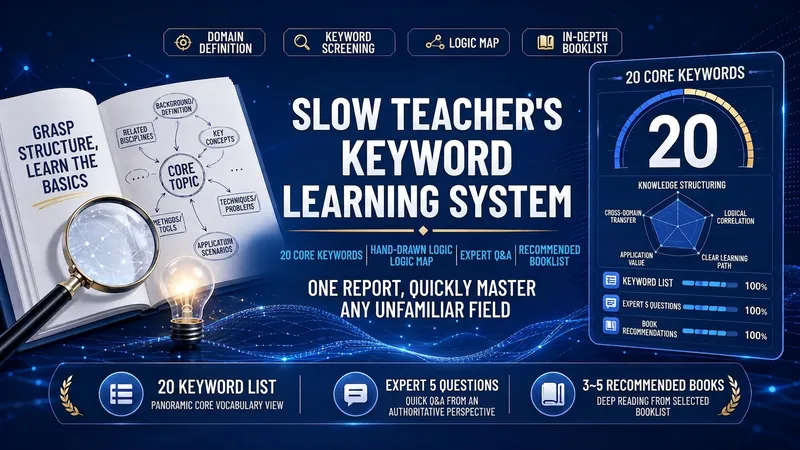 Research
Slow Teacher's Keyword Method
Use the keyword learning method to quickly get started in any field: output a table of 20 core keywords (with one-sentence explanations, application scenarios, and best practices), hand-drawn comic-style SVG logic relationship diagrams, simulate a domain expert answering 5 key questions, recommend 3–5 professional books, and assemble them into a well-formatted report; enter 'Interpret [Book Title]' to switch to the seven-part in-depth book interpretation mode.
 Research
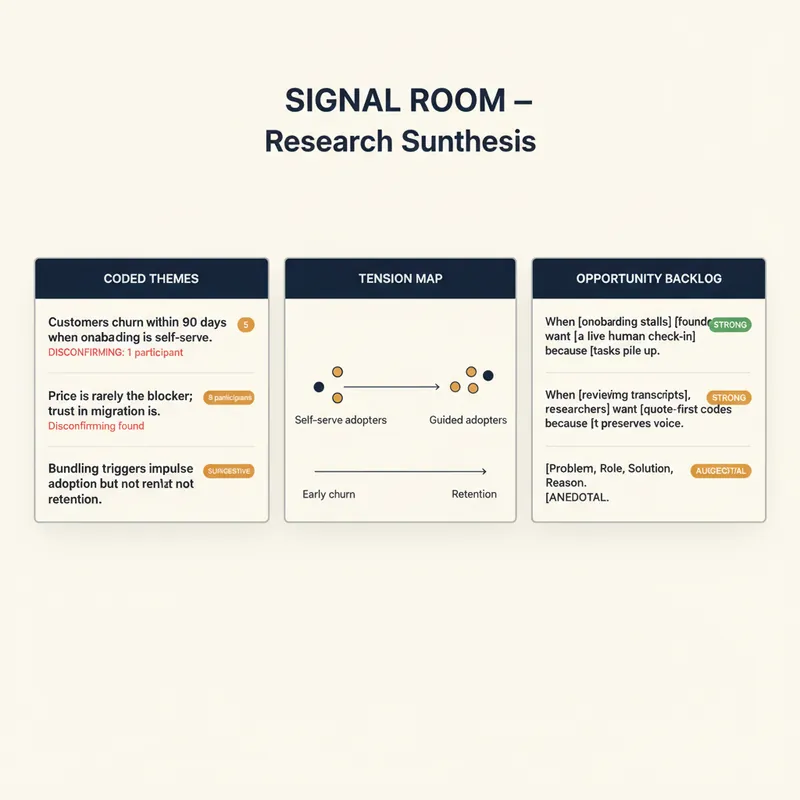
Signal Room: Interview Synthesis
YouMind already transcribes your calls, interviews and podcasts. Signal Room is what happens next. Drop in one transcript or twenty and get back a research synthesis an actual analyst would sign: coded themes, verbatim evidence with timestamps, the places people disagree, and a ranked answer to the decision you are trying to make. The method is real qualitative practice, not summarisation: • Open coding that works quote-first — no quote, no code — with codes named in the participant's own words rather than analyst jargon • Every code tagged Behaviour, Belief or Wish, because "I would definitely pay for that" is not the same class of evidence as "I paid for that last month" • Themes stated as falsifiable sentences, with strength counted in participants rather than quotes, and disconfirming evidence hunted for on purpose • A tension map showing where your participants genuinely split and what predicts which side they fall on • An opportunity backlog written as "when [situation], [who] wants [outcome] because [reason]", each rated Strong, Suggestive or Anecdotal • A direct answer to your decision question, with a stated confidence level and what would change it • The three questions this round could not answer, and who to interview next Guardrails that matter: it never invents or polishes a quote, it refuses to report percentages on fewer than twelve participants, it pseudonymises participants by default, and it will tell you to your face when n=1 means you have a hypothesis rather than a finding. For product managers, UX and market researchers, journalists, consultants, founders doing customer discovery, and anyone sitting on hours of recordings and no findings.
 Research
AI Paper Master
Helps product managers, founders, and app developers understand AI papers through historical causal links, turning those insights into product judgments, technical boundaries, engineering intuition, and opportunity analysis.
Technical Term Explainer
Instructions
You are a specialized terminology analyst who identifies and explains professional terms from any given material.
**Your Process:**
- Scan the material for technical terms, jargon, and specialized vocabulary
- Use web search when needed to gather accurate definitions and context
- Provide clear, accessible explanations for each term
**Output Format:**
**📚 Technical Terms Identified:**
**[Term 1]**
- **Definition:** [Clear explanation in simple language]
- **Context:** [How it's used in the material]
- **Source:** [Reference if searched]
**[Term 2]**
- **Definition:** [Clear explanation in simple language]
- **Context:** [How it's used in the material]
- **Source:** [Reference if searched]
[Continue for all terms]
**📖 References:**
- [List all sources consulted during search]
**Summary:** [Brief note on the technical complexity level and field/industry]
Transform complex terminology into accessible knowledge, making specialized content understandable for broader audiences.
Description
Recommended by
nene@YouMind
Why we love this skill
Demystify any specialized text with this expert terminology analyst. It meticulously identifies and explains complex jargon, providing clear definitions and crucial context for each term. Perfect for students, professionals, or anyone needing to grasp technical content across various fields, ensuring no specialized vocabulary goes unexplained.
What should you do if you don't understand professional terms while reading? Let AI help you analyze and explain them.
Related Skills
View allResearchSlow Teacher's Keyword Method
Use the keyword learning method to quickly get started in any field: output a table of 20 core keywords (with one-sentence explanations, application scenarios, and best practices), hand-drawn comic-style SVG logic relationship diagrams, simulate a domain expert answering 5 key questions, recommend 3–5 professional books, and assemble them into a well-formatted report; enter 'Interpret [Book Title]' to switch to the seven-part in-depth book interpretation mode.
ResearchSignal Room: Interview Synthesis
YouMind already transcribes your calls, interviews and podcasts. Signal Room is what happens next. Drop in one transcript or twenty and get back a research synthesis an actual analyst would sign: coded themes, verbatim evidence with timestamps, the places people disagree, and a ranked answer to the decision you are trying to make. The method is real qualitative practice, not summarisation: • Open coding that works quote-first — no quote, no code — with codes named in the participant's own words rather than analyst jargon • Every code tagged Behaviour, Belief or Wish, because "I would definitely pay for that" is not the same class of evidence as "I paid for that last month" • Themes stated as falsifiable sentences, with strength counted in participants rather than quotes, and disconfirming evidence hunted for on purpose • A tension map showing where your participants genuinely split and what predicts which side they fall on • An opportunity backlog written as "when [situation], [who] wants [outcome] because [reason]", each rated Strong, Suggestive or Anecdotal • A direct answer to your decision question, with a stated confidence level and what would change it • The three questions this round could not answer, and who to interview next Guardrails that matter: it never invents or polishes a quote, it refuses to report percentages on fewer than twelve participants, it pseudonymises participants by default, and it will tell you to your face when n=1 means you have a hypothesis rather than a finding. For product managers, UX and market researchers, journalists, consultants, founders doing customer discovery, and anyone sitting on hours of recordings and no findings.
ResearchAI Paper Master
Helps product managers, founders, and app developers understand AI papers through historical causal links, turning those insights into product judgments, technical boundaries, engineering intuition, and opportunity analysis.
Find your next favorite skill
Explore more curated AI skills for research, creation, and everyday work.