Teacher Man's Reading Engineering
Edit SCI papers, reviews, and NSFC grants
Teacher Man's Reading Engineering
Edit SCI papers, reviews, and NSFC grants
Showcase
Description
Applies reading engineering principles to refine the language and logic of SCI research papers, SCI reviews, and NSFC grant proposals, enhancing academic clarity and readability while preserving scientific meaning and evidence.
Recommended by
Dancang
Why we love this skill
Centers on reading engineering to organize arguments and information hierarchies before refining language, covering SCI papers, reviews, and NSFC proposals. Strictly maintains boundaries for data, citations, and claim strength, boosting readability while preventing over-editing or unsupported additions.
Best for
Ideal for researchers and academic writers looking to improve the clarity and readability of their research papers, reviews, or grant proposals.
How to use this Skill
Provide your input
Paste paragraphs, drafts, or files of your research paper, review, or grant proposal, and specify the scope, purpose, or formatting requirements.
Run the Skill
Optimizes language, logic, and transitions based on document type while preserving scientific meaning, evidence, data, and citations, flagging areas needing verification.
Review your result
Receive a ready-to-use revised draft, along with a brief explanation of changes and necessary items to verify.
Related Skills
View all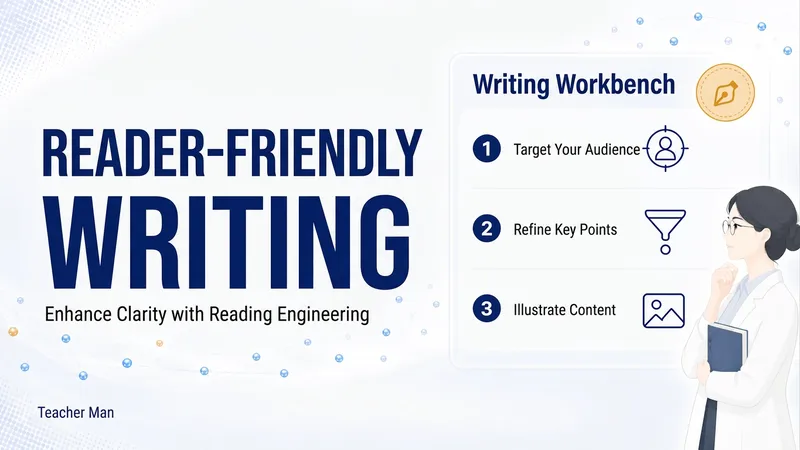
Slow Teacher's Readable Writing
Using a reader-friendly writing approach, this skill prioritizes revising and polishing NSFC grant proposals, SCI research papers, and SCI reviews. It streamlines argumentation logic, paragraph transitions, and bilingual expression to help reviewers and academic readers easily understand your research. It faithfully preserves scientific meaning, evidence, and uncertainty without fabricating data or literature. It can also be used to write and revise social media posts and book commentary drafts.
 Write
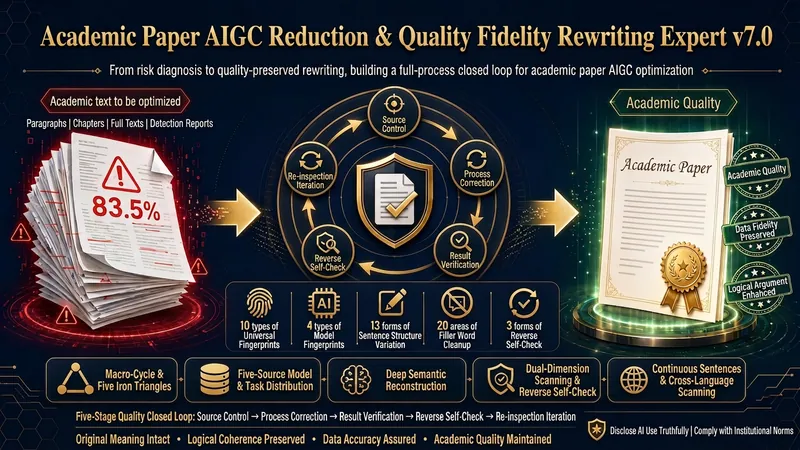
AIGC Reduction & Rewrite v7.0
📚 Academic Paper AIGC Reduction and Quality-Preserving Rewriting Expert v7.0 Designed for graduate students, researchers, and paper authors, this academic text optimization skill operates on a core closed loop of 'source control → process correction → result verification → reverse self-check → iterative re-check'. It systematically diagnoses and optimizes issues such as templated expressions, mechanical logic, vague content, inaccurate terminology, and style inconsistencies while preserving original meaning, technical terms, data, and core conclusions. 🔍📝 🌟 Core Capabilities 🔬 Multi-layer Risk Diagnosis Covers 10 types of universal text fingerprints and assists in identifying common expression patterns of models such as ChatGPT, Claude, DeepSeek, and Wenxin Yiyan. 🧠 Deep Semantic Restructuring Goes beyond synonym replacement to rebuild more natural and in-depth academic reasoning by adjusting proposition expression, information order, argument approach, and evidence organization. ✍️ Quality-Preserving Rewriting Comprehensively applies 13 sentence transformation strategies and 20 methods for cleaning high-frequency templated expressions, improving mechanical sentence structures, repetitive connectors, and overly rigid formatting. 📊 Full-text Structure Diagnosis Through macro-cycle and five key triangles, checks whether research problems, theory, literature review, methods, results, conclusions, and innovation form a complete closed loop. 🧩 Fine-grained Section Adaptation Develops differentiated diagnostic and rewriting strategies for abstract, introduction, literature review, research methods, results, discussion, and conclusion respectively. 🌐 Cross-language Risk Scanning Assists in identifying translationese, passive voice stacking, long sentence nesting, and mixed Chinese-English formatting abnormalities to make Chinese academic expression more natural and accurate. 🔄 Reverse Self-check Loop After rewriting, re-verifies from three aspects: technique distribution, new text fingerprints, and information integrity, to avoid 'becoming more templated' or losing key content. 🛡️ Academic Integrity Protection Does not fabricate literature, data, cases, or policy evidence; separately marks information requiring author verification and reminds users to honestly disclose AI usage. 🎯 Use Cases ✅ Single paragraph or partial section optimization ✅ Targeted modification of marked paragraphs from inspection reports ✅ Polishing of abstract, introduction, literature review, discussion, and conclusion ✅ Full-text AIGC risk feature diagnosis ✅ Language and structure adaptation for target journals ✅ Pre-submission quality review and consistency check 📦 Final Deliverables 📄 Quality-preserving rewritten text 🔎 Risk and issue diagnosis report 🛠️ Rewriting strategy and technique description ✅ Reverse self-check and information integrity report 💡 Items requiring author verification and subsequent revision suggestions 🎓 Original meaning preserved · Logic intact · No fabricated data · Academic quality maintained ⚠️ This skill aims to improve academic expression quality and reduce text risk features. It does not guarantee passage through any specific detection platform or achieving a particular detection score.
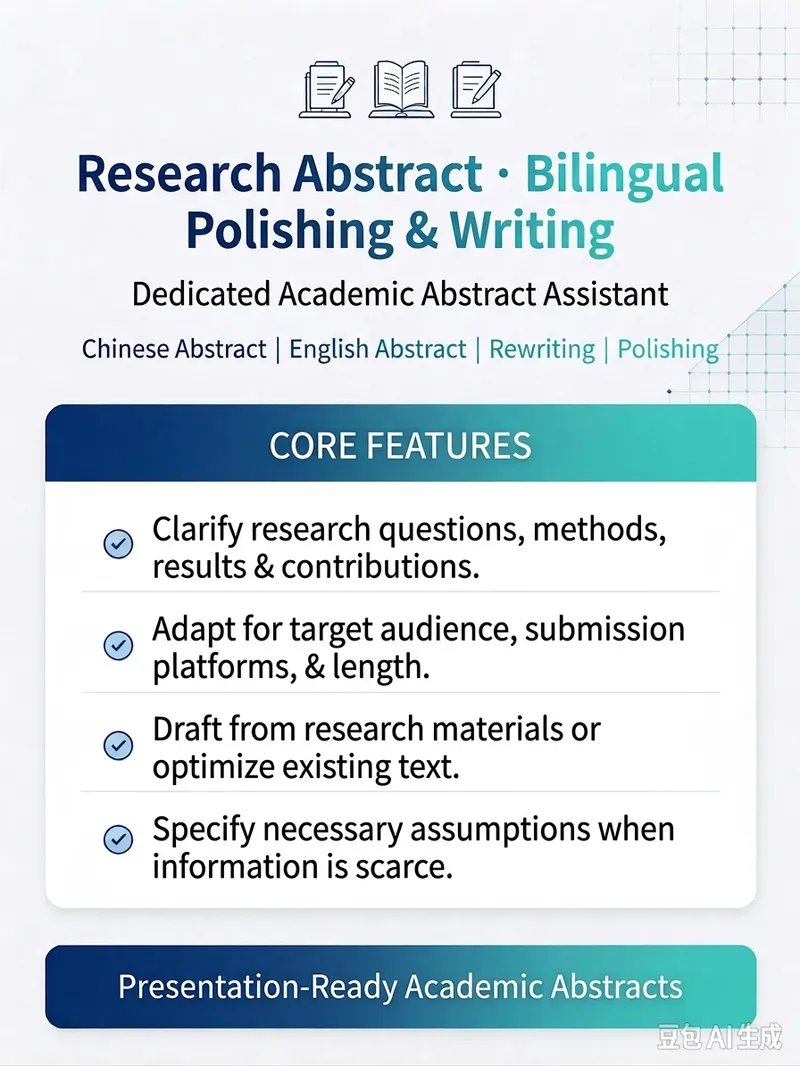
Bilingual Paper Abstract Writer
Designed for paper abstracts and academic writing scenarios, this helps you write, rewrite, and polish Chinese or English abstracts, making research questions, methods, results, and contributions clearer, more accurate, and aligned with academic contexts. Whether drafting from research materials or optimizing existing text, it adapts to your target audience, submission platform, length, and language style to produce ready-to-use versions, clearly stating necessary assumptions when information is insufficient. Beyond bilingual abstracts, it supports structured writing for introductions, literature reviews, methodology, results, discussion, and grant proposals. When handling complex or lengthy materials, it first outlines headings, core arguments, and paragraph relationships before drafting the main text, reducing logical leaps, redundancy, and empty clichés. During revisions, it explains key adjustment directions to help you continue refining your work. Outputs focus not only on language fluency but also on verifying factual basis, citation and copyright risks, academic expression, sensitive phrasing, and compliance boundaries, while distinguishing facts, opinions, speculations, and citations. For legal, medical, financial, or other high-risk research, it serves as a writing draft and review checklist to help you spot issues before submission, publication, or further revision.
Information
- Version
- v5
- Last updated
- Runtime credits
- Usage-based
- Models
- Auto
- Use cases
- Writing & content
- What you get
- Document
