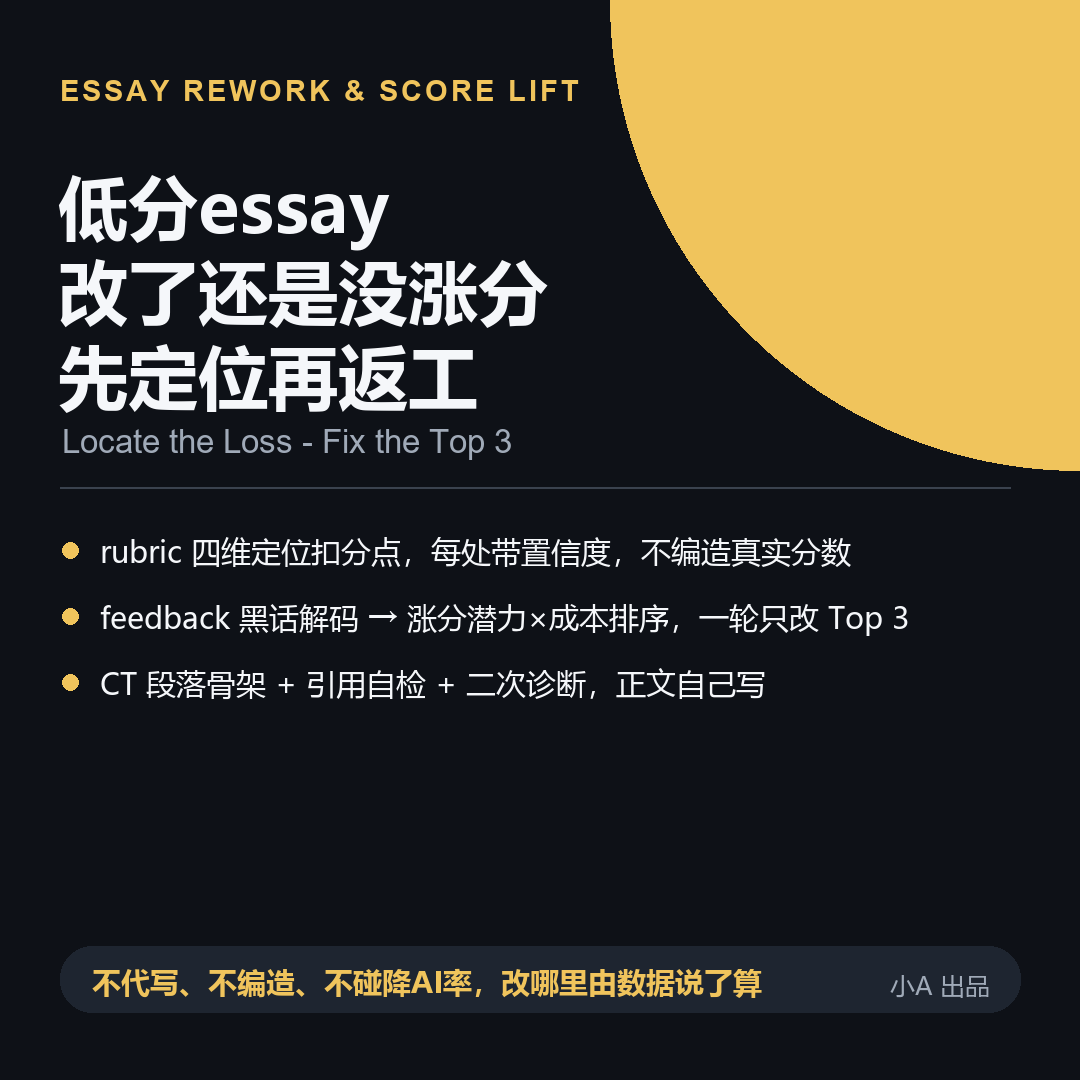
Essay Revision and Score Booster
Locate lost points and plan step-by-step essay revisions
Essay Revision and Score Booster
Locate lost points and plan step-by-step essay revisions
Showcase
Description
Your essay gets a 58, and the feedback simply says "needs more critical analysis." You revise it seven or eight times, drifting further off track, and the next score is still a 62—3,000 words and 30 references later, still falling short of a 70. ### Why does it stay at 62 after eight revisions? It is not because you are not working hard, but because you are **spreading your effort evenly**: rewriting the whole piece, adding random citations everywhere, and editing low-impact areas. This Skill first helps you answer two questions: **Where are the points actually leaking? And what changes are most likely to boost your score?** Only then does it get to work. ### How it works 1. **Point-Loss Localization**: Scans across four rubric dimensions (argument structure, critical analysis, evidence citation, language format), providing evidence anchors and confidence levels for every point lost. If unclear, it marks it as "to be verified" and never fabricates claims. 2. **Feedback Decoding**: Translates comments like "too descriptive / lacks critical analysis / unclear" into specific actions and locations. 3. **Revision Priority**: Categorizes tasks into First, Next, Batch, and Skip based on "score-boosting potential × revision cost," focusing on **only the top 3 per round**—the core defense against drifting off track. 4. **Critical Thinking Frameworks**: Provides fillable paragraph frameworks (claim, evidence, analysis, counter-argument, conclusion). You fill in and verify the evidence yourself; the Skill does not write the final text for you. 5. **Citation Self-Check & Secondary Diagnosis**: More citations do not mean correct citations. After revising, run another diagnosis to see if weak points have shifted. ### What it does not do (red lines) - **No ghostwriting**: Provides only diagnosis, frameworks, and checklists; you write your own essay. - **No fabrication**: Scores, literature, citations, evidence, and sources—anything missing is marked as "to be added / to be verified." - **No AI-detection bypassing / Turnitin evasion**: This is academic misconduct and is not supported. It only helps improve the genuine quality of your argument and analysis. - **No guaranteed results**: Does not guarantee score increases, specific scores, or passing outcomes.
Recommended by
Dancang
Why we love this skill
Breaks down vague feedback like "needs more critical analysis" into a localized, prioritized, and actionable revision path. It emphasizes diagnosis before revision, tackles only the Top 3 items per round, and uses paragraph frameworks and citation self-checks instead of ghostwriting.
Best for
Students looking to purposefully revise their essays based on rubrics to improve argumentation and critical analysis quality.
How to use this Skill
Provide your input
Provide your draft essay, rubric, original grading feedback, target score, and deadline. Missing materials will be flagged as pending.
Run the Skill
Identifies potential point loss across grading dimensions, decodes feedback, prioritizes revisions by impact and cost, and provides analytical paragraph skeletons and citation checks.
Review your result
Receive a point-loss diagnosis, feedback action checklist, revision priorities, fillable paragraph skeletons, citation checklist, and secondary diagnosis. Does not generate submittable essay text.
Related Skills
View all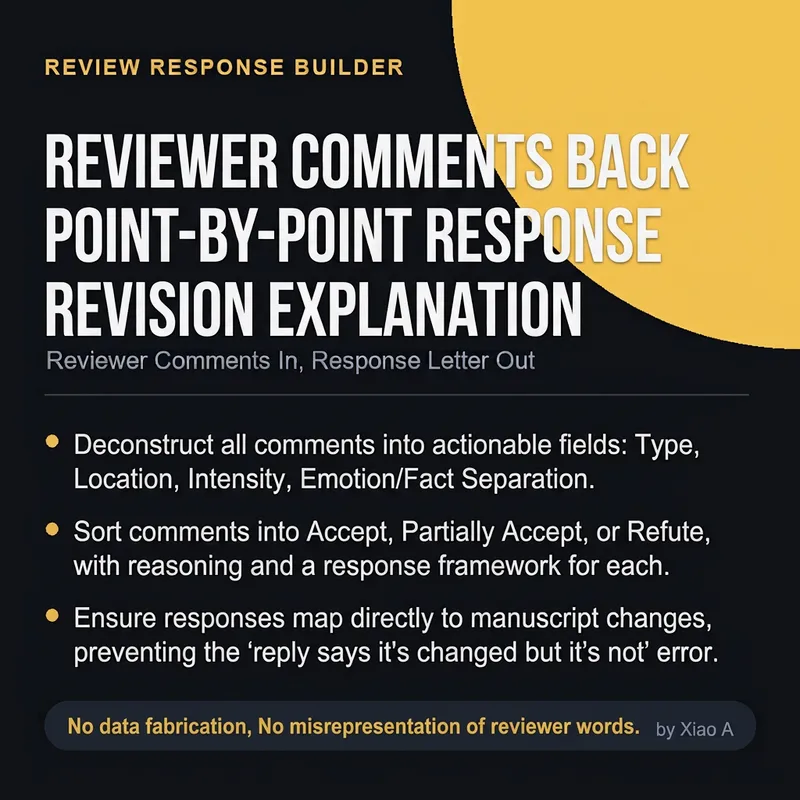 Write
Peer Review Response Generator
Struggling to respond to a mountain of peer review comments? This Skill parses feedback into actionable items, sorts them by acceptance status, provides structured response templates, creates a mapping table between replies and manuscript edits, and assembles a professional response letter and revision checklist. After receiving dozens of comments, the hardest part is categorizing them, prioritizing edits, and respectfully rebutting points without provoking reviewers. This workflow breaks down reviews into structured fields: type, location, demand strength, and feasibility. It separates reviewer tone from actual requested actions. Incoming comments are triaged into three categories: accept, partially accept, or rebut, with clear determination criteria and proven response frameworks. Rebuttals follow strict red lines to remain professional and evidence-based. The critical step is the revision mapping table, which ensures every promised change matches actual manuscript edits, preventing discrepancies. Finally, it formats a numbered response letter and a revision checklist for your supervisor. **Note**: This is a guidance-only Skill. It delivers worksheets, response frameworks, and checklists. It does not write manuscript text, fabricate experimental data or literature, or guarantee acceptance.
 Write
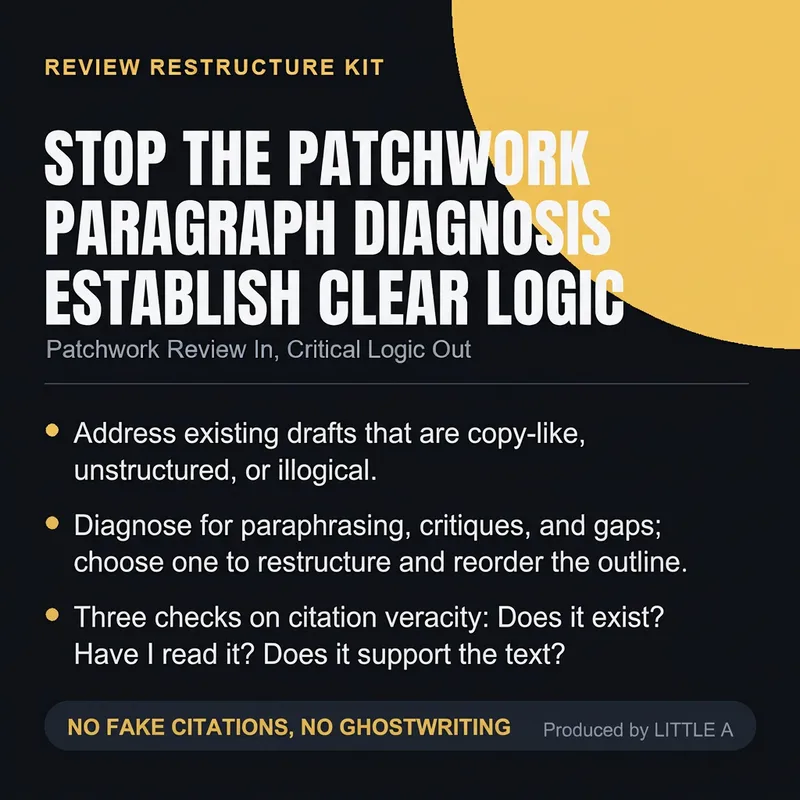
Literature Review Redesigner
Finished a literature review draft only to hear it feels like a book report or a disconnected list of sources? This tool is built specifically for revision, not writing from scratch: paragraph-by-paragraph diagnosis, a choice of three thematic threads, actionable rewriting methods, and rigorous citation verification. ## Summary **Stop struggling with drafts dismissed as mere book reports. Transform a list of summaries into a coherent logical thread without generating fake citations.** ## Details The hardest part of a literature review isn't reading; it's spending weeks compiling dozens of sources into a draft only to be told it lacks logic, feels piecemeal, or reads like a simple summary of who said what. The root cause is usually a missing narrative thread that ties the literature together. This skill specializes in restructuring. First, it tags your draft paragraph by paragraph—identifying pure paraphrase, critique, or research gap—and flags questionable citations. Next, it offers three distinct organizing threads (by problem, by debate, or by gap), explains the rationale, and outlines a new structure. It then guides you on how to revise each section: using comparative sentences, highlighting disagreements, stating your judgment, and concluding with research gaps. It provides precise revision methods rather than writing the text for you. Crucially, it includes citation verification. Every reference is evaluated for authenticity, first-hand reading, and true support. AI-suggested references are verified thoroughly, and unverified entries are removed to prevent fabricated citations that reviewers easily spot. Finally, it uses a reverse-reading technique to test the logical thread. **This is a guidance-only skill**: it delivers diagnostics, threads, outlines, and revision methods without full ghostwriting, reference fabrication, or guaranteed approval. You remain responsible for verifying all sources.
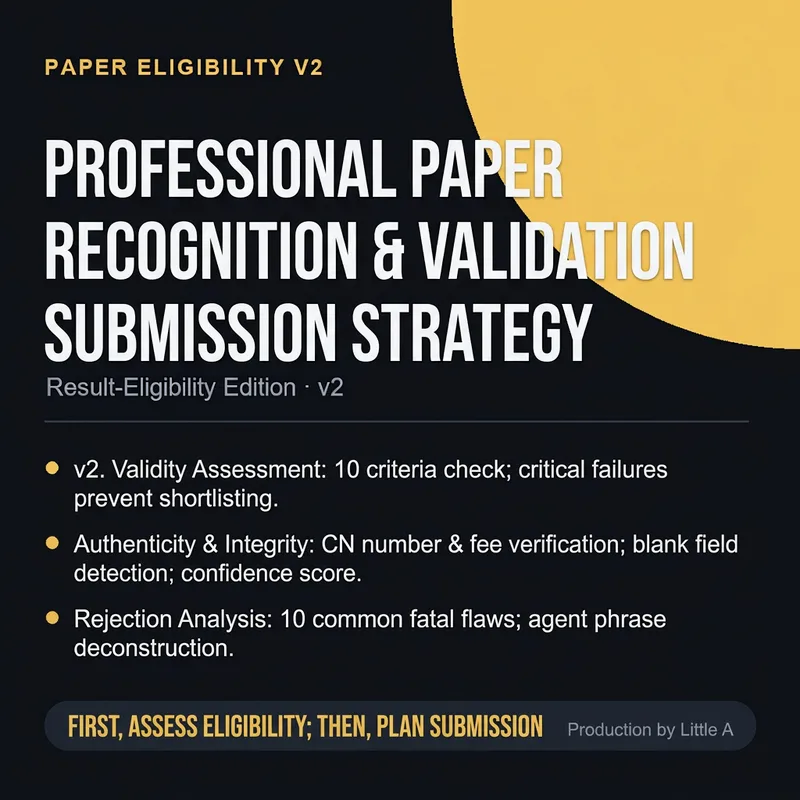
Professional Title Paper Evaluation and Submission Planner
v1 solved where to submit, common pitfalls, and scheduling. Real pain points usually surface beforehand: people spend thousands and wait months only to have materials rejected because the paper isn't recognized—wrong author order, mismatched affiliations, missing database indexing, supplements, duplicate submissions, or high AIGC/plagiarism scores. ## Quick Summary **Verify whether the paper qualifies before choosing a journal.** Many people waste a year not from picking the wrong journal, but due to author rank, affiliation mismatch, unindexed issues, supplements, duplicate use, etc. v2 prioritizes 10 validity checks and eliminates AI-generated journal numbers and fees. ## What Changed from v1 to v2 | Dimension | v1.0.0 | v2.0.0 | | --- | --- | --- | | Priority | Journal Selection: Red/Yellow/Green lists | **10 Validity Checks**: Red flags stop journal selection | | Journal Data | Recommended 5-10 journals with CN/fees/cycles | **Never generated**: Verification portals + blank fields + confidence ratings | | Insufficient Time | Margin warning only | 4 alternative path decision trees | | After Rejection | None | 10 hard-hit rejection reviews + agency phrasing breakdown | Retained: Institutional requirements, red/yellow/green ratings, comparison tables, countdown schedules, 4-step verification, audit trails, and agency red lines. ## What You Will Get 1. **10 Validity Check Items**: Author rank, affiliation, relevance, time window, indexing, regular issues, plagiarism/AIGC, reuse, word count, negative list. 2. **Rank Check Items**: What intermediate, associate, and senior titles need to confirm with their institution. 3. **Hard Criteria Checklist**: Translates institutional terms into 6 actionable constraints. 4. **Candidate Journal Verification Sheet**: Official verification portals with blank fields to prevent fabrication. 5. **Decision & Countdown Tables**: Reverse-calculates deadlines, separating publication and indexing. 6. **Rejection Review & Agency Phrasing**: Evaluates claims like fast indexing or guaranteed approval with ready-to-use replies. 7. **4-Step Verification & Audit Trail**: Official filing, directory checks, issue comparison, and report packaging. ## Who This Is For - Teachers in primary/secondary schools or universities, and engineering, healthcare, agricultural, or research professionals. - **Those with a paper who are unsure if it qualifies.** - Anyone confused by agency recommendations or timeframes. - **Those whose materials were rejected last year.** - Previous v1 users: updated via this skill, replacing outdated journal lists. ## Why No Recommended Journal List Journal data constantly changes, and AI-generated numbers and fees are risky. v2 provides verification portals and rules so you can check official sites and editor offices—taking 5 minutes to prevent rejection. > Pure guidance format · No ghostwriting · Output editable intermediate assets.
Information
- Version
- v3
- Last updated
- Runtime credits
- Usage-based
- Models
- Auto
- Use cases
- Writing & contentLearning & education
- What you get
- ReportDocumentPlan
