<inputs> Ask me for: one question a user asks my product and its one-line answer, two album covers, a royalty-free song around 110 BPM with a quiet intro and a hard drop (Mixkit, free for commercial use), and my logo for the ending. If I skip anything, use these defaults: "is this all code?" / "yes. every frame.", two atmospheric photos, and Mixkit "Head Bang". </inputs> <direction> A 22-second square loop, 1440x1440 at 60fps. 2D only, one continuous take. Nothing cuts: each scene grows from the one before it, and every gesture carries the camera into the next space. Each morph takes 0.8s on cubic-bezier(.45,0,.15,1). The camera zoom follows the same curve, making the shape changes feel almost invisible. Content dissolves during the second half of each glide. One gesture per scene. Look: a warm light stage (#f3f3f0 to #e3e3de), black UI, and a dark app world (#121212) tinted by the current album cover. Use one green accent (#1ed760), Geist for UI, the real macOS pointer, and soft layered shadows that grow as shapes lift. Banned: hard cuts, bouncy springs, particles, glows, zooming in and immediately back out, holds longer than 1s, anything that feels like a template. </direction> <structure> Follow the song's beats. The press lands on the drop. Generate: the cursor clicks. The pill glides into a spinner, then becomes a check. Chat: the check splits into three typing dots with goo. The left dot flies up, becomes the question bubble and types the question. The right dot flies down into the reply. Both bubbles shrink back into dots as they glide toward the center and merge with the middle dot. Play: the middle dot bends into a play triangle, one point at a time. The cursor presses it on the drop. A white button appears under the click as the dark app floods the frame around it, leaving the white shape as the play button. The camera pulls back to reveal the full now-playing screen: large cover, title, heart (liked, filling green), progress bar, controls and volume. Swipe: the cursor drags the cover sideways. The next track slides in, and the app changes its tint to match the new cover. Drag: the camera glides toward the volume slider. The cursor pulls it to max and keeps going. The bar rubber-bands, dragging the camera sideways out of the app and onto a dark dotted canvas while the camera follows the knob. Chart: the line lands and curves upward into a green chart as the number counts up. The volume knob becomes the chart's final point. Dive: the cursor clicks that point. The camera dives into it until the light stage fills the frame. Ending: an "Ask [my product]" button grows from the light, narrows into a line, then fans out into my logo (default: the Claude spark, with six copies rotating into twelve rays in Claude orange). Hold for 2s.
Music Video
استكشف مطالبات فيديو مجانية ضمن فئة Music Video من مكتبة YouMind، والمجمعة تحت حالات الاستخدام. كل مطالبة مختارة من مسارات عمل إبداعية حقيقية وجاهزة للنسخ والتعديل وإعادة الاستخدام.

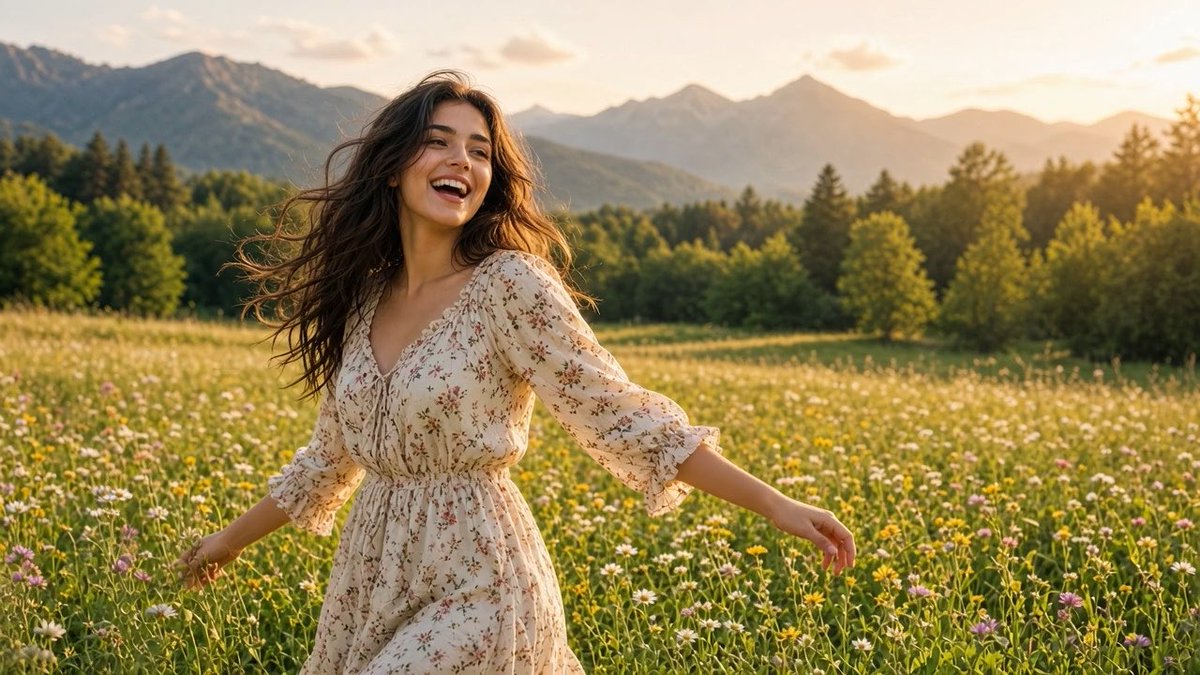
Use the uploaded woman as the visual reference and preserve her facial appearance, hairstyle, and overall look. Place her in a beautiful natural setting—lush green meadow surrounded by trees, wildflowers, mountains in the distance, warm golden-hour sunlight and gentle wind. She happily sings and dances naturally through the meadow, moving rhythmically and playfully while occasionally looking toward the camera. Cinematic realistic footage, smooth camera tracking, natural body movement, flowing hair and clothing, realistic lighting, vibrant but natural colors, shallow depth of field, joyful music-video atmosphere, high detail, 4K, no text, no distortion, no extra people.”
A sung explainer from @leploutos gave me an idea: what if AI agents explained themselves over a house groove? Ten Treblo tracks, one human choice. Then Opus 5.5 got one brief: turn the chosen song into a film, not a slideshow. It built the motion, synced the words, rendered, checked and fixed its own work. Almost one-shot from our side—not one untested take. No editing timeline dragged by hand. Follow the copper thread. It becomes something else 😉 Taste set the direction. An experiment from our @agenticrealism world. Curious about the thinking behind it? Our articles go deeper. Link below. Agentic Music. This is Crazy.
Make a beat-synced motion graphics music video for this track. Go all out. <Your music style> <Your music lyrics>
Keep the exact same woman, face, hairstyle, outfit, body proportions, boots, stage, lighting, camera angle and concert environment from the reference image. Animate her naturally performing an energetic, graceful dance on stage. She starts with the same pose, then smoothly moves her arms to the rhythm, sways her hips, takes a few confident dance steps, turns slightly, and finishes with a joyful pose. Her long red hair moves naturally with her dancing. Add realistic facial expressions and a happy smile. Purple and white concert spotlights pulse gently in sync with the music, with subtle stage haze and background bokeh. Camera makes a smooth cinematic slow push-in with slight handheld concert movement. Realistic human motion, natural anatomy, accurate hands and feet, no distortion, no extra limbs, no outfit changes. Upbeat pop-dance music with a catchy beat, energetic drums, bass and bright synths, perfectly synchronized with her movements. Keep the scene visually consistent from beginning to end, cinematic, high quality, realistic concert performance. Negative prompt: No face change, no identity change, no clothes change, no extra fingers, no extra arms or legs, no body distortion, no warped hands, no unnatural movement, no camera glitches, no background changes
[attach character image] make a 15-second animation of it, built in code. topic: the last day of Oktoberfest. one last ‘Prost!’ as the Wiesn lights go out. find free public-domain sounds online, sync them to the animation, and mix everything with ffmpeg.
"This is the song, it will be posted on X. Create a related video for it." Then I pasted the lyrics and said: "Finish all of it."
Create a 30-second full-code-driven animation using SVG vector graphics and synthesized original soundtrack. Visual Style: Abandon line boiling; use hand-written vector gradients, soft shadows, and night sky glows. Scene Sequence: 1. A small character steps on the ground, charges up, runs into the sunset, and hits a star which explodes. 2. Sync every action (stepping, charging, running, exploding) precisely to piano and harp notes frame-by-frame. 3. Ending: Cursive text "Claude Opus 5.5" does a flip and lands as a decimal point, followed by confetti falling from a blink. Technical Requirement: Every frame and note must be written by code.
Make a complete music video for the song in this folder, with all visuals drawn and animated in JavaScript. Use the entire song. SETUP Inspect this folder and identify the song and any lyrics or reference files. Preserve my original files unchanged. Use this existing animation starter: https://t.co/oN3A7ZZyEl Clone it into a new ./video subfolder, unless an existing copy is already present. Do not overwrite existing work or clone into the nonempty project root. Read its README.md and ANIMATION_GUIDE.md completely, then inspect render.mjs and the project configuration. Use the existing rendering machinery rather than inventing a replacement. Check Node.js, Chrome, and FFmpeg. Inspect the package configuration and install the project dependencies. Ask before making system-wide changes or downloading large additional tools. Do not use fal, external image/video generation, paid APIs, or the hybrid music-video plugin. All finished visuals must be code-drawn. CREATIVE DIRECTION Create a cohesive, visually imaginative animated music video with a handmade, papery, illustrated feel. Express the song's meaning through scenes, characters, visual metaphors, and purposeful transitions. Establish an engaging opening and develop recurring visual motifs. Do not make a slideshow, a generic audio visualizer, or one animation loop repeated for the entire song. Design characters appropriate to this song rather than automatically using the starter's mascot. MUSIC AND TIMING Use the supplied recording as the continuous master soundtrack. Do not remix, replace, speed up, or shorten it. Measure its duration and use available local audio-analysis tools to identify musical sections and likely beat/accent timings. Record these in a shared timeline and drive animation from that timeline. Use supplied lyrics as authoritative. If lyrics are missing, use a local transcription tool only if available, flag uncertain words, and do not invent lyrics. Continue with non-lyric visuals where necessary. When verified lyrics are available, use expressive, readable lyric animation where it strengthens the scene. This explicitly overrides the starter's default preference against lettering. PRODUCTION Write STORYBOARD.md with timed scenes covering the complete recording. Save the project brief and rerender instructions in CLAUDE.md. Then build the video. Make reasonable creative decisions and continue without stopping for approval at every scene. Test a few representative frames and a short section before the full render. Inspect the resulting images and frame sequences, fix visible defects, and keep the animation practical for this computer. Use efficient code-drawn textures if expensive watercolor effects make rendering impractical. DELIVERY Render the complete video
Make a film about its own prompt. 15 seconds. 0 keyframes. 0 samples every frame is code. every sound is code. even the equalizer is dancing to its own soundtrack step 1 → score first - the music is written in code at 120 BPM, every beat exported as data step 2 → one function draws everything - seek(t) paints frame t, no timers, no randomness step 3 → the visuals hear the song - FFT on its own mix, the bars are the real track step 4 → it grades itself - one still per beat, scored 1-10, fixes the lowest on camera
Install Blender as a Python module in a cloud Linux environment, execute everything from scene construction to rendering via scripts. Assemble stage, lighting, confetti, and camera work with code, render with Cycles. Automate post-processing (glow, flash, chromatic aberration) and MP4 conversion. No sample materials for BGM. Synthesize kick, snare, bass, and synth with numpy code. Analyze hip height of dance to identify original tempo at approx 137 BPM. Correct dance timing per beat so dips align with kicks within ±0.5 frames. Align cuts, lighting, zoom, and texture switches to beat heads, ending with all statics on the final hit. Calculate camera every frame with Python: steep drops, orbits, face close-ups to horizontal pans. Change textures and meshes to chrome, gold, hologram, voxel at beat heads.
Make a 37-second demoscene tech demo for the track ~/Downloads/(filename).mp3. The goal is graphics nobody has seen before. Like it's a statement for a new AI demoscene. Story, in one continuous shot with no cuts: - A chrome sphere floats in dark fog. On each hit in the track, it gains one Mandelbox fractal level. - In the drop, the object grows until its top face is a landscape. Fly low over it at sunset, then dive off its edge. - At the end, the fractal collapses into 3D gold letters of the title. Carve the letters from the same fractal and light them with the same light. Look: path-traced quality. Soft shadows, ambient occlusion, glossy reflections, fog with light shafts, depth of field, motion blur, bloom. Sync: analyse the track first. Save a JSON beat map with hits, breaks, and kick, snare and hat onsets. Kicks pulse the light. Hats add surface detail. Tech: - One WebGL2 fragment-shader raymarcher. One HTML page is both the live player and the render source. - Live: 60 fps in Chrome. - Offline: 1920x1080 at 60 fps with 16 samples per pixel. Render it in headless Chrome on the Mac GPU, pipe the PNG frames to ffmpeg, and use the MP3 as the audio. - Do not use AI image or video generators. - Check contact sheets of stills before the full render.
Make a 15s motion video in code (1920x1080, 60fps, one HTML file drawing every frame from a single seek(t) function, rendered with Playwright + ffmpeg, original synthesized sound at 128 BPM). Idea: a blank résumé fills itself in, one skill per bar, and every skill gets proved on screen before it's ticked. Story: a paper résumé slams onto a dark page and its rows type in (skills, type, systems, depth, data) → the camera pushes into the orange bullet until it floods the frame → five skill meters fill, each on a different curve → one word swings from thin to black on the beat, then flips through six typefaces → a dot grid ripples and resolves into a pixel mascot → a square tunnel flies at the camera and an extruded "3D" slams out → bars trace a spring curve while a counter lands on the reel's real frame count → "EVERY FRAME ON THE BEAT." one word per beat → the résumé comes back, filled in, mascot in the photo box. Rules: one orange accent carries every transition; springs, never linear; every state change sits on the beat; no corner labels, no fake HUD numbers.
Create a 20.00-second kinetic spoken-word film titled “BUILD THE FLOOR.” Treat this as an original miniature speech staged inside a typographic field. Every line reorganizes the field of the frame. The final declaration must stand on a field that finally lies flat. Deliver one self-contained HTML file, 1080×1080, targeting 60fps, using SVG and/or Canvas. Embed all required assets. ART DIRECTION Background #102820. Letterforms # F4E9D5. Field lines and filings # F2B544. A magnetic-monument world: streamlines, flux, stillness at the null. Typography stays crisp; particles are atmosphere only. High-contrast serif for the speech, heavy grotesque for load-bearing words, restrained monospace for flux gauges. No horseshoe magnets, lightning, electron diagrams, or sci-fi arcs. ORIGINAL SPEECH — EXACT WORDS, EXACT ORDER “We were told to wait.” “So we learned the weight of waiting.” “Then one voice made room.” “Then another.” “Now the floor belongs to us.” Do not attribute these words to any real person. No extra slogans. The complete speech must be understandable without audio. CENTRAL VISUAL RULE Words have assigned field roles. WAIT is a repelling plate; letterforms lean away from it, kerning compressed. WAITING is field lines sagging under load while filings stream toward the low side. VOICE is one pole reversed; the field reorganizes and letters stand upright along it. ROOM is a null point, a still eye inside the field. FLOOR is the field flattened into a horizontal plane. These roles must emerge from the actual letterforms responding to the field, not from illustrations. STORYBOARD 0.00–3.00 — “We were told to wait.” The sentence leans away from the WAIT plate; streamlines compress against it. Available space pinches on the plate side; the sentence remains readable, pressed but intact. 3.00–6.50 — “So we learned the weight of waiting.” Reveal in phrase groups. Field lines sag deeper with each phrase. Filings — deterministic, hash-seeded per id and time — drift along the streamlines toward the low side and gather. The WAITING glyph hangs tilted inside the field as a suspended load. 6.50–10.00 — “Then one voice made room.” VOICE enters; one pole reverses. The field reorganizes: old streamlines retract by dash-offset while new ones draw in. Letters rotate upright along the new field — analytic rotation of whole glyphs, never path morphing. ROOM opens as a null point, a still eye; the counter of the O in ROOM is its center, and the next composition sits calm inside it. 10.00–12.50 — “Then another.” A second pole turns. The field becomes symmetric; every letter stands vertical. The baseline levels into the first perfect horizontal in the film. Hold absolute stillness for at least 400ms — even the filings pause. 12.50–16.00 — “Now the floor belongs to us.” The field flattens into a hor
0:00–0:05 — Maasai village, firelit clearing: The camera moves low among a Maasai fireside gathering, weaving past men in red shúkà cloth seated in conversation, some sharing a gourd of fermented milk. It settles on a circle of clapping men as a warrior mid-leap rises impossibly high in the adumu jumping dance, beads and ochre-dyed hair swinging, firelight flaring across his face. Crash zoom to the calabash drummer's hands, striking at lightning speed. 0:05–0:10 — Whip pan to Mongolian steppe camp: A sudden fast 360-degree whip pan cuts across darkness and lands on a Mongolian steppe camp, a roaring bonfire outside a felt ger tent. A throat-singer crouches low, chest and throat resonating with a deep guttural drone, while beside him a horsehead fiddle player draws long, sorrowful notes, firelight catching the carved horse head at the instrument's neck. Rapid focus pull to the fiddle player's bow arm sawing with practiced intensity. 0:10–0:15 — Whip pan to Viking hall: A violent whip pan hurls the camera into a smoke-filled Viking longhouse, torchlight catching axe blades and shields mounted on timber walls. Bearded warriors pound wooden tankards on long tables in unison, chanting low and building, a horn-blower raising a great curved war horn and sounding a deep bellow that cuts through the hall. 0:15–0:20 — Whip pan to Plains fire circle: Another hard whip pan lands on a Native American Plains fire circle at night, a hide drum group seated tight around a large ceremonial drum, mallets striking in unified, driving rhythm. Quick whip pan to a dancer in feathered regalia spinning through rising sparks, fringe and feathers blurring with motion. 0:20–0:25 — Whip pan to Māori haka: A final sharp whip pan crashes into a Māori gathering at night, warriors performing the haka in fierce unison — stamping feet shaking loose earth, tongues bared, eyes wide, hands slapping chests and thighs in thunderous rhythm. 0:25–0:30 — Rhythmic collapse, hold on fire: The camera pulls back slightly but stays within the Māori circle, holding steady as the stamping rhythm reaches its peak, dust rising and catching firelight — the frame holds on their pounding feet and fierce expressions as the sequence closes.
A beat-synced 3D sphere falling animation video: match the quality of professional Blender effects. The music consists of several classic instrumental tracks, with scenes switching according to the music. As the 3D spheres fall, they bounce off objects in the scene and light them up in rhythm with the music. Include some humorous elements. Use Three.js for implementation; do not use Blender.
Make a dance video of Marcus Aurelius with Cleopatra and Rumi doing spins like Durvishes then breakdown and into the splits
Subject & Character: A mysterious and beautiful young East Asian woman standing in a ruined ancient shrine surrounded by endless red spider lilies under a dark stormy sky. She wears an elegant black gothic traditional-inspired dress with red accents, long flowing sleeves, and dark fabric moving naturally with her body. Her expression is cold, melancholic, and hypnotic — a mixture of sadness, loneliness, and quiet confidence. Maintain the original character appearance, face, hairstyle, outfit design, and cinematic atmosphere. ⸻ Action & Choreography: 15-second intense cinematic dance performance. The woman performs a powerful fusion of dark contemporary dance, gothic choreography, and sharp hip-hop inspired movements. Her movements are elegant but explosive: * sudden shoulder hits * sharp arm waves * dramatic body isolations * fast hand gestures like a ritual dance * powerful spins * flowing sleeve movements * low crouching movements * sudden freezes matching the rhythm Her long sleeves and hair follow every movement with realistic physics. The dance feels like a lonely ghost performing a final ritual in a forgotten world. She moves from stillness into explosive motion, expressing grief, anger, and acceptance. ⸻ Camera Direction: Vertical cinematic video 9:16 Use dynamic movie-style camera language: 0-3 seconds * Start with a slow cinematic push-in from a wide shot. * Woman stands motionless in the middle of the spider lily field. * Wind moves her hair and dress. * Rain droplets fall. 3-6 seconds * Sudden beat drop. * Camera rapidly circles around her. * She begins sharp dance movements. * Fast shoulder hits and arm movements. * Red spider lilies shake violently around her. 6-10 seconds * Dynamic handheld camera following her movement. * Low-angle shots showing power and elegance. * Quick cinematic cuts: * close-up of her eyes * close-up of hands * flowing black fabric * footsteps stepping through wet ground 10-13 seconds * She performs a powerful spin. * Camera rotates with her. * Hair and sleeves create a circular motion. * Fog swirls around her like a supernatural force. 13-15 seconds * Music suddenly slows. * She stops moving. * Camera pulls far away. * She becomes a lonely silhouette surrounded by endless red flowers. * A single red spider lily petal falls in front of the lens. ⸻ Environment & Lighting: Dark abandoned Japanese-inspired shrine ruins. Heavy rain, wet stone ground, dense fog. Cold blue cinematic lighting mixed with deep crimson highlights from spider lilies. The atmosphere is: * beautiful * tragic * mysterious * supernatural * elegant horror The environment itself reacts to her dance: * flowers shake violently around her * fog swirls around her like a supernatural force
<inputs> Ask me for: one question a user asks my product and its one-line answer, two album covers, a royalty-free song around 110 BPM with a quiet intro and a hard drop (Mixkit, free for commercial use), and my logo for the ending. If I skip anything, use these defaults: "is this all code?" / "yes. every frame.", two atmospheric photos, and Mixkit "Head Bang". </inputs> <direction> A 22-second square loop, 1440x1440 at 60fps. 2D only, one continuous take. Nothing cuts: each scene grows from the one before it, and every gesture carries the camera into the next space. Each morph takes 0.8s on cubic-bezier(.45,0,.15,1). The camera zoom follows the same curve, making the shape changes feel almost invisible. Content dissolves during the second half of each glide. One gesture per scene. Look: a warm light stage (#f3f3f0 to #e3e3de), black UI, and a dark app world (#121212) tinted by the current album cover. Use one green accent (#1ed760), Geist for UI, the real macOS pointer, and soft layered shadows that grow as shapes lift. Banned: hard cuts, bouncy springs, particles, glows, zooming in and immediately back out, holds longer than 1s, anything that feels like a template. </direction> <structure> Follow the song's beats. The press lands on the drop. Generate: the cursor clicks. The pill glides into a spinner, then becomes a check. Chat: the check splits into three typing dots with goo. The left dot flies up, becomes the question bubble and types the question. The right dot flies down into the reply. Both bubbles shrink back into dots as they glide toward the center and merge with the middle dot. Play: the middle dot bends into a play triangle, one point at a time. The cursor presses it on the drop. A white button appears under the click as the dark app floods the frame around it, leaving the white shape as the play button. The camera pulls back to reveal the full now-playing screen: large cover, title, heart (liked, filling green), progress bar, controls and volume. Swipe: the cursor drags the cover sideways. The next track slides in, and the app changes its tint to match the new cover. Drag: the camera glides toward the volume slider. The cursor pulls it to max and keeps going. The bar rubber-bands, dragging the camera sideways out of the app and onto a dark dotted canvas while the camera follows the knob. Chart: the line lands and curves upward into a green chart as the number counts up. The volume knob becomes the chart's final point. Dive: the cursor clicks that point. The camera dives into it until the light stage fills the frame. Ending: an "Ask [my product]" button grows from the light, narrows into a line, then fans out into my logo (default: the Claude spark, with six copies rotating into twelve rays in Claude orange). Hold for 2s.
A sung explainer from @leploutos gave me an idea: what if AI agents explained themselves over a house groove? Ten Treblo tracks, one human choice. Then Opus 5.5 got one brief: turn the chosen song into a film, not a slideshow. It built the motion, synced the words, rendered, checked and fixed its own work. Almost one-shot from our side—not one untested take. No editing timeline dragged by hand. Follow the copper thread. It becomes something else 😉 Taste set the direction. An experiment from our @agenticrealism world. Curious about the thinking behind it? Our articles go deeper. Link below. Agentic Music. This is Crazy.
[attach character image] make a 15-second animation of it, built in code. topic: the last day of Oktoberfest. one last ‘Prost!’ as the Wiesn lights go out. find free public-domain sounds online, sync them to the animation, and mix everything with ffmpeg.
Create a 30-second full-code-driven animation using SVG vector graphics and synthesized original soundtrack. Visual Style: Abandon line boiling; use hand-written vector gradients, soft shadows, and night sky glows. Scene Sequence: 1. A small character steps on the ground, charges up, runs into the sunset, and hits a star which explodes. 2. Sync every action (stepping, charging, running, exploding) precisely to piano and harp notes frame-by-frame. 3. Ending: Cursive text "Claude Opus 5.5" does a flip and lands as a decimal point, followed by confetti falling from a blink. Technical Requirement: Every frame and note must be written by code.
Make a film about its own prompt. 15 seconds. 0 keyframes. 0 samples every frame is code. every sound is code. even the equalizer is dancing to its own soundtrack step 1 → score first - the music is written in code at 120 BPM, every beat exported as data step 2 → one function draws everything - seek(t) paints frame t, no timers, no randomness step 3 → the visuals hear the song - FFT on its own mix, the bars are the real track step 4 → it grades itself - one still per beat, scored 1-10, fixes the lowest on camera
Make a 37-second demoscene tech demo for the track ~/Downloads/(filename).mp3. The goal is graphics nobody has seen before. Like it's a statement for a new AI demoscene. Story, in one continuous shot with no cuts: - A chrome sphere floats in dark fog. On each hit in the track, it gains one Mandelbox fractal level. - In the drop, the object grows until its top face is a landscape. Fly low over it at sunset, then dive off its edge. - At the end, the fractal collapses into 3D gold letters of the title. Carve the letters from the same fractal and light them with the same light. Look: path-traced quality. Soft shadows, ambient occlusion, glossy reflections, fog with light shafts, depth of field, motion blur, bloom. Sync: analyse the track first. Save a JSON beat map with hits, breaks, and kick, snare and hat onsets. Kicks pulse the light. Hats add surface detail. Tech: - One WebGL2 fragment-shader raymarcher. One HTML page is both the live player and the render source. - Live: 60 fps in Chrome. - Offline: 1920x1080 at 60 fps with 16 samples per pixel. Render it in headless Chrome on the Mac GPU, pipe the PNG frames to ffmpeg, and use the MP3 as the audio. - Do not use AI image or video generators. - Check contact sheets of stills before the full render.
Create a 20.00-second kinetic spoken-word film titled “BUILD THE FLOOR.” Treat this as an original miniature speech staged inside a typographic field. Every line reorganizes the field of the frame. The final declaration must stand on a field that finally lies flat. Deliver one self-contained HTML file, 1080×1080, targeting 60fps, using SVG and/or Canvas. Embed all required assets. ART DIRECTION Background #102820. Letterforms # F4E9D5. Field lines and filings # F2B544. A magnetic-monument world: streamlines, flux, stillness at the null. Typography stays crisp; particles are atmosphere only. High-contrast serif for the speech, heavy grotesque for load-bearing words, restrained monospace for flux gauges. No horseshoe magnets, lightning, electron diagrams, or sci-fi arcs. ORIGINAL SPEECH — EXACT WORDS, EXACT ORDER “We were told to wait.” “So we learned the weight of waiting.” “Then one voice made room.” “Then another.” “Now the floor belongs to us.” Do not attribute these words to any real person. No extra slogans. The complete speech must be understandable without audio. CENTRAL VISUAL RULE Words have assigned field roles. WAIT is a repelling plate; letterforms lean away from it, kerning compressed. WAITING is field lines sagging under load while filings stream toward the low side. VOICE is one pole reversed; the field reorganizes and letters stand upright along it. ROOM is a null point, a still eye inside the field. FLOOR is the field flattened into a horizontal plane. These roles must emerge from the actual letterforms responding to the field, not from illustrations. STORYBOARD 0.00–3.00 — “We were told to wait.” The sentence leans away from the WAIT plate; streamlines compress against it. Available space pinches on the plate side; the sentence remains readable, pressed but intact. 3.00–6.50 — “So we learned the weight of waiting.” Reveal in phrase groups. Field lines sag deeper with each phrase. Filings — deterministic, hash-seeded per id and time — drift along the streamlines toward the low side and gather. The WAITING glyph hangs tilted inside the field as a suspended load. 6.50–10.00 — “Then one voice made room.” VOICE enters; one pole reverses. The field reorganizes: old streamlines retract by dash-offset while new ones draw in. Letters rotate upright along the new field — analytic rotation of whole glyphs, never path morphing. ROOM opens as a null point, a still eye; the counter of the O in ROOM is its center, and the next composition sits calm inside it. 10.00–12.50 — “Then another.” A second pole turns. The field becomes symmetric; every letter stands vertical. The baseline levels into the first perfect horizontal in the film. Hold absolute stillness for at least 400ms — even the filings pause. 12.50–16.00 — “Now the floor belongs to us.” The field flattens into a hor
A beat-synced 3D sphere falling animation video: match the quality of professional Blender effects. The music consists of several classic instrumental tracks, with scenes switching according to the music. As the 3D spheres fall, they bounce off objects in the scene and light them up in rhythm with the music. Include some humorous elements. Use Three.js for implementation; do not use Blender.
Subject & Character: A mysterious and beautiful young East Asian woman standing in a ruined ancient shrine surrounded by endless red spider lilies under a dark stormy sky. She wears an elegant black gothic traditional-inspired dress with red accents, long flowing sleeves, and dark fabric moving naturally with her body. Her expression is cold, melancholic, and hypnotic — a mixture of sadness, loneliness, and quiet confidence. Maintain the original character appearance, face, hairstyle, outfit design, and cinematic atmosphere. ⸻ Action & Choreography: 15-second intense cinematic dance performance. The woman performs a powerful fusion of dark contemporary dance, gothic choreography, and sharp hip-hop inspired movements. Her movements are elegant but explosive: * sudden shoulder hits * sharp arm waves * dramatic body isolations * fast hand gestures like a ritual dance * powerful spins * flowing sleeve movements * low crouching movements * sudden freezes matching the rhythm Her long sleeves and hair follow every movement with realistic physics. The dance feels like a lonely ghost performing a final ritual in a forgotten world. She moves from stillness into explosive motion, expressing grief, anger, and acceptance. ⸻ Camera Direction: Vertical cinematic video 9:16 Use dynamic movie-style camera language: 0-3 seconds * Start with a slow cinematic push-in from a wide shot. * Woman stands motionless in the middle of the spider lily field. * Wind moves her hair and dress. * Rain droplets fall. 3-6 seconds * Sudden beat drop. * Camera rapidly circles around her. * She begins sharp dance movements. * Fast shoulder hits and arm movements. * Red spider lilies shake violently around her. 6-10 seconds * Dynamic handheld camera following her movement. * Low-angle shots showing power and elegance. * Quick cinematic cuts: * close-up of her eyes * close-up of hands * flowing black fabric * footsteps stepping through wet ground 10-13 seconds * She performs a powerful spin. * Camera rotates with her. * Hair and sleeves create a circular motion. * Fog swirls around her like a supernatural force. 13-15 seconds * Music suddenly slows. * She stops moving. * Camera pulls far away. * She becomes a lonely silhouette surrounded by endless red flowers. * A single red spider lily petal falls in front of the lens. ⸻ Environment & Lighting: Dark abandoned Japanese-inspired shrine ruins. Heavy rain, wet stone ground, dense fog. Cold blue cinematic lighting mixed with deep crimson highlights from spider lilies. The atmosphere is: * beautiful * tragic * mysterious * supernatural * elegant horror The environment itself reacts to her dance: * flowers shake violently around her * fog swirls around her like a supernatural force

Use the uploaded woman as the visual reference and preserve her facial appearance, hairstyle, and overall look. Place her in a beautiful natural setting—lush green meadow surrounded by trees, wildflowers, mountains in the distance, warm golden-hour sunlight and gentle wind. She happily sings and dances naturally through the meadow, moving rhythmically and playfully while occasionally looking toward the camera. Cinematic realistic footage, smooth camera tracking, natural body movement, flowing hair and clothing, realistic lighting, vibrant but natural colors, shallow depth of field, joyful music-video atmosphere, high detail, 4K, no text, no distortion, no extra people.”
Make a beat-synced motion graphics music video for this track. Go all out. <Your music style> <Your music lyrics>
Keep the exact same woman, face, hairstyle, outfit, body proportions, boots, stage, lighting, camera angle and concert environment from the reference image. Animate her naturally performing an energetic, graceful dance on stage. She starts with the same pose, then smoothly moves her arms to the rhythm, sways her hips, takes a few confident dance steps, turns slightly, and finishes with a joyful pose. Her long red hair moves naturally with her dancing. Add realistic facial expressions and a happy smile. Purple and white concert spotlights pulse gently in sync with the music, with subtle stage haze and background bokeh. Camera makes a smooth cinematic slow push-in with slight handheld concert movement. Realistic human motion, natural anatomy, accurate hands and feet, no distortion, no extra limbs, no outfit changes. Upbeat pop-dance music with a catchy beat, energetic drums, bass and bright synths, perfectly synchronized with her movements. Keep the scene visually consistent from beginning to end, cinematic, high quality, realistic concert performance. Negative prompt: No face change, no identity change, no clothes change, no extra fingers, no extra arms or legs, no body distortion, no warped hands, no unnatural movement, no camera glitches, no background changes
"This is the song, it will be posted on X. Create a related video for it." Then I pasted the lyrics and said: "Finish all of it."
Make a complete music video for the song in this folder, with all visuals drawn and animated in JavaScript. Use the entire song. SETUP Inspect this folder and identify the song and any lyrics or reference files. Preserve my original files unchanged. Use this existing animation starter: https://t.co/oN3A7ZZyEl Clone it into a new ./video subfolder, unless an existing copy is already present. Do not overwrite existing work or clone into the nonempty project root. Read its README.md and ANIMATION_GUIDE.md completely, then inspect render.mjs and the project configuration. Use the existing rendering machinery rather than inventing a replacement. Check Node.js, Chrome, and FFmpeg. Inspect the package configuration and install the project dependencies. Ask before making system-wide changes or downloading large additional tools. Do not use fal, external image/video generation, paid APIs, or the hybrid music-video plugin. All finished visuals must be code-drawn. CREATIVE DIRECTION Create a cohesive, visually imaginative animated music video with a handmade, papery, illustrated feel. Express the song's meaning through scenes, characters, visual metaphors, and purposeful transitions. Establish an engaging opening and develop recurring visual motifs. Do not make a slideshow, a generic audio visualizer, or one animation loop repeated for the entire song. Design characters appropriate to this song rather than automatically using the starter's mascot. MUSIC AND TIMING Use the supplied recording as the continuous master soundtrack. Do not remix, replace, speed up, or shorten it. Measure its duration and use available local audio-analysis tools to identify musical sections and likely beat/accent timings. Record these in a shared timeline and drive animation from that timeline. Use supplied lyrics as authoritative. If lyrics are missing, use a local transcription tool only if available, flag uncertain words, and do not invent lyrics. Continue with non-lyric visuals where necessary. When verified lyrics are available, use expressive, readable lyric animation where it strengthens the scene. This explicitly overrides the starter's default preference against lettering. PRODUCTION Write STORYBOARD.md with timed scenes covering the complete recording. Save the project brief and rerender instructions in CLAUDE.md. Then build the video. Make reasonable creative decisions and continue without stopping for approval at every scene. Test a few representative frames and a short section before the full render. Inspect the resulting images and frame sequences, fix visible defects, and keep the animation practical for this computer. Use efficient code-drawn textures if expensive watercolor effects make rendering impractical. DELIVERY Render the complete video
Install Blender as a Python module in a cloud Linux environment, execute everything from scene construction to rendering via scripts. Assemble stage, lighting, confetti, and camera work with code, render with Cycles. Automate post-processing (glow, flash, chromatic aberration) and MP4 conversion. No sample materials for BGM. Synthesize kick, snare, bass, and synth with numpy code. Analyze hip height of dance to identify original tempo at approx 137 BPM. Correct dance timing per beat so dips align with kicks within ±0.5 frames. Align cuts, lighting, zoom, and texture switches to beat heads, ending with all statics on the final hit. Calculate camera every frame with Python: steep drops, orbits, face close-ups to horizontal pans. Change textures and meshes to chrome, gold, hologram, voxel at beat heads.
Make a 15s motion video in code (1920x1080, 60fps, one HTML file drawing every frame from a single seek(t) function, rendered with Playwright + ffmpeg, original synthesized sound at 128 BPM). Idea: a blank résumé fills itself in, one skill per bar, and every skill gets proved on screen before it's ticked. Story: a paper résumé slams onto a dark page and its rows type in (skills, type, systems, depth, data) → the camera pushes into the orange bullet until it floods the frame → five skill meters fill, each on a different curve → one word swings from thin to black on the beat, then flips through six typefaces → a dot grid ripples and resolves into a pixel mascot → a square tunnel flies at the camera and an extruded "3D" slams out → bars trace a spring curve while a counter lands on the reel's real frame count → "EVERY FRAME ON THE BEAT." one word per beat → the résumé comes back, filled in, mascot in the photo box. Rules: one orange accent carries every transition; springs, never linear; every state change sits on the beat; no corner labels, no fake HUD numbers.
0:00–0:05 — Maasai village, firelit clearing: The camera moves low among a Maasai fireside gathering, weaving past men in red shúkà cloth seated in conversation, some sharing a gourd of fermented milk. It settles on a circle of clapping men as a warrior mid-leap rises impossibly high in the adumu jumping dance, beads and ochre-dyed hair swinging, firelight flaring across his face. Crash zoom to the calabash drummer's hands, striking at lightning speed. 0:05–0:10 — Whip pan to Mongolian steppe camp: A sudden fast 360-degree whip pan cuts across darkness and lands on a Mongolian steppe camp, a roaring bonfire outside a felt ger tent. A throat-singer crouches low, chest and throat resonating with a deep guttural drone, while beside him a horsehead fiddle player draws long, sorrowful notes, firelight catching the carved horse head at the instrument's neck. Rapid focus pull to the fiddle player's bow arm sawing with practiced intensity. 0:10–0:15 — Whip pan to Viking hall: A violent whip pan hurls the camera into a smoke-filled Viking longhouse, torchlight catching axe blades and shields mounted on timber walls. Bearded warriors pound wooden tankards on long tables in unison, chanting low and building, a horn-blower raising a great curved war horn and sounding a deep bellow that cuts through the hall. 0:15–0:20 — Whip pan to Plains fire circle: Another hard whip pan lands on a Native American Plains fire circle at night, a hide drum group seated tight around a large ceremonial drum, mallets striking in unified, driving rhythm. Quick whip pan to a dancer in feathered regalia spinning through rising sparks, fringe and feathers blurring with motion. 0:20–0:25 — Whip pan to Māori haka: A final sharp whip pan crashes into a Māori gathering at night, warriors performing the haka in fierce unison — stamping feet shaking loose earth, tongues bared, eyes wide, hands slapping chests and thighs in thunderous rhythm. 0:25–0:30 — Rhythmic collapse, hold on fire: The camera pulls back slightly but stays within the Māori circle, holding steady as the stamping rhythm reaches its peak, dust rising and catching firelight — the frame holds on their pounding feet and fierce expressions as the sequence closes.
Make a dance video of Marcus Aurelius with Cleopatra and Rumi doing spins like Durvishes then breakdown and into the splits
<inputs> Ask me for: one question a user asks my product and its one-line answer, two album covers, a royalty-free song around 110 BPM with a quiet intro and a hard drop (Mixkit, free for commercial use), and my logo for the ending. If I skip anything, use these defaults: "is this all code?" / "yes. every frame.", two atmospheric photos, and Mixkit "Head Bang". </inputs> <direction> A 22-second square loop, 1440x1440 at 60fps. 2D only, one continuous take. Nothing cuts: each scene grows from the one before it, and every gesture carries the camera into the next space. Each morph takes 0.8s on cubic-bezier(.45,0,.15,1). The camera zoom follows the same curve, making the shape changes feel almost invisible. Content dissolves during the second half of each glide. One gesture per scene. Look: a warm light stage (#f3f3f0 to #e3e3de), black UI, and a dark app world (#121212) tinted by the current album cover. Use one green accent (#1ed760), Geist for UI, the real macOS pointer, and soft layered shadows that grow as shapes lift. Banned: hard cuts, bouncy springs, particles, glows, zooming in and immediately back out, holds longer than 1s, anything that feels like a template. </direction> <structure> Follow the song's beats. The press lands on the drop. Generate: the cursor clicks. The pill glides into a spinner, then becomes a check. Chat: the check splits into three typing dots with goo. The left dot flies up, becomes the question bubble and types the question. The right dot flies down into the reply. Both bubbles shrink back into dots as they glide toward the center and merge with the middle dot. Play: the middle dot bends into a play triangle, one point at a time. The cursor presses it on the drop. A white button appears under the click as the dark app floods the frame around it, leaving the white shape as the play button. The camera pulls back to reveal the full now-playing screen: large cover, title, heart (liked, filling green), progress bar, controls and volume. Swipe: the cursor drags the cover sideways. The next track slides in, and the app changes its tint to match the new cover. Drag: the camera glides toward the volume slider. The cursor pulls it to max and keeps going. The bar rubber-bands, dragging the camera sideways out of the app and onto a dark dotted canvas while the camera follows the knob. Chart: the line lands and curves upward into a green chart as the number counts up. The volume knob becomes the chart's final point. Dive: the cursor clicks that point. The camera dives into it until the light stage fills the frame. Ending: an "Ask [my product]" button grows from the light, narrows into a line, then fans out into my logo (default: the Claude spark, with six copies rotating into twelve rays in Claude orange). Hold for 2s.
Make a beat-synced motion graphics music video for this track. Go all out. <Your music style> <Your music lyrics>
"This is the song, it will be posted on X. Create a related video for it." Then I pasted the lyrics and said: "Finish all of it."
Make a film about its own prompt. 15 seconds. 0 keyframes. 0 samples every frame is code. every sound is code. even the equalizer is dancing to its own soundtrack step 1 → score first - the music is written in code at 120 BPM, every beat exported as data step 2 → one function draws everything - seek(t) paints frame t, no timers, no randomness step 3 → the visuals hear the song - FFT on its own mix, the bars are the real track step 4 → it grades itself - one still per beat, scored 1-10, fixes the lowest on camera
Make a 15s motion video in code (1920x1080, 60fps, one HTML file drawing every frame from a single seek(t) function, rendered with Playwright + ffmpeg, original synthesized sound at 128 BPM). Idea: a blank résumé fills itself in, one skill per bar, and every skill gets proved on screen before it's ticked. Story: a paper résumé slams onto a dark page and its rows type in (skills, type, systems, depth, data) → the camera pushes into the orange bullet until it floods the frame → five skill meters fill, each on a different curve → one word swings from thin to black on the beat, then flips through six typefaces → a dot grid ripples and resolves into a pixel mascot → a square tunnel flies at the camera and an extruded "3D" slams out → bars trace a spring curve while a counter lands on the reel's real frame count → "EVERY FRAME ON THE BEAT." one word per beat → the résumé comes back, filled in, mascot in the photo box. Rules: one orange accent carries every transition; springs, never linear; every state change sits on the beat; no corner labels, no fake HUD numbers.
A beat-synced 3D sphere falling animation video: match the quality of professional Blender effects. The music consists of several classic instrumental tracks, with scenes switching according to the music. As the 3D spheres fall, they bounce off objects in the scene and light them up in rhythm with the music. Include some humorous elements. Use Three.js for implementation; do not use Blender.

Use the uploaded woman as the visual reference and preserve her facial appearance, hairstyle, and overall look. Place her in a beautiful natural setting—lush green meadow surrounded by trees, wildflowers, mountains in the distance, warm golden-hour sunlight and gentle wind. She happily sings and dances naturally through the meadow, moving rhythmically and playfully while occasionally looking toward the camera. Cinematic realistic footage, smooth camera tracking, natural body movement, flowing hair and clothing, realistic lighting, vibrant but natural colors, shallow depth of field, joyful music-video atmosphere, high detail, 4K, no text, no distortion, no extra people.”
Keep the exact same woman, face, hairstyle, outfit, body proportions, boots, stage, lighting, camera angle and concert environment from the reference image. Animate her naturally performing an energetic, graceful dance on stage. She starts with the same pose, then smoothly moves her arms to the rhythm, sways her hips, takes a few confident dance steps, turns slightly, and finishes with a joyful pose. Her long red hair moves naturally with her dancing. Add realistic facial expressions and a happy smile. Purple and white concert spotlights pulse gently in sync with the music, with subtle stage haze and background bokeh. Camera makes a smooth cinematic slow push-in with slight handheld concert movement. Realistic human motion, natural anatomy, accurate hands and feet, no distortion, no extra limbs, no outfit changes. Upbeat pop-dance music with a catchy beat, energetic drums, bass and bright synths, perfectly synchronized with her movements. Keep the scene visually consistent from beginning to end, cinematic, high quality, realistic concert performance. Negative prompt: No face change, no identity change, no clothes change, no extra fingers, no extra arms or legs, no body distortion, no warped hands, no unnatural movement, no camera glitches, no background changes
Create a 30-second full-code-driven animation using SVG vector graphics and synthesized original soundtrack. Visual Style: Abandon line boiling; use hand-written vector gradients, soft shadows, and night sky glows. Scene Sequence: 1. A small character steps on the ground, charges up, runs into the sunset, and hits a star which explodes. 2. Sync every action (stepping, charging, running, exploding) precisely to piano and harp notes frame-by-frame. 3. Ending: Cursive text "Claude Opus 5.5" does a flip and lands as a decimal point, followed by confetti falling from a blink. Technical Requirement: Every frame and note must be written by code.
Install Blender as a Python module in a cloud Linux environment, execute everything from scene construction to rendering via scripts. Assemble stage, lighting, confetti, and camera work with code, render with Cycles. Automate post-processing (glow, flash, chromatic aberration) and MP4 conversion. No sample materials for BGM. Synthesize kick, snare, bass, and synth with numpy code. Analyze hip height of dance to identify original tempo at approx 137 BPM. Correct dance timing per beat so dips align with kicks within ±0.5 frames. Align cuts, lighting, zoom, and texture switches to beat heads, ending with all statics on the final hit. Calculate camera every frame with Python: steep drops, orbits, face close-ups to horizontal pans. Change textures and meshes to chrome, gold, hologram, voxel at beat heads.
Create a 20.00-second kinetic spoken-word film titled “BUILD THE FLOOR.” Treat this as an original miniature speech staged inside a typographic field. Every line reorganizes the field of the frame. The final declaration must stand on a field that finally lies flat. Deliver one self-contained HTML file, 1080×1080, targeting 60fps, using SVG and/or Canvas. Embed all required assets. ART DIRECTION Background #102820. Letterforms # F4E9D5. Field lines and filings # F2B544. A magnetic-monument world: streamlines, flux, stillness at the null. Typography stays crisp; particles are atmosphere only. High-contrast serif for the speech, heavy grotesque for load-bearing words, restrained monospace for flux gauges. No horseshoe magnets, lightning, electron diagrams, or sci-fi arcs. ORIGINAL SPEECH — EXACT WORDS, EXACT ORDER “We were told to wait.” “So we learned the weight of waiting.” “Then one voice made room.” “Then another.” “Now the floor belongs to us.” Do not attribute these words to any real person. No extra slogans. The complete speech must be understandable without audio. CENTRAL VISUAL RULE Words have assigned field roles. WAIT is a repelling plate; letterforms lean away from it, kerning compressed. WAITING is field lines sagging under load while filings stream toward the low side. VOICE is one pole reversed; the field reorganizes and letters stand upright along it. ROOM is a null point, a still eye inside the field. FLOOR is the field flattened into a horizontal plane. These roles must emerge from the actual letterforms responding to the field, not from illustrations. STORYBOARD 0.00–3.00 — “We were told to wait.” The sentence leans away from the WAIT plate; streamlines compress against it. Available space pinches on the plate side; the sentence remains readable, pressed but intact. 3.00–6.50 — “So we learned the weight of waiting.” Reveal in phrase groups. Field lines sag deeper with each phrase. Filings — deterministic, hash-seeded per id and time — drift along the streamlines toward the low side and gather. The WAITING glyph hangs tilted inside the field as a suspended load. 6.50–10.00 — “Then one voice made room.” VOICE enters; one pole reverses. The field reorganizes: old streamlines retract by dash-offset while new ones draw in. Letters rotate upright along the new field — analytic rotation of whole glyphs, never path morphing. ROOM opens as a null point, a still eye; the counter of the O in ROOM is its center, and the next composition sits calm inside it. 10.00–12.50 — “Then another.” A second pole turns. The field becomes symmetric; every letter stands vertical. The baseline levels into the first perfect horizontal in the film. Hold absolute stillness for at least 400ms — even the filings pause. 12.50–16.00 — “Now the floor belongs to us.” The field flattens into a hor
Make a dance video of Marcus Aurelius with Cleopatra and Rumi doing spins like Durvishes then breakdown and into the splits
A sung explainer from @leploutos gave me an idea: what if AI agents explained themselves over a house groove? Ten Treblo tracks, one human choice. Then Opus 5.5 got one brief: turn the chosen song into a film, not a slideshow. It built the motion, synced the words, rendered, checked and fixed its own work. Almost one-shot from our side—not one untested take. No editing timeline dragged by hand. Follow the copper thread. It becomes something else 😉 Taste set the direction. An experiment from our @agenticrealism world. Curious about the thinking behind it? Our articles go deeper. Link below. Agentic Music. This is Crazy.
[attach character image] make a 15-second animation of it, built in code. topic: the last day of Oktoberfest. one last ‘Prost!’ as the Wiesn lights go out. find free public-domain sounds online, sync them to the animation, and mix everything with ffmpeg.
Make a complete music video for the song in this folder, with all visuals drawn and animated in JavaScript. Use the entire song. SETUP Inspect this folder and identify the song and any lyrics or reference files. Preserve my original files unchanged. Use this existing animation starter: https://t.co/oN3A7ZZyEl Clone it into a new ./video subfolder, unless an existing copy is already present. Do not overwrite existing work or clone into the nonempty project root. Read its README.md and ANIMATION_GUIDE.md completely, then inspect render.mjs and the project configuration. Use the existing rendering machinery rather than inventing a replacement. Check Node.js, Chrome, and FFmpeg. Inspect the package configuration and install the project dependencies. Ask before making system-wide changes or downloading large additional tools. Do not use fal, external image/video generation, paid APIs, or the hybrid music-video plugin. All finished visuals must be code-drawn. CREATIVE DIRECTION Create a cohesive, visually imaginative animated music video with a handmade, papery, illustrated feel. Express the song's meaning through scenes, characters, visual metaphors, and purposeful transitions. Establish an engaging opening and develop recurring visual motifs. Do not make a slideshow, a generic audio visualizer, or one animation loop repeated for the entire song. Design characters appropriate to this song rather than automatically using the starter's mascot. MUSIC AND TIMING Use the supplied recording as the continuous master soundtrack. Do not remix, replace, speed up, or shorten it. Measure its duration and use available local audio-analysis tools to identify musical sections and likely beat/accent timings. Record these in a shared timeline and drive animation from that timeline. Use supplied lyrics as authoritative. If lyrics are missing, use a local transcription tool only if available, flag uncertain words, and do not invent lyrics. Continue with non-lyric visuals where necessary. When verified lyrics are available, use expressive, readable lyric animation where it strengthens the scene. This explicitly overrides the starter's default preference against lettering. PRODUCTION Write STORYBOARD.md with timed scenes covering the complete recording. Save the project brief and rerender instructions in CLAUDE.md. Then build the video. Make reasonable creative decisions and continue without stopping for approval at every scene. Test a few representative frames and a short section before the full render. Inspect the resulting images and frame sequences, fix visible defects, and keep the animation practical for this computer. Use efficient code-drawn textures if expensive watercolor effects make rendering impractical. DELIVERY Render the complete video
Make a 37-second demoscene tech demo for the track ~/Downloads/(filename).mp3. The goal is graphics nobody has seen before. Like it's a statement for a new AI demoscene. Story, in one continuous shot with no cuts: - A chrome sphere floats in dark fog. On each hit in the track, it gains one Mandelbox fractal level. - In the drop, the object grows until its top face is a landscape. Fly low over it at sunset, then dive off its edge. - At the end, the fractal collapses into 3D gold letters of the title. Carve the letters from the same fractal and light them with the same light. Look: path-traced quality. Soft shadows, ambient occlusion, glossy reflections, fog with light shafts, depth of field, motion blur, bloom. Sync: analyse the track first. Save a JSON beat map with hits, breaks, and kick, snare and hat onsets. Kicks pulse the light. Hats add surface detail. Tech: - One WebGL2 fragment-shader raymarcher. One HTML page is both the live player and the render source. - Live: 60 fps in Chrome. - Offline: 1920x1080 at 60 fps with 16 samples per pixel. Render it in headless Chrome on the Mac GPU, pipe the PNG frames to ffmpeg, and use the MP3 as the audio. - Do not use AI image or video generators. - Check contact sheets of stills before the full render.
0:00–0:05 — Maasai village, firelit clearing: The camera moves low among a Maasai fireside gathering, weaving past men in red shúkà cloth seated in conversation, some sharing a gourd of fermented milk. It settles on a circle of clapping men as a warrior mid-leap rises impossibly high in the adumu jumping dance, beads and ochre-dyed hair swinging, firelight flaring across his face. Crash zoom to the calabash drummer's hands, striking at lightning speed. 0:05–0:10 — Whip pan to Mongolian steppe camp: A sudden fast 360-degree whip pan cuts across darkness and lands on a Mongolian steppe camp, a roaring bonfire outside a felt ger tent. A throat-singer crouches low, chest and throat resonating with a deep guttural drone, while beside him a horsehead fiddle player draws long, sorrowful notes, firelight catching the carved horse head at the instrument's neck. Rapid focus pull to the fiddle player's bow arm sawing with practiced intensity. 0:10–0:15 — Whip pan to Viking hall: A violent whip pan hurls the camera into a smoke-filled Viking longhouse, torchlight catching axe blades and shields mounted on timber walls. Bearded warriors pound wooden tankards on long tables in unison, chanting low and building, a horn-blower raising a great curved war horn and sounding a deep bellow that cuts through the hall. 0:15–0:20 — Whip pan to Plains fire circle: Another hard whip pan lands on a Native American Plains fire circle at night, a hide drum group seated tight around a large ceremonial drum, mallets striking in unified, driving rhythm. Quick whip pan to a dancer in feathered regalia spinning through rising sparks, fringe and feathers blurring with motion. 0:20–0:25 — Whip pan to Māori haka: A final sharp whip pan crashes into a Māori gathering at night, warriors performing the haka in fierce unison — stamping feet shaking loose earth, tongues bared, eyes wide, hands slapping chests and thighs in thunderous rhythm. 0:25–0:30 — Rhythmic collapse, hold on fire: The camera pulls back slightly but stays within the Māori circle, holding steady as the stamping rhythm reaches its peak, dust rising and catching firelight — the frame holds on their pounding feet and fierce expressions as the sequence closes.
Subject & Character: A mysterious and beautiful young East Asian woman standing in a ruined ancient shrine surrounded by endless red spider lilies under a dark stormy sky. She wears an elegant black gothic traditional-inspired dress with red accents, long flowing sleeves, and dark fabric moving naturally with her body. Her expression is cold, melancholic, and hypnotic — a mixture of sadness, loneliness, and quiet confidence. Maintain the original character appearance, face, hairstyle, outfit design, and cinematic atmosphere. ⸻ Action & Choreography: 15-second intense cinematic dance performance. The woman performs a powerful fusion of dark contemporary dance, gothic choreography, and sharp hip-hop inspired movements. Her movements are elegant but explosive: * sudden shoulder hits * sharp arm waves * dramatic body isolations * fast hand gestures like a ritual dance * powerful spins * flowing sleeve movements * low crouching movements * sudden freezes matching the rhythm Her long sleeves and hair follow every movement with realistic physics. The dance feels like a lonely ghost performing a final ritual in a forgotten world. She moves from stillness into explosive motion, expressing grief, anger, and acceptance. ⸻ Camera Direction: Vertical cinematic video 9:16 Use dynamic movie-style camera language: 0-3 seconds * Start with a slow cinematic push-in from a wide shot. * Woman stands motionless in the middle of the spider lily field. * Wind moves her hair and dress. * Rain droplets fall. 3-6 seconds * Sudden beat drop. * Camera rapidly circles around her. * She begins sharp dance movements. * Fast shoulder hits and arm movements. * Red spider lilies shake violently around her. 6-10 seconds * Dynamic handheld camera following her movement. * Low-angle shots showing power and elegance. * Quick cinematic cuts: * close-up of her eyes * close-up of hands * flowing black fabric * footsteps stepping through wet ground 10-13 seconds * She performs a powerful spin. * Camera rotates with her. * Hair and sleeves create a circular motion. * Fog swirls around her like a supernatural force. 13-15 seconds * Music suddenly slows. * She stops moving. * Camera pulls far away. * She becomes a lonely silhouette surrounded by endless red flowers. * A single red spider lily petal falls in front of the lens. ⸻ Environment & Lighting: Dark abandoned Japanese-inspired shrine ruins. Heavy rain, wet stone ground, dense fog. Cold blue cinematic lighting mixed with deep crimson highlights from spider lilies. The atmosphere is: * beautiful * tragic * mysterious * supernatural * elegant horror The environment itself reacts to her dance: * flowers shake violently around her * fog swirls around her like a supernatural force